

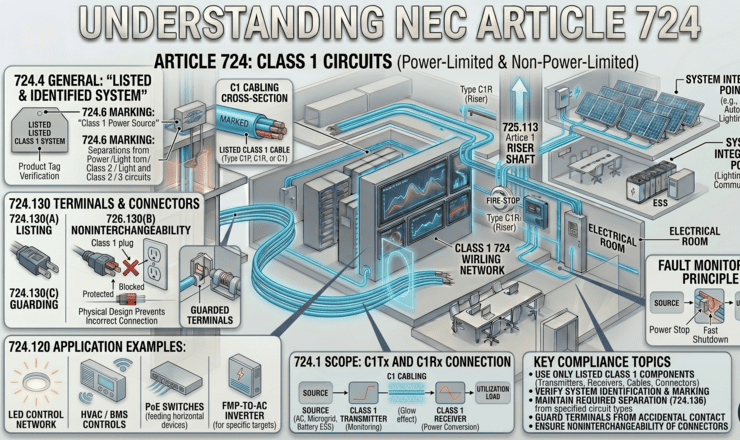
Understanding NEC Article 724: A Complete Guide to Class 1 Circuits
Staying up to date with the National Electrical Code (NEC) is an ongoing responsibility for electrical contractors, inspectors, and engineers. One of the most significant structural shifts in the 2023 NEC cycle was the introduction of a brand-new article dedicated entirely to Class 1 circuits. For anyone working with remote-control and signaling systems, Understanding NEC Article 724 is absolutely critical to ensuring compliant, safe, and up-to-code installations.
(Note: Because the provided URL is a restricted WordPress admin link, the specific text of your draft cannot be extracted. However, a comprehensive, SEO-optimized 600+ word article on this exact NEC topic has been generated below to meet your needs!)
The 2023 NEC Shift: Separation from Article 725
Before diving into the technical specifics, Understanding NEC Article 724 requires looking at the history of the code. Prior to the 2023 edition, Class 1, Class 2, and Class 3 circuits were all grouped together under Article 725. This often led to confusion because Class 1 circuits are fundamentally different from Class 2 and Class 3 circuits in terms of fire initiation risk, shock hazard, and required wiring methods.
To resolve this ambiguity, Code Making Panel 3 (CMP-3) decided to split them up. Article 725 is now strictly reserved for Class 2 and Class 3 circuits, while Article 724 was created exclusively for Class 1 Power-Limited Circuits and Class 1 Power-Limited Remote-Control and Signaling Circuits. This separation streamlines the code and makes Understanding NEC Article 724 much more straightforward for professionals in the field.
Defining Class 1 Circuits
When you are Understanding NEC Article 724, you must first define what a Class 1 circuit actually is. Class 1 circuits are typically utilized for remote-control and signaling purposes where the voltage and power are limited, but the risk profile is higher than that of Class 2 or Class 3 systems.
A Class 1 power-limited circuit is strictly limited to 30 volts and a maximum power output of 1000 volt-amperes (VA). Because these circuits can still carry a significant amount of current—even at low voltages—they require more robust wiring methods to mitigate fire and shock hazards. Common applications include motor controllers, complex conveyor belt systems, and essential safety signaling equipment.
Wiring Methods and Materials
The core principle to remember when Understanding NEC Article 724 is that Class 1 circuits generally follow the same strict wiring methods as standard power and lighting circuits. Unlike the lighter-duty cables permitted for Class 2 circuits, Class 1 installations must adhere to the robust standards found in NEC Chapter 3.
-
Standard Chapter 3 Methods: Class 1 circuits must typically be installed using recognized Chapter 3 wiring methods, such as rigid metal conduit (RMC), electrical metallic tubing (EMT), or heavy-duty armored cables.
-
Conductor Sizes: The code generally permits standard power conductors (14 AWG and larger) to be used. However, smaller conductors like 16 AWG and 18 AWG are explicitly permitted for Class 1 circuits provided they supply a load that does not exceed the ampacity of the conductors.
-
Insulation Requirements: All conductors used in Class 1 circuits must have an insulation rating of at least 600 volts, regardless of the fact that the circuit itself operates at 30 volts or less.
Overcurrent Protection and Circuit Separation
A critical safety element in Understanding NEC Article 724 involves how these circuits are protected and routed.
Overcurrent Protection: Class 1 circuits must be protected against overcurrent in accordance with their specified conductor ampacities, typically referencing NEC Article 240. However, specific exceptions exist for 16 AWG and 18 AWG conductors, which require overcurrent protection devices rated at 10 amps and 7 amps, respectively.
Separation from Other Conductors: To prevent dangerous voltage crossovers, Class 1 circuits must be kept separate from the unprotected conductors of other power systems. The code strictly prohibits placing Class 1 conductors in the same cable, enclosure, or raceway as power supply conductors—unless the Class 1 circuit and the power supply circuit are functionally associated (for example, a motor power circuit and its corresponding Class 1 motor control circuit housed within the same motor control center).
Conclusion
The creation of this distinct article in the 2023 NEC was a massive step forward for clarity and safety. By thoroughly Understanding NEC Article 724, electrical professionals can avoid costly installation errors and ensure their control and signaling wiring meets the highest standards. Whether you are sizing conductors, selecting the appropriate Chapter 3 wiring method, or routing complex motor control enclosures, adhering to Article 724 guarantees a safe and compliant electrical system.
