



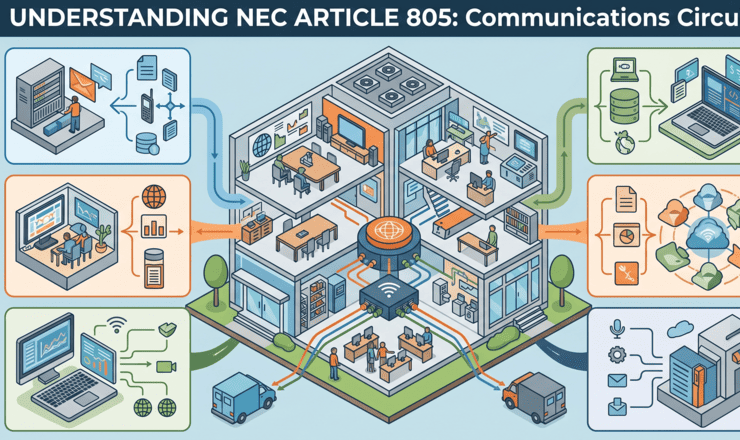
Understanding NEC Article 805: A Comprehensive Guide to Communications Circuits
When it comes to low-voltage electrical work, information technology infrastructure, and modern telecommunications, Understanding NEC Article 805 is absolutely essential. The National Electrical Code (NEC) has undergone significant changes in recent code cycles to adapt to the rapidly evolving landscape of smart buildings, network-powered systems, and high-speed data transmission. Part of this evolution was a major reorganization of Chapter 8, which resulted in the creation and refinement of Article 805, specifically dedicated to “Communications Circuits.” For electricians, IT systems designers, and low-voltage technicians, Understanding NEC Article 805 is no longer optional—it is a critical requirement for ensuring the safe, compliant, and reliable installation of communications cabling inside modern structures.
The Scope and Purpose of Article 805
To begin Understanding NEC Article 805, one must first recognize what it actually covers. Historically within the NEC, general requirements and specific circuit rules were blended together. Today, Article 800 serves as the broad “General Requirements for Communications Systems,” while Article 805 zeroes in specifically on the installation, routing, and protection of the communications circuits themselves.
This specific article covers traditional telephone wiring, intercom systems, and copper-based local area network (LAN) cabling like twisted-pair Ethernet. It focuses heavily on the wiring that operates within a building to facilitate voice, audio, and data transmission. By separating these specific circuit rules from the general overarching requirements, the NEC has made it easier for installers to reference the exact guidelines needed for their distinct cabling tasks.
Separation of Circuits: A Core Safety Principle
A major pillar of Understanding NEC Article 805 revolves around the strict physical separation of power and communications. Communications circuits typically operate at very low voltages. If these delicate cables were to come into direct contact with standard power circuits (such as 120V or 277V lighting and receptacle lines), the results could be catastrophic—leading to severe equipment damage, electrical fires, or lethal shock hazards for anyone using a connected telephone or network device.
Article 805 dictates clear physical separation requirements. Communications cables must be kept strictly separated from high-voltage electrical light and power conductors, as well as Class 1 circuits. Furthermore, the code provides guidelines on how communications cables should safely cross power lines (preferably at right angles to minimize induction) and mandates the use of physical barriers, distinct raceways, or appropriate conduit spacing when both types of systems are forced to share the same structural pathways.
Cable Routing, Pathways, and Structural Support
Proper installation techniques are another crucial facet of Understanding NEC Article 805. The code explicitly prohibits the “lazy” practice of laying communications cables loosely across suspended ceiling grids. Instead, all low-voltage cabling must be properly and independently supported using approved hangers, cable trays, surface raceways, or J-hooks attached directly to the building’s permanent structure.
Additionally, Article 805 emphasizes the importance of maintaining the integrity of fire-rated walls, floors, and ceilings. Whenever a communications circuit penetrates a fire-resistant structure, approved firestopping materials must be used to seal the opening. This prevents the spread of fire and toxic smoke, ensuring that the convenience of a low-voltage installation does not accidentally compromise the building’s overall life-safety architecture.
Grounding and Bonding Requirements
No discussion about telecommunications safety is complete without addressing grounding, and Understanding NEC Article 805 means paying close attention to these protective rules. Proper grounding and bonding are vital to protect both sensitive networking equipment and human personnel from lightning strikes, sudden power surges, and accidental contact with higher-voltage lines.
The article details the requirements for bonding the communications network to the building’s main electrical grounding electrode system. It dictates the sizing of the Telecommunications Bonding Conductor (TBC) and specifies how primary bonding busbars should be utilized within telecommunications rooms. Ensuring the shortest, straightest possible path to ground is a recurring theme in the code to maximize the effectiveness of the protective ground fault path.
The Rise of Power over Ethernet (PoE)
In modern installations, communications cables are no longer just carrying data; they are increasingly carrying power. With the rise of Power over Ethernet (PoE), devices like wireless access points, security cameras, and LED lighting are powered directly through standard network cables. Understanding NEC Article 805 in conjunction with other sections is critical here. While 805 governs the communications aspect, technicians must be highly aware of the heat generated by heavily bundled cables carrying PoE, ensuring that bundle sizes and cable ratings meet the NEC’s strict thermal limitations to prevent cable degradation.
Conclusion
In summary, the landscape of building connectivity is more complex and demanding than ever before. For anyone involved in the design, installation, or inspection of low-voltage systems, Understanding NEC Article 805 is the foundational key to mastering this complexity safely. By strictly adhering to its guidelines regarding circuit separation, proper structural support, meticulous firestopping, and comprehensive grounding, electrical professionals can ensure that their communications infrastructures are not only high-performing but fundamentally safe for years to come.
