



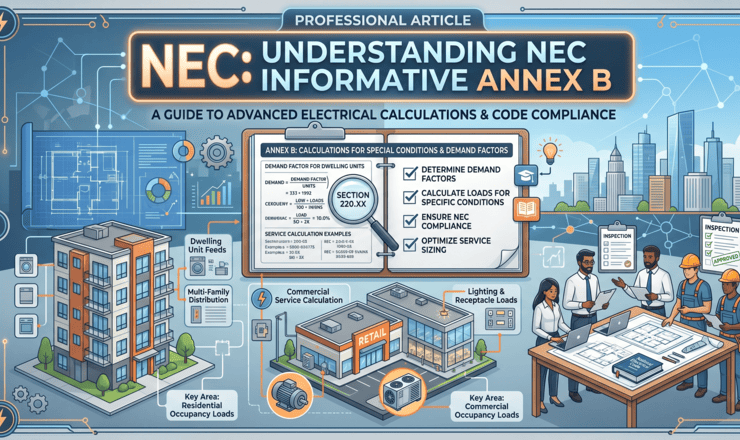
Understanding NEC Informative Annex B: A Complete Guide to Ampacity Calculations
For electrical engineers, designers, and master electricians, calculating the correct conductor ampacity is a foundational skill that ensures the safety and reliability of any electrical installation. While the standard tables in the National Electrical Code (NEC) Chapter 3 are sufficient for everyday residential and light commercial wiring, complex industrial and underground projects require a deeper level of analysis. This is where Understanding NEC Informative Annex B becomes absolutely essential. By diving into this crucial section of the Code, professionals can properly size conductors under engineering supervision, taking into account the nuanced thermal dynamics of complex electrical installations.
What is NEC Informative Annex B?
To start Understanding NEC Informative Annex B, it is important to recognize its purpose within the wider context of the National Electrical Code. Unlike the mandatory, strictly enforced rules found in Chapters 1 through 9, the annexes serve primarily as informational resources. Annex B specifically provides application information for calculating ampacities under engineering supervision. It acts as a highly detailed supplement to the standard ampacity tables (such as Table 310.16), offering advanced methodologies for determining exactly how much current a conductor can safely carry without exceeding its insulation temperature rating.
The backbone of this annex is rooted in the Neher-McGrath method, a complex mathematical formula developed in 1957 by J.H. Neher and M.H. McGrath. Understanding NEC Informative Annex B means understanding that this section applies the Neher-McGrath principles to calculate heat dissipation in underground cable systems and dense duct banks, providing an accurate, real-world assessment of conductor capabilities.
The Impact of Ambient Temperature and Thermal Resistivity
When dealing with underground electrical installations, heat dissipation is the primary concern and limiting factor. Two of the most critical variables discussed in this annex are ambient earth temperature and soil thermal resistivity (commonly referred to as Rho).
When Understanding NEC Informative Annex B, professionals learn that the standard NEC ampacity tables assume specific, idealized baseline conditions—such as an ambient earth temperature of 20°C (68°F) and a standard soil thermal resistivity (Rho) of 90. However, the real world rarely matches these exact parameters. If you are laying cables in dry, rocky, or sandy soil (which has poor heat transfer properties and a high Rho value) or in extremely hot geographical regions, the standard ampacity values will be dangerously inaccurate. Understanding NEC Informative Annex B provides the necessary correction factors and detailed tables to adjust your ampacity ratings based on actual environmental conditions, ensuring that your conductors do not overheat, melt, or degrade prematurely.
Navigating Underground Duct Banks and Mutual Heating
One of the most valuable, day-to-day aspects of Understanding NEC Informative Annex B is its extensive guidance on underground electrical duct banks. In large-scale commercial projects, campus data centers, or high-capacity EV charging stations, you rarely put just a single pipe in the ground. Instead, you have multiple conduits tightly grouped together within a shared concrete envelope.
When multiple current-carrying conductors are installed in close proximity, they generate a massive amount of heat—a phenomenon known as mutual heating. Standard Code tables simply do not fully account for the severe thermal constraints of these dense arrangements. Understanding NEC Informative Annex B allows engineers to reference detailed configuration figures and specialized tables that accurately reflect the heat trapped within these specific duct banks. By utilizing this information, designers can apply the correct derating factors or calculate the precise larger cable size needed to safely handle continuous high load factors.
The Role of Engineering Supervision
It is critical to note that the use of Annex B is heavily tied to the concept of “engineering supervision.” This dictates that these advanced calculations should be performed or overseen by qualified electrical engineers who thoroughly understand the physical and environmental variables at play. Understanding NEC Informative Annex B is not just about tracing your finger across a chart; it involves analyzing geotechnical soil data, differentiating between continuous and non-continuous loads, and making highly informed decisions about cable spacing to optimize thermal heat transfer.
Conclusion
Ultimately, Understanding NEC Informative Annex B separates basic electrical installations from highly engineered, fail-safe power delivery systems. Whether you are routing heavy feeder cables for an industrial manufacturing plant or designing massive underground duct banks for a utility-scale solar project, this annex provides the advanced thermal and mathematical framework required to calculate exact ampacity. By thoroughly Understanding NEC Informative Annex B, electrical professionals guarantee code compliance, maximize long-term system efficiency, and protect properties from the hidden, catastrophic dangers of thermal overload.
