Mastering Electrically Safe Work Conditions: The Definitive Guide to Occupational Electrical Hazard Elimination
- Introduction to Electrically Safe Work Conditions and the Elimination Mandate
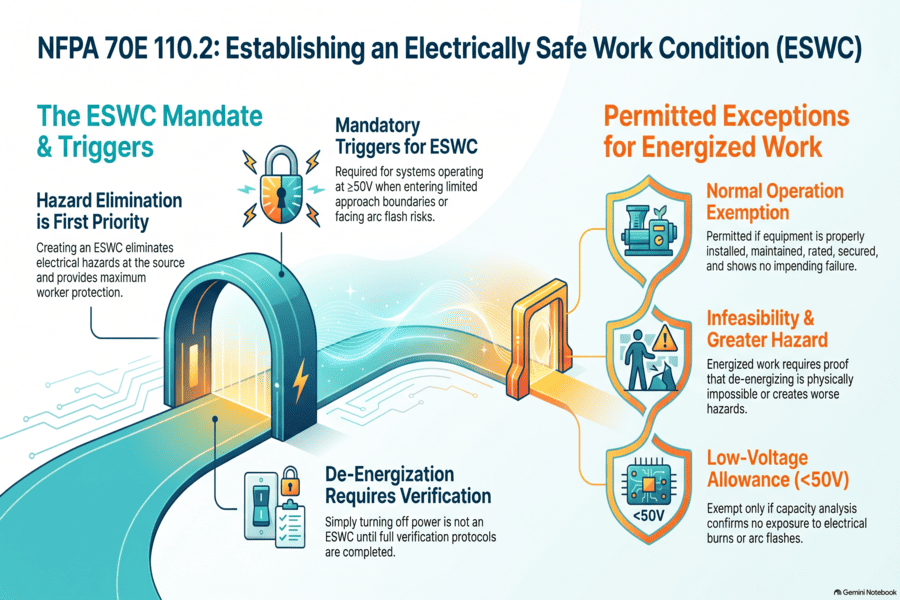
Establishing an Electrically Safe Work Condition (ESWC) is the cornerstone of effective workplace electrical safety management. Safe work practices serve as the structural foundation of an organization’s occupational health and safety management system, directing employee activity and dictating how tasks are planned, executed, and safeguarded. Within this framework, creating an ESWC is not merely a procedural option or a temporary site safety measure; it represents the primary work practice and the highest order of risk mitigation available to employers and workers. By systematically de-energizing, locking out, and verifying the absence of voltage on electrical equipment, an ESWC effectively neutralizes electrical hazards at their origin, ensuring that workers return home safely at the end of every shift.
Under comprehensive workplace safety regulations, employers are mandated to establish, document, and implement a written ESWC policy within their overall electrical safety program (ESP) or health and safety management system. A central directive of this policy is the strict mandate that hazard elimination must be prioritized above all lower-level risk control methods. In the standard hierarchy of risk control methods—which ranks measures from most effective to least effective—elimination sits at the absolute top, followed by substitution, engineering controls, awareness, administrative controls, and personal protective equipment (PPE). Controls at the top of the hierarchy (elimination, substitution, and engineering controls) are applied directly at the source of possible injury and are far less vulnerable to human error. Conversely, lower-level controls such as administrative procedures and PPE fail to remove the hazard itself; they merely place a physical barrier or operational rule between the worker and an active hazard.
HIERARCHY OF RISK CONTROL METHODS
+—————————————+ MOST EFFECTIVE
| ELIMINATION | (Applied at source;
+—————————————+ least reliant on
| SUBSTITUTION | human behavior)
+—————————————+
| ENGINEERING CONTROLS |
+—————————————+
| AWARENESS |
+—————————————+
| ADMINISTRATIVE CONTROLS | LEAST EFFECTIVE
+—————————————+ (Does not remove hazard;
| PERSONAL PROTECTIVE EQUIPMENT | highly vulnerable to
+—————————————+ human error)
Hazard elimination can be executed in two distinct operational contexts. Ideally, elimination is designed into the electrical system during initial engineering or equipment replacement, removing exposed energization points or incorporating remote operation capabilities. Where physical hazard elimination was not engineered into existing legacy equipment, establishing an ESWC via standardized work procedures serves as the operational implementation of hazard elimination. While establishing an ESWC utilizes administrative controls (such as lockout procedures and written verification steps) to achieve the de-energized state, the ultimate outcome is the absolute elimination of electrical energy from the immediate work area. Once an ESWC is fully verified, there is zero electrical energy in proximity to the task, the risk of shock or arc flash is completely removed, and workers are no longer reliant on protective garments or specialized safety equipment to prevent injury.
To maintain compliance and ensure uncompromised workplace safety, organizations must clearly understand the specific physical and operational criteria that make the establishment of an ESWC mandatory.
- Operational Triggers: When an Electrically Safe Work Condition Is Required
The transition from standard equipment operation to maintenance or servicing introduces critical exposure points where workers face potential electric shock, electrocution, or arc flash burns. To prevent workplace incidents, regulatory standards establish clear operational parameters and physical threshold boundaries that trigger the mandatory creation of an Electrically Safe Work Condition. Understanding these specific boundaries is essential for task planning, job safety analysis, and determining when de-energization must be enforced prior to initiating work.
An ESWC is automatically required before an employee performs work on energized electrical conductors and circuit parts whenever either of two primary conditions exists:
- Voltage and Boundary Threshold: The conductors or circuit parts operate at voltages equal to or greater than 50 volts, and the employee crosses into the limited approach boundary (the electric shock protection boundary surrounding exposed energized parts).
- Arc Flash Interaction Hazard: The employee interacts with electrical equipment where conductors or circuit parts may not be explicitly exposed, but the nature of the interaction creates an increased likelihood of injury from a potential arc flash hazard.
ELECTRIC SHOCK APPROACH BOUNDARIES
+———————————–+
| Limited Approach Boundary |
| +—————————–+ |
| | Restricted Approach Boundary| |
| | +———————–+ | |
| | | Exposed Energized | | |
| | | Conductor/Part | | |
| | +———————–+ | |
| +—————————–+ |
+———————————–+
* Crossing into the Limited Approach Boundary at >= 50V MANDATES an ESWC.
The requirement to establish an ESWC applies to both exposed live parts and enclosed equipment under specific interaction scenarios. While exposed live parts operating at 50V or higher present an obvious shock and arc flash threat upon crossing the limited approach boundary, non-exposed equipment can be equally hazardous. Actions described as “interacting with equipment”—such as racking a circuit breaker in or out of switchgear, opening or closing heavy disconnect switches, or pushing internal reset buttons—can induce mechanical or electrical stresses capable of initiating a catastrophic arcing fault. An arc flash event generates intense thermal radiation, blast pressure waves, flying shrapnel, and toxic metal vapor. If an operational task elevates the likelihood of an arc flash event, the equipment must be placed into an ESWC regardless of whether the internal busbars or terminals are visibly exposed.
A crucial distinction exists between electric shock protection boundaries and arc flash protection boundaries. The trigger for establishing an ESWC based on shock protection—crossing the limited approach boundary at 50 volts or greater—is entirely independent of whether an arc flash hazard is present or what the incident energy calculation reveals. An employer cannot waive the requirement for an ESWC simply because an arc flash risk assessment yields low thermal energy values or because the employee is wearing arc-rated clothing. Unless energized work meets strictly defined regulatory exceptions, an employee must never be exposed to an electric shock hazard above 50 volts, regardless of the personal protective equipment worn.
While the mandate for de-energization is strict, safety frameworks recognize that absolute de-energization is not always operationally possible, establishing narrow exceptions where energized electrical work may be exceptionally authorized.
- Critical Exceptions and Justifications for Energized Electrical Work
Energized electrical work is inherently dangerous and exposes personnel to severe risks, including fatal electrocution and life-altering thermal burns. Consequently, working on live conductors or circuit parts operating at 50 volts or higher is strictly prohibited as a standard operating procedure. Energized work is treated as a rare, highly controlled exception that requires rigorous technical justification, comprehensive risk assessment, and formal management authorization through an Energized Electrical Work Permit (EEWP). Employer priorities such as project deadlines, production quotas, management pressure, or the financial costs of scheduling a utility outage are explicit non-justifications that never warrant exposing workers to energized hazards.
The regulatory framework defines five specific exceptions where energized work or operational interaction is permitted without establishing an ESWC:
+———————————————————————————–+
| AUTHORIZED ENERGIZED WORK EXCEPTIONS |
+———————————————————————————–+
| 1. Normal Operating Conditions (Must satisfy ALL 7 criteria simultaneously) |
| 2. Disconnecting Means Operation (Risk assessment required prior to operation) |
| 3. Infeasibility Exception (Diagnostics, testing, continuous process limits) |
| 4. Greater Hazard Exception (Life support, emergency alarms, hazardous vent) |
| 5. Low-Voltage Exception (<50V with verified low capacity/thermal/arc/shock risk) |
+———————————————————————————–+
Exception 1: Normal Operating Conditions
Normal interaction with electrical equipment for its intended design function (such as switching a wall switch or operating a panelboard breaker) does not constitute “working on” live parts and is permitted without creating an ESWC, provided that ALL seven of the following criteria are satisfied simultaneously:
- Proper Installation: Equipment is installed in full compliance with applicable industry codes, standards, and manufacturer instructions.
- Proper Maintenance: Equipment is maintained in accordance with manufacturer recommendations and industry standards. Maintenance must encompass not only the equipment being operated, but also all upstream overcurrent protective devices. If an upstream circuit breaker is unmaintained, environmental degradation or mechanical binding can delay its trip mechanism, doubling or tripling fault-clearing times. For example, a panelboard labeled for 6.4 cal/cm² of incident energy based on a 0.1-second clearing time could actually subject an operator to 21.4 cal/cm² if an unmaintained upstream breaker takes 0.3 seconds to trip—transforming a routine task into a catastrophic, life-threatening burn hazard.
- Fault Current Rating: Equipment is properly rated for the maximum available fault current present at its line terminals. Upstream system modifications by utilities or facility engineering (such as transformer upgrades) can dramatically alter fault current levels, rendering equipment under-rated if not re-evaluated.
- Listing and Manufacturer Instructions: Equipment is used strictly in accordance with its listing, labeling, and manufacturer instructions.
- Secured Doors: Equipment doors are closed and fully secured.
- Secured Covers: All equipment covers and deadfronts are in place and properly secured with all designed fasteners.
- No Evidence of Impending Failure: There is zero visual, audible, or olfactory evidence of impending failure. Indications of impending failure include arcing sounds, smoke, ozone odors, visible physical damage, overheating discoloration, loose or binding components, or exposure to water damage.
If even a single condition among these seven is breached—such as a missing cover bolt, evidence of moisture ingress, or lack of documented upstream breaker maintenance—the equipment can no longer be considered in a normal operating condition, and normal manual operation is strictly prohibited.
Exception 2: Disconnecting Means Operation
Operating an energized disconnecting means or isolating element (such as opening a main switch or circuit breaker) is specifically permitted for the purpose of establishing an ESWC or returning equipment to service after an ESWC has been established. Operating a disconnect switch is the primary mechanism by which electrical energy is isolated from downstream equipment. The upstream system supplying the disconnecting device is not required to be placed in an ESWC prior to operating the handle. However, this allowance is conditional: a comprehensive pre-operation risk assessment must be performed prior to throwing the switch to verify that no unacceptable risk exists—such as visual cabinet damage, moisture contamination, phase-to-phase swelling, or a known history of arcing faults. If unacceptable risk is identified, the upstream supply must be de-energized before the disconnect can be operated.
Exception 3: Infeasibility Exception
Energized work is permitted where the employer can conclusively demonstrate that the specific task is physically or operationally infeasible to perform in a de-energized state due to equipment design limitations or operational requirements. Infeasibility is strictly task-based, not financial or convenience-based. Authorized examples include:
- Performing diagnostic testing, voltage measurements, phase alignment, and troubleshooting of electrical circuits that can only be performed while the circuit is energized.
- Performing work on circuits forming an integral part of a continuous industrial process that would require a complete, catastrophic facility shutdown to permit work on a single sub-circuit.
Note on Modern Technology: Continuous technical advancements alter what is deemed “infeasible.” The development of remote programming ports, exterior voltage test portals, optical infrared windows, and remote breaker racking systems means that tasks previously requiring door-opening and live exposure can now be accomplished safely without exposing workers to energized parts.
Exception 4: Greater Hazard Exception
Energized work is permitted where the employer can document that de-energizing equipment introduces an increased risk or an additional hazard to human life or facility safety. The additional hazards are not limited to electrical risks and often include mechanical, chemical, or environmental hazards. Authorized examples include:
- Interruption of life-support equipment in healthcare facilities.
- Deactivation of active emergency alarm systems or fire suppression controls.
- Shutdown of hazardous location ventilation equipment designed to prevent toxic or explosive chemical accumulations.
Technical Rationale on Unplanned Failure vs. Scheduled Outage: Performing energized work under the guise of avoiding a shutdown actually increases catastrophic risk. If an arcing fault occurs while performing energized work on a live system, the resulting arc flash and explosive pressure wave can destroy the gear entirely, rendering the equipment permanently inoperable for days, weeks, or months. This unplanned, catastrophic failure results in a far longer and more hazardous facility shutdown than a brief, controlled, scheduled outage to establish an ESWC. Furthermore, when claiming a Greater Hazard exception, employers must establish alternate contingency plans (e.g., temporary backup ventilation or secondary life-support power) to maintain safety in the event that an unexpected arcing fault occurs during live work.
Exception 5: Low-Voltage (<50V) Exception
Energized electrical conductors and circuit parts operating at less than 50 volts are not required to be de-energized if a preliminary evaluation confirms that the energy capacity of the source and upstream overcurrent protection will not subject the worker to increased exposure to electrical burns, arc flashes, or explosions.
Critical Low-Voltage Shock Warning: While voltages under 50V generally eliminate the risk of fatal electric shock under standard dry conditions, electric shock or electrocution can still occur below 50 volts under specific environmental or physiological conditions. In damp or wet work environments, or when a worker has skin lacerations, cuts, or abrasions on their hands, internal body resistance is drastically reduced, allowing lethal current to pass through the body at low voltages. Furthermore, low-voltage high-capacity energy sources—such as 12-volt or 24-volt industrial battery banks and large capacitor banks—possess immense short-circuit energy capabilities. An accidental short circuit across a low-voltage high-capacity battery bank can trigger violent arc flash explosions and generate extreme thermal radiation capable of causing severe skin burns and igniting clothing.
Even when an exception applies or when preparing to shut equipment down, workers face severe transition risks before de-energization is verified.
- Mandatory Safety Protocols Until an ESWC Is Fully Established
A critical vulnerability in industrial electrical safety occurs during the transitional phase between routine operation and the finalized establishment of an Electrically Safe Work Condition. Operating a circuit breaker handle to the “OFF” position or attaching lockout padlocks and tagout notices does not, in itself, constitute an ESWC. De-energized equipment must never be assumed safe until formal operational verification steps have been executed in their entirety.
TRANSITIONAL STATE SAFETY PROTOCOL
+————————————————-+
| Breaker Switched OFF & Locks/Tags Applied |
+————————————————-+
|
v MUST TREAT CONDUCTORS AS
+————————————————-+ FULLY ENERGIZED!
| MANDATORY PROTECTIVE MEASURES: | – Full PPE Required
| – Maintain Shock & Arc Flash Boundaries | – Safe Work Practices
| – Execute LIVE-DEAD-LIVE Test Protocol | – Rated Test Instruments
+————————————————-+
|
v VERIFICATION COMPLETE
+————————————————-+
| ELECTRICALLY SAFE WORK CONDITION ESTABLISHED |
+————————————————-+
A primary reason de-energization cannot be assumed simply because a switch handle is thrown is the potential for internal mechanical linkage failure. An operator moving an external breaker handle to the “OFF” position may observe the handle move, but internal mechanical linkages can bind, shear, or break, leaving internal contacts fully welded or closed. In such cases, the external indicator displays “OFF” while internal busbars remain fully energized at hazardous potentials.
Consequently, until all verification steps are complete, electrical conductors and circuit parts MUST be treated as fully energized. Workers operating within approach boundaries during the verification process are required to utilize safety-related work practices, boundaries, and personal protective equipment identical to those mandated for working on exposed live parts. This protective regime must match the maximum potential voltage and incident energy levels of the system.
The Live-Dead-Live Testing Protocol: A Non-Negotiable Life-Preservation Rule
Voltage measurement is inherently an energized work procedure. To verify the absence of voltage on circuits operating at 50 volts or higher, qualified personnel must treat the Live-Dead-Live protocol as a non-negotiable life-preservation rule. Testing a circuit without verifying meter functionality both immediately before and immediately after the target measurement is a primary cause of false-zero readings and fatal electrocutions. If a test meter’s internal fuse blows or its battery fails during the target measurement, the meter will display zero volts on a fully live circuit—leading a worker directly into lethal contact.
+—————–+ +—————–+ +—————–+
| STEP 1 | | STEP 2 | | STEP 3 |
| Test Known | –> | Test Target | –> | Re-Test Known |
| Source/Proving | | De-Energized | | Source/Proving |
| Unit | | Conductor | | Unit |
+—————–+ +—————–+ +—————–+
(Verifies meter (Verifies zero (Verifies meter
is operational) voltage on task) did not fail during)
- Verify Instrument Operation on Known Source: Prior to testing the target de-energized equipment, test the voltage meter on a known energized voltage source (or a verified built-in proving unit) to confirm that the meter display, internal fuses, selector switch, and test leads are fully functional.
- Test Target Conductors: Test all phase-to-phase and phase-to-ground conductors on the target equipment to confirm a zero-voltage reading across all potential current paths.
- Re-Verify Instrument Operation on Known Source: Immediately following the target test, re-test the voltage instrument on the known energized source (or proving unit) to confirm that the meter did not experience an internal component failure, blown fuse, or battery collapse during the test.
Test instruments, probes, and leads utilized for this process must be visually inspected for cracks, damaged insulation, or exposed metal before every use. Furthermore, test meters must be approved for the purpose, correctly rated for the specific circuit parameters, and assigned to the correct Category rating (CAT II, CAT III, or CAT IV) corresponding to the distribution location within the facility (e.g., CAT IV for primary service entrances, CAT III for distribution panelboards and branch circuits).
Only after the Live-Dead-Live test protocol confirms zero voltage—and all mechanical locking, tagging, and ground-grounding requirements are met—is the equipment officially in an Electrically Safe Work Condition. At that precise point, the electrical hazard is eliminated, and work may proceed without specialized electrical PPE or shock approach boundaries.
To test and reinforce core competencies regarding these principles, complete the technical assessment in the following section.
- Electrical Safety Knowledge Assessment
This multiple-choice assessment evaluates critical technical knowledge regarding Electrically Safe Work Conditions, hierarchy of risk control prioritization, threshold criteria, normal operating exceptions, authorized energized work justifications, and verification protocols. Select the single best answer for each question.