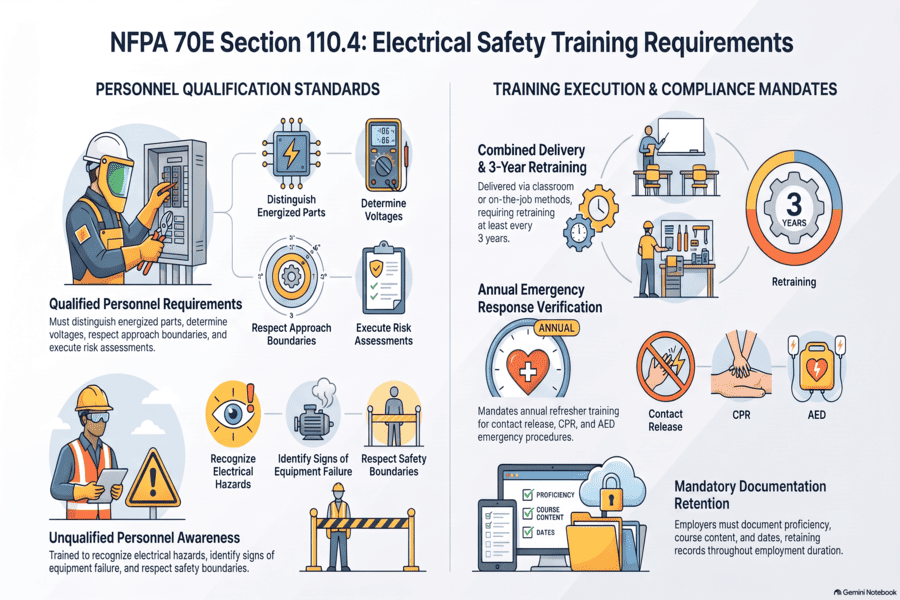
Workplace Electrical Safety: Comprehensive Guide to Employee Training Requirements
- Fundamentals of Workplace Electrical Safety Training
Workplace electrical safety training is a critical operational foundation for establishing an effective Electrical Safety Program (ESP). Modern industrial and commercial operations rely heavily on complex electrical distribution systems, making electrical hazard mitigation essential to occupational health and safety management. A structured training program serves as a proactive defense mechanism, reducing workplace injuries and fatalities by fostering constant employee vigilance against electrical hazards—including electric shock, arc flash burns, thermal burns, and arc blast forces—which are frequently invisible until triggered by human interaction or equipment failure. By embedding safety principles directly into everyday work routines, training ensures that safety policies transition from abstract administrative mandates into active, life-saving field practices.
The overarching mandate for electrical safety training applies to all employees exposed to electrical hazards in work environments where risk is not reduced to a safe, acceptable level solely by electrical installation methods. Achieving regulatory compliance is not a passive exercise in administrative recordkeeping; rather, effective training establishes a direct operational link between hazard identification and real-world injury prevention. Employees must be trained to recognize specific hazards associated with electrical energy, understand the direct causal relationship between hazard exposure and severe bodily harm, and select appropriate safety-related work practices.
Central to this hazard framework is the mandatory 50-volt baseline threshold. Electrical conductors and circuit parts operating at 50 volts or greater must be placed into an Electrically Safe Work Condition (ESWC) before an employee performs work within the limited approach boundary or interacts with equipment where an increased likelihood of injury from an arc flash hazard exists. Crucially, workplace training must educate workers that shock hazards are not strictly confined to systems operating above this threshold; under damp or wet environmental conditions, or where an employee has lacerated skin, severe electric shock or electrocution can occur at values below 50 volts.
When equipment cannot be de-energized or placed into an ESWC, interaction is permitted only under strict exceptions—most notably during “Normal Equipment Operation” as defined by standard compliance exceptions. For equipment to be considered operating under a normal operating condition, training must verify that all seven of the following specific criteria are simultaneously satisfied:
- Proper Installation: The equipment is installed in accordance with applicable industry codes, standards, and manufacturer recommendations.
- Proper Maintenance: The equipment is maintained in accordance with manufacturer recommendations and applicable standards (e.g., NFPA 70B).
- Fault Current Rating: The equipment is properly rated for the maximum available fault current at its installed location.
- Listed Instructions: The equipment is used in accordance with instructions included in its listing and labeling and manufacturer instructions.
- Doors Closed and Secured: All equipment doors are closed and properly secured.
- Covers Secured: All equipment covers are fully in place and secured.
- Absence of Impending Failure: There is no evidence of impending failure (such as arcing, overheating, loose or bound parts, visible physical damage, deterioration, water damage, or unusual odors/noises).
Exposure Scenario | Primary Training Scope | Hazard Awareness & Behavioral Expectations |
Normal Equipment Operation (All 7 normal operating criteria fully satisfied) | Basic operational safety; task-specific operating sequences; verifying equipment rating limits and normal operating status. | Recognize normal operating conditions; identify physical signs of impending failure; maintain secured doors and covers; handle attachment caps properly. |
Direct Interaction / Energized Tasks (Diagnostic testing, troubleshooting, voltage measuring, working within approach boundaries) | Advanced technical hazard evaluation; approach boundary calculation; test instrument selection and CAT ratings; PPE selection; ESWC creation. | Distinguish exposed energized components; determine nominal system voltages; execute Hierarchy of Risk Control (HoRC); perform “LIVE-DEAD-LIVE” testing. |
Conductive, Damp, or Outdoor Environments (Portable cord-and-plug tool usage, wet locations, temporary construction power) | Environmental shock risk factors (including shock risk below 50V); Ground-Fault Circuit-Interrupter (GFCI) operation; cord set inspection. | Recognize elevated shock/burn risks in damp conditions or with damaged skin; verify GFCI protection prior to energization; inspect cords for jacket damage. |
Establishing this foundational understanding of risk and operating thresholds prepares the groundwork for clearly differentiating employee competency levels and safety responsibilities across the workforce.
- Differentiating Competency: Qualified vs. Unqualified Personnel
Establishing a precise distinction between qualified and unqualified personnel is a strategic operational necessity within any Electrical Safety Program. Inadvertently permitting an unqualified worker to perform tasks requiring technical hazard recognition—or assuming a qualified worker is universally competent across all equipment types—creates severe human error risks that lead directly to catastrophic electrical incidents. Proper classification ensures that personnel are assigned strictly to tasks corresponding to their verified skills, proven technical knowledge, and hazard mitigation training.
+—————————————+
| WORKPLACE PERSONNEL TYPES |
+—————————————+
|
+——————–+——————–+
| |
v v
+——————————+ +——————————+
| QUALIFIED PERSON | | UNQUALIFIED PERSON |
+——————————+ +——————————+
| * Equipment construction & | | * Trained in safety practices |
| operation knowledge | | for normal equipment use |
| * Hazard identification & | | * Must recognize signs of |
| avoidance skills | | impending failure |
| * Approach boundary logic | | * Cannot cross Restricted |
| * Meter CAT ratings & | | Approach Boundary |
| LIVE-DEAD-LIVE protocol | | * Escort required inside |
| * PPE & HoRC execution | | Limited Approach Boundary |
| * Permitted within Limited & | | |
| Restricted Boundaries | | |
+——————————+ +——————————+
To be deemed a “qualified person” under workplace safety standards, an employee must possess technical knowledge regarding the construction and operation of specific electrical equipment or work methods and be fully trained to identify and avoid the electrical hazards present. Technical qualification is task- and equipment-specific; a worker qualified on low-voltage control panels may be completely unqualified to work on high-voltage switchgear. Comprehensive criteria for qualified personnel include:
- Precautionary Techniques & Safety Tools: Proficiency in safety policies, work procedures, personal protective equipment (PPE), insulating and shielding materials, insulated tools, and test equipment.
- Boundary Determination & Voltage Analysis: Practical ability to distinguish exposed energized electrical conductors and circuit parts from non-energized parts, determine nominal system voltages, and apply specified limited approach boundaries and restricted approach boundaries.
- Hierarchy of Risk Control (HoRC) & Job Planning: Mastery of job safety planning, hazard identification, risk assessment, and application of control methods in descending order: Elimination, Substitution, Engineering Controls, Awareness, Administrative Controls, and PPE.
- Test Instrument Selection & Category (CAT) Ratings: Qualified workers must be trained to select the correct test instrument approved for the specific circuit voltage and system location, fully understanding instrument limitations and Category ratings:
- Category IV (CAT IV): Primary supply connections, outdoor overhead/underground utility lines, and service entrances.
- Category III (CAT III): Building distribution systems, feeder lines, branch circuits, and hardwired equipment panels.
- Category II (CAT II): Single-phase receptacle-connected loads and plug-connected portable equipment.
- Category I (CAT I): Protected electronic equipment and signal-level circuits.
- Mandatory Visual Inspection: Prior to every use, test instruments, leads, cables, power cords, probes, and connectors must be visually inspected for external defects, cracked casing, worn lead insulation, or exposed metal. Damaged equipment must be removed from service immediately.
- Voltage Testing & “LIVE-DEAD-LIVE” Protocol: When testing to verify the absence of voltage on conductors or circuit parts operating at 50 volts or higher, qualified workers must execute the mandatory “LIVE-DEAD-LIVE” protocol:
- Test the instrument on a known voltage source (LIVE).
- Test the target de-energized electrical circuit for absence of voltage (DEAD).
- Re-test the instrument on the known voltage source to confirm meter functionality (LIVE).
- Supervised On-the-Job Training (OJT): A worker undergoing OJT to become qualified is considered qualified only for the specific duties being performed, provided they demonstrate the safe execution of those duties under the direct supervision of a qualified person.
Unqualified personnel must be trained in and familiar with all electrical safety-related practices necessary for their protection during routine work operations. Unqualified workers must strictly adhere to behavioral safety rules, including:
- Recognizing potential electrical hazards and understanding the direct relationship between electrical exposure and severe bodily injury.
- Identifying physical signs of impending equipment failure (e.g., arcing, overheating, smoke, loose or bound parts, visible physical damage, deterioration, water damage, unusual odors) and immediately evacuating the area.
- Handling attachment plugs correctly by pulling the plug cap directly rather than yanking on the flexible cord.
- Adhering to strict prohibitions against resetting automatically tripped circuit breakers, which requires escalation to a qualified person to analyze and correct the fault.
- Respecting approach boundaries by never crossing the restricted approach boundary and crossing the limited approach boundary only when continuously escorted by a qualified person.
- Maintaining safe approach distances from overhead power lines, keeping conductive materials clear of electrical equipment, and avoiding the use of damaged cords or sparking tools.
Dimension | Qualified Persons | Unqualified Persons |
Authorized Tasks | Diagnostic testing, troubleshooting, voltage measuring, establishing an ESWC, approved energized work. | Normal operation of properly installed/maintained equipment, non-electrical routine duties. |
Boundary Limits | Authorized to cross Limited and Restricted Approach Boundaries using job safety planning and PPE. | Prohibited from Restricted Boundary; permitted within Limited Boundary only when continuously escorted. |
Technical Skill Requirements | Equipment construction knowledge, nominal voltage calculation, HoRC execution, meter CAT selection, LIVE-DEAD-LIVE testing. | Hazard awareness, recognizing impending equipment failure, proper plug handling, safety alerting techniques. |
Supervision Level | Authorized to work independently on qualified tasks; direct supervision of OJT trainees. | Direct continuous supervision/escort required when inside limited approach boundaries. |
Defining clear qualification parameters enables an organization to enforce procedural rigor during high-risk tasks, including Lockout/Tagout protocols and emergency response preparedness.
- Procedural Mastery: Lockout/Tagout (LOTO) and Emergency Response Preparedness
Procedural rigor in Lockout/Tagout (LOTO) and emergency response preparedness is the ultimate safeguard against fatal electrical shocks, arc flash burns, and electrocutions. When hazardous electrical energy is not controlled, minor deviations in procedure can lead to fatalities. Establishing an Electrically Safe Work Condition (ESWC) through verified LOTO procedures eliminates hazards at the source, representing the highest priority in the Hierarchy of Risk Control.
+—————————————————————–+
| ELECTRIC SHOCK EMERGENCY RESPONSE SEQUENCE |
+—————————————————————–+
|
v
+—————————————————————–+
| 1. SAFE ENERGY DISCONNECT / SAFE CONTACT RELEASE |
| De-energize circuit immediately OR use non-conductive rescue |
| equipment (rescue hook) to release victim safely. |
+—————————————————————–+
|
v
+—————————————————————–+
| 2. IMMEDIATE MEDICAL EMERGENCY CALL |
| Contact 911 or activate facility emergency response system. |
+—————————————————————–+
|
v
+—————————————————————–+
| 3. LIFE-SAVING INTERVENTION (CPR / AED) |
| Administer CPR and deploy Automated External Defibrillator |
| (AED) if victim is unresponsive/without pulse. |
+—————————————————————–+
|
v
+—————————————————————–+
| 4. SECURE SCENE & INITIATE INCIDENT INVESTIGATION |
| Isolate hazardous area and initiate formal investigation. |
+—————————————————————–+
Lockout/Tagout (LOTO) Training Framework
Initial LOTO training is mandatory for all employees involved in establishing an ESWC. Training must instruct workers on detailed energy control procedures and instill personal accountability for executing LOTO steps. Retraining in LOTO procedures must occur when procedures are revised, at intervals not to exceed 3 years, or when annual supervision/auditing indicates employee non-compliance.
Host and Contract Employer Governance
Operational disconnects between host employers and contract employers introduce severe lethal risks. Safety standards mandate explicit joint governance requirements:
- Mandatory Documented Meeting: Where the host employer has knowledge of covered electrical hazards related to the contract employer’s work, a formal, documented meeting between the host and contract employer is required prior to work commencement.
- Host Employer Information Sharing: The host employer must inform the contractor of known covered electrical hazards and facility installation parameters needed to perform risk assessments.
- Contract Employer Obligations: Contract employers must ensure their workers are instructed in communicated hazards, adhere to facility safety rules, and advise the host employer of any unique hazards introduced by their work or newly discovered hazards during task execution.
- Violation Reporting & Corrective Actions: The host employer must report observed contract employer safety violations to the contractor. In response, the contract employer must advise the host employer of the specific measures taken to correct reported violations and prevent recurrence.
Incident & Near-Miss Investigation Mandates
To maintain a proactive safety culture, an Electrical Safety Program (ESP) must include documented elements to formally investigate all electrical incidents. This mandate rests on a critical safety principle: near misses involving electricity must be viewed as near fatalities, and every electric shock is a potential electrocution. An electric shock that causes a minor sensation today could result in severe injury or death tomorrow under slightly altered physical or environmental conditions. Incident investigations must systematically analyze the root causes of all electrical contacts, arcing events, and near misses to determine required corrective actions—including necessary revisions to ESP procedures, equipment maintenance schedules, or employee training programs.
Emergency Response & Life-Saving Interventions
- Contact Release Training: Employees exposed to electric shock hazards or responsible for victim release must be trained in safe rescue methods (e.g., immediate power disconnect, utilizing non-conductive insulated rescue hooks or shock rescue kits). Rescuers must avoid becoming secondary victims by identifying and isolating hazards prior to touching the victim. Refresher training for Contact Release must occur annually.
- First Aid, CPR, and AED Operation: Personnel designated to respond to medical emergencies must be trained in First Aid, Cardiopulmonary Resuscitation (CPR), and Automated External Defibrillator (AED) operation (if an AED is included in the facility emergency plan). Training frequency must satisfy the specific requirements of the certifying body (e.g., American Heart Association, American Red Cross). Employers must verify at least annually that designated employee emergency response training is fully current.
Immediate Steps During an Electric Shock Emergency
- Safe Energy Disconnect / Safe Contact Release: Immediately de-energize the circuit supplying the equipment. If power cannot be shut off instantly, use certified, non-conductive rescue equipment (such as an insulated rescue stick or hook) to safely free the victim without directly contacting their body or energized parts.
- Immediate Call for Medical Assistance: Instantly alert facility emergency responders or call 911 to request emergency medical services (EMS).
- Resuscitation and AED Administration: Once the victim is safely clear of energized components, check for responsiveness and breathing. If the victim is unresponsive or lacks a pulse, immediately initiate CPR and apply an Automated External Defibrillator (AED) as soon as available.
- Secure the Area and Initiate Incident Investigation: Isolate the work site to prevent exposure to other personnel and notify safety management to initiate a formal incident/near-miss investigation.
Mastered emergency and lockout protocols rely on a robust administrative infrastructure to manage training frequencies, track compliance, and preserve critical records over time.
- Administrative Governance: Delivery Methods, Retraining Triggers, and Compliance Records
Administrative governance provides the organizational framework necessary to sustain electrical safety competencies, maintain regulatory compliance, and ensure work practices adapt to operational changes. A robust administrative framework treats electrical safety as a continuous improvement cycle requiring routine auditing, structured instruction, and formal verification.
+—————————————————————–+
| ADMINISTRATIVE GOVERNANCE INFRASTRUCTURE |
+—————————————————————–+
|
+——————————+——————————+
| | |
v v v
+——————+ +——————+ +——————+
| DELIVERY METHODS | | RETRAINING RULES | | AUDITS & RECORDS |
+——————+ +——————+ +——————+
| * Classroom | | * Max 3-Year | | * 3-Tier Audits: |
| * On-the-Job | | Interval | | – ESP (3 yr) |
| (OJT) | | * Annual Non- | | – Field (1 yr) |
| * Interactive | | Compliance | | – LOTO (1 yr) |
| Web-Based | | * New Tech/Equip | | * Name, Dates, & |
| * Format Dictated| | * Job Duty Change| | Syllabus Content|
| by Risk Level | | * Tasks <1/Year | | * Retain Duration|
| | | * Unused Practices| | of Employment |
+——————+ +——————+ +——————+
Training Delivery Methods
Electrical safety training must be delivered via classroom instruction, on-the-job training (OJT), or a combination of both. Classroom instruction may incorporate interactive, participatory web-based or electronic learning modules. The type and extent of training provided are directly dictated by the degree of electrical risk to which the employee is exposed. Computer-based training modules must be interactive and participatory to mirror the efficacy of traditional classroom settings, while OJT provides hands-on practical skill acquisition under direct qualified supervision.
Retraining Mandates & Mandatory Triggers
Comprehensive retraining in electrical safety-related work practices and applicable safety standard updates must occur at intervals not to exceed 3 years. However, immediate retraining is triggered prior to the 3-year interval whenever any of the following five conditions occur:
- Supervision or Audit Non-Compliance: Regular supervision or annual field work inspections indicate that the employee is not complying with required safety-related work practices.
- New Technology or Equipment: The introduction of new technology, new types of equipment, or modified procedures necessitates safety practices different from those normally utilized by the employee.
- Infrequently Performed Tasks: The employee must perform tasks that are carried out less often than once per year.
- Unused Work Practices: The employee needs to review safety-related work practices not normally used during their regular job duties.
- Job Role Changes: The employee’s job duties or scope of work assignments change.
Three-Tier Auditing Regime
To verify that administrative governance and field practices align with safety standards, employers must implement a mandatory three-tier auditing framework:
- Electrical Safety Program (ESP) Audit: The overall Electrical Safety Program shall be audited at intervals not to exceed 3 years to verify that ESP principles and procedures comply with current safety standards.
- Field Work Audit: Field work shall be audited at intervals not to exceed 1 year to verify that employee safety practices follow documented ESP procedures. When field auditing identifies non-compliance, corrective action must immediately mandate appropriate revisions to the training program or safety procedures.
- Lockout/Tagout Program & Procedure Audit: Lockout/tagout procedures must be audited by a qualified person at intervals not to exceed 1 year. The audit must cover at least one lockout/tagout in progress and evaluate the LOTO program, training, and worker execution to correct identified deficiencies.
- Audit Documentation: All audits conducted under these three tiers must be formally documented.
Strict Recordkeeping Standards
Employers must maintain complete documentation confirming that each employee has received the required training. Recordkeeping must satisfy the following criteria:
- Proficiency Timing: Records must be established when the employee formally demonstrates proficiency in the safety work practices involved.
- Mandatory Record Contents: Documentation must explicitly state the employee’s name, the exact dates of training, and the detailed content of the training (e.g., course syllabus, curriculum outline, table of contents, or training objectives).
- Retention Period: Training records for both general electrical safety and Lockout/Tagout procedures must be retained for the entire duration of the employee’s employment.
Establishing rigorous administrative records completes the framework, enabling organizations to evaluate individual worker knowledge through structured practical assessment.
- Practical Assessment: Multiple Choice Knowledge Evaluation
Verifiable knowledge retention is essential to ensure that employees translate administrative standards into safe field behaviors. The following diagnostic evaluation tests critical practical comprehension derived exclusively from workplace electrical safety mandates.