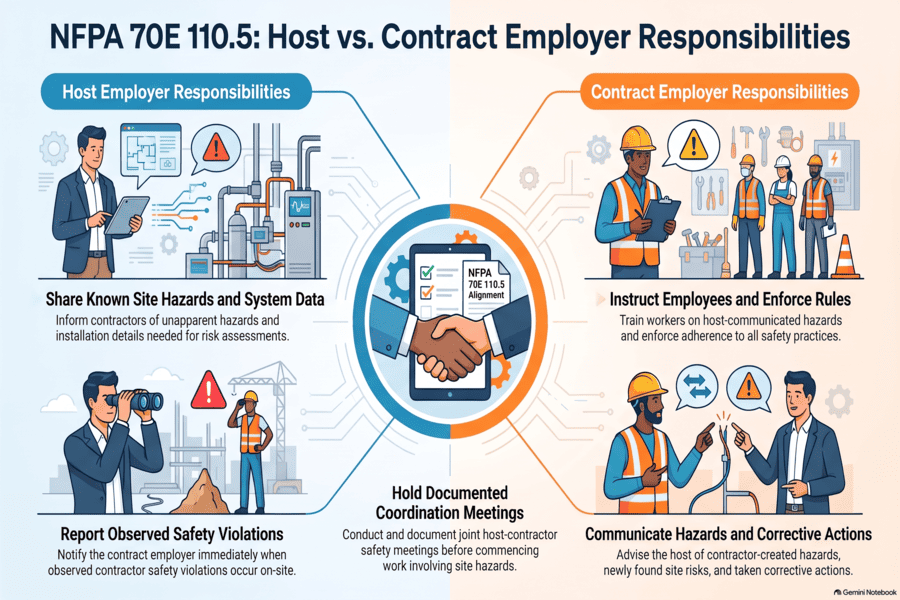
Shared Safety Responsibilities: A Guide for Host and Contract Employers
- Navigating Dual-Employer Dynamics in Electrical Workplace Safety
Multi-employer industrial and commercial facilities present intricate operational environments where overlapping institutional and operational responsibilities can create critical gaps in safety management. When host facility operators and visiting specialty contractors execute work concurrently, ambiguous boundaries regarding equipment ownership, system history, and procedural enforcement significantly elevate the risk of severe electrical incidents. Establishing absolute clarity between entities is an operational imperative. Defining structural boundaries ensures that facility owners, construction managers, prime contractors, and independent service vendors maintain continuous joint accountability. Under applicable regulatory frameworks, the Authority Having Jurisdiction (AHJ) enforcing workplace safety standards holds final authority in evaluating site agreements and determining host versus contract employer status in complex or ambiguous multi-employer relationships. Clear role definition guarantees that facility-specific hazard intelligence and standardized work rules are formally exchanged long before personnel interact with electrical infrastructure.
To establish this structural clarity, the operational roles and site contexts of host and contract employers are defined below:
Host Employer Role & Context | Contract Employer Role & Context |
Operational Scope: Facility owner, general contractor, construction manager, or designated on-site facility manager who contracts for work to be performed within the premises. | Operational Scope: Independent specialty contractor, trade subcontractor, commercial service vendor (e.g., vending equipment technicians), or secondary corporate division executing contracted scopes of work. |
Site Context: Possesses comprehensive institutional knowledge of facility design, equipment installation history, utility feeds, maintenance logs, and unique localized electrical hazards. | Site Context: Provides specialized technical capabilities but may be unfamiliar with physical site layouts, legacy equipment quirks, unmapped circuit modifications, or facility-specific risks. |
Primary Focus: Serves as the primary custodian of facility electrical safety data, provides essential system parameters for risk assessments, controls general site access, and monitors overall facility compliance. | Primary Focus: Maintains direct oversight of frontline craft personnel, directly instructs field workers on site-specific hazards, enforces safe work practices, and verifies employee training qualifications. |
Role Dynamics: Functions within dynamic operational boundaries evaluated by the Authority Having Jurisdiction (AHJ); an entity (such as a prime contractor or facility manager) can shift between host and contract roles based on specific contract terms and operational control. | Role Dynamics: Bears direct legal and operational responsibility for protecting its workforce across varying job sites, adapting internal safety programs to satisfy host site mandates without compromising safety standards. |
Defining these structural roles establishes the foundation for examining the proactive hazard disclosure duties required of host facility operators.
- Core Obligations and Hazard Disclosures of Host Employers
As the primary custodian of facility electrical infrastructure, installation records, and operational history, the host employer bears a non-delegable duty to disclose site-specific hazard information. Visiting contractors cannot independently ascertain hidden electrical anomalies, unmapped distribution feeds, or historical equipment modifications prior to commencing work. By systematically compiling and transmitting technical data, host facility operators enable contract employers to conduct valid risk assessments, establish appropriate approach boundaries, and execute effective field-level hazard controls.
Primary host employer mandates center on four foundational obligations:
- Communicating Known, Unrecognized Electrical Hazards
- Mandate: Host employers must formally inform contract employers of known electrical hazards that relate to the contractor’s scope of work and might not be recognized by the contractor or its field personnel.
- Impact on Risk Mitigation: Disclosing hidden hazards—such as concealed energized busway runs, ungrounded legacy circuits, backfed control transformers, or degraded insulation—prevents visiting craft workers from inadvertently crossing limited approach boundaries or opening compromised enclosures without appropriate protective measures.
- Providing System Installation Information for Risk Assessments
- Mandate: Host employers must provide accurate equipment and installation data required by the contract employer to complete mandatory shock risk assessments, arc flash risk assessments, and job safety planning.
- Impact on Risk Mitigation: Providing critical technical parameters—including short-circuit available fault current, upstream protective device clearing times, transformer impedance, and maintenance condition records—ensures contractors can calculate exact incident energy exposures, establish arc flash boundaries, select properly rated personal protective equipment (PPE), and determine whether energized work is legally justifiable.
- Pre-Work Exchange of Written Electrical Safety Programs (ESPs)
- Mandate: Host employers must explicitly exchange their written Electrical Safety Programs (ESPs) with contract employers prior to the authorization of field activities.
- Impact on Risk Mitigation: Exchanging written ESPs eliminates operational assumptions, identifies procedural discrepancies between host site rules and contractor standard operating procedures, and establishes explicit agreement on safety expectations, lockout/tagout (LOTO) protocols, and site safety governance.
- Monitoring and Reporting Observed Safety Violations
- Mandate: Host employers must actively monitor work activities across the facility and formally report any observed contract employer safety violations directly to contract management.
- Impact on Risk Mitigation: Reporting observed infractions—such as improper voltage testing, uncalibrated test meters, failure to establish an electrically safe work condition, or bypassed arc flash PPE mandates—preserves contractual management channels while ensuring non-compliant behaviors are corrected immediately before an incident occurs.
While host employers must disclose known hazards and oversee facility operations, comprehensive risk mitigation depends equally on the field-level safety protocols executed by contract employers.
- Essential Duties and Feedback Loops for Contract Employers
Contract employers maintain direct authority over frontline field crews and bear immediate operational responsibility for enforcing day-to-day electrical compliance. Specialized trade capabilities must be integrated with the host facility’s unique operating environment. To achieve this, contract employers must execute a structured, three-part feedback protocol that converts host hazard disclosures into frontline protection while maintaining continuous bidirectional safety reporting back to host facility management.
Contract employers must integrate safety governance into daily field operations through a sequential protocol:
- Personnel Instruction on Host-Communicated Hazards
- Prior to authorizing personnel to enter approach boundaries or initiate physical work, the contract employer must explicitly instruct assigned workers on all site-specific hazards disclosed by the host employer.
- This instruction must be delivered as a mandatory, site-specific addition to foundational electrical safety training, ensuring that field crews thoroughly comprehend localized system hazards, emergency isolation points, and specific facility rules.
- Strict Enforcement of Safe Work Practices and Host Rules
- The contract employer must enforce rigid employee compliance with standard electrical safety work practices and host-mandated facility rules.
- When a host employer’s site safety mandates are more stringent than the contractor’s standard operating procedures—such as mandatory complex lockout/tagout protocols or broader arc flash boundaries—the contract employer must enforce compliance with the more protective host standard.
- Bidirectional Reporting and Closed-Loop Communication
- The contract employer must systematically report crucial field data back to the host employer across three specific operational triggers:
- Unique Contractor-Introduced Hazards: Any new operational hazards introduced by the contractor’s activities, such as temporary generator power distribution, temporary high-voltage cable runs, exposed temporary wiring, or process disruptions.
- Newly Identified Site Hazards: Any previously uncommunicated site hazards discovered during task execution. Crucially, this includes physical or system alterations—such as an upstream utility transformer replacement that alters available fault current and invalidates existing equipment interrupting ratings or incident energy labels.
- Corrective Actions Implemented: Detailed documentation of specific remedial measures executed to correct safety violations formally reported by the host employer, verifying that non-compliant work practices will not recur.
- The contract employer must systematically report crucial field data back to the host employer across three specific operational triggers:
Structured Feedback Loop Summary: The communication process begins with the Host Hazard Disclosure & ESP Exchange, leading to Contractor Site-Specific Instruction, followed by Field Execution & Enforcement. Field findings then generate Bidirectional Hazard & Action Reporting (capturing newly discovered hazards like utility transformer rating changes), which feeds directly into Joint Host-Contractor Remediation & Program Adjustment.
To bind these reciprocal obligations into an enforceable operational framework, host and contract management must engage in formal joint safety governance prior to authorizing hazardous work.
- Joint Safety Governance: Documented Alignment and Coordination
Informal verbal agreements, unwritten assumptions, and casual handshakes are entirely unacceptable for managing workplace electrical hazards. Complex multi-employer industrial environments require formal, written alignment to prevent catastrophic misunderstandings regarding equipment isolation, operational boundaries, and emergency protocols. Formal joint coordination ensures that both host facility operators and contract leadership establish verifiable consensus on all safety protocols before personnel enter electrical approach boundaries or perform task activities.
Where a host employer has knowledge of electrical hazards related to a contract employer’s scope of work, a formal, documented alignment meeting between both entities is mandatory prior to commencing operations.
Mandatory Elements of Joint Safety Alignment Meetings
- Scope of Work & Technical Hazard Review: Formal review of contractor work plans, review of system line diagrams, and mutual evaluation of potential shock, arc flash, and thermal burn hazards within the work zone.
- Pre-Work ESP Reconciliation: Mutual exchange and side-by-side reconciliation of both host and contractor written Electrical Safety Programs (ESPs) to eliminate procedural contradictions and determine rule dominance.
- Energized Electrical Work Coordination: Formal review of tasks requesting energized work. Verification that establishing an electrically safe work condition is infeasible due to equipment design or operational limitations, verification of diagnostic testing necessity, and written signature approval of Energized Electrical Work Permits (EEWPs) by host management.
- Energy Control & Lockout/Tagout Selection: Written agreement on whether host or contractor lockout/tagout (LOTO) procedures will be executed, detailing specific isolation points, zero-energy state verification steps, complex LOTO lockbox protocols, and re-testing procedures.
- Emergency Response, First Aid & Rescue Protocols: Coordination of facility emergency response procedures, verification of designated CPR/AED certified personnel, assignment of safety watch personnel, and staging of specialized electric shock contact release equipment.
- Mid-Project Change Management Protocols: Mandatory operational process for managing mid-project alterations. If equipment modifications, scope expansion, unexpected engineering changes, or utility grid adjustments (such as transformer swaps altering fault current) occur mid-project, work must pause immediately. Parties must re-evaluate risk assessments, revise EEWPs/LOTO plans, hold an updated job briefing, and re-document joint alignment before resuming operations.
Establishing this documented alignment provides a fully audited operational framework, ensuring host and contract personnel execute field tasks with zero ambiguity.
- Assessment & Knowledge Check: Host and Contract Employer Responsibilities
Direct your attention to the scenario-based competency evaluation below to test your understanding of host and contract employer safety obligations.