Mastering Portable Electrical Equipment Safety: Practices for Flexible Cords, Plugs, and Hazardous Environments
- Strategic Importance of Portable Equipment Safety
While fixed premises wiring is safely enclosed within rigid metallic conduits, heavy-duty panelboards, and permanent structural elements, portable cord- and plug-connected electrical equipment presents a fundamentally higher risk profile. Portable tools, extension cords, and temporary power distribution units operate at the dynamic frontline of industrial operations, where they are continuously subjected to physical movement, harsh environmental exposure, severe mechanical stress, and rough handling. Cords are routinely pulled, tightly coiled, dragged across abrasive surfaces, routed through high-traffic walkways, and exposed to moisture, chemicals, and weather extremes. This relentless mechanical and environmental exposure makes portable equipment uniquely vulnerable to outer jacket degradation, insulation breakdown, and internal conductor strain. Because temporary distribution components serve as the immediate physical interface between the facility’s power supply and the worker, maintaining continuous vigilance and rigorous safety controls within an organization’s Electrical Safety Program (ESP) is critical to preventing electric shock, arc flash burns, and electrocution.
Temporary electrical distribution setups using flexible extension cords, temporary power taps, and cord-connected tools introduce complex operational risks. A foundational engineering requirement for flexible cords is that they must remain continuous lengths without field-installed splices or taps. Splices introduce mechanical weaknesses and high-resistance electrical joints that strip the cord of its physical flexibility and outer jacket insulation integrity. When temporary cords are improperly spliced, excessively extended, or overloaded, the cumulative circuit impedance increases significantly. This added impedance can restrict fault current levels below the magnetic trip threshold of overcurrent protective devices, extending fault clearing times and creating severe thermal, arcing, and shock hazards.
Workplace incident investigations dramatically highlight the fatal consequences of neglecting portable equipment controls. In one illustrative case study, a 19-year-old construction laborer lost his life while constructing a waterfront bulkhead at a lake edge. Power for the job site was drawn from an exterior 120-volt, 20-ampere residential porch receptacle that lacked Ground-Fault Circuit-Interrupter (GFCI) protection. To reach the waterfront, workers joined two 100-foot extension cords in series. One of these cords had previously suffered damage and was subjected to an unauthorized field repair using replacement attachment caps. During this field repair, the non-color-coded internal conductors were cross-wired—establishing a lethal reversed polarity condition—and the equipment grounding conductor inside the plug cap had pulled completely loose from its terminal. Although this damaged cord had previously shocked workers, it was neither tagged nor permanently removed from service. On the day of the incident, the laborer handled the energized, cross-wired, and ungrounded connector cap while standing near the wet bulkhead. Current passed directly through his body to ground; he collapsed unconscious into four and a half feet of water and drowned. This case demonstrates how compounding failures—unauthorized field repairs, lack of pre-use inspection, failure to tag defective gear, missing equipment grounding continuity, and the absence of GFCI protection—transform everyday portable equipment into deadly hazards.
Effective safety management of portable electrical tools begins with proper physical handling and preserving the structural integrity of the grounding path.
- Safe Handling, Storage, and Equipment Grounding Integrity
Preserving the outer physical insulation and low-impedance grounding paths of flexible cords serves as the primary line of defense against electrical shock hazards. Flexible cords house active current-carrying phase and neutral conductors alongside protective grounding elements within a single composite outer sheath. Any mechanical stress that pinches the cord, severs the outer protective jacket, or crushes internal insulation creates an immediate pathway for fault currents to energize non-current-carrying metal tool frames or expose workers to live copper conductors. Consequently, strict operational mandates govern the physical handling, routing, and storage of cord-and-plug-connected equipment.
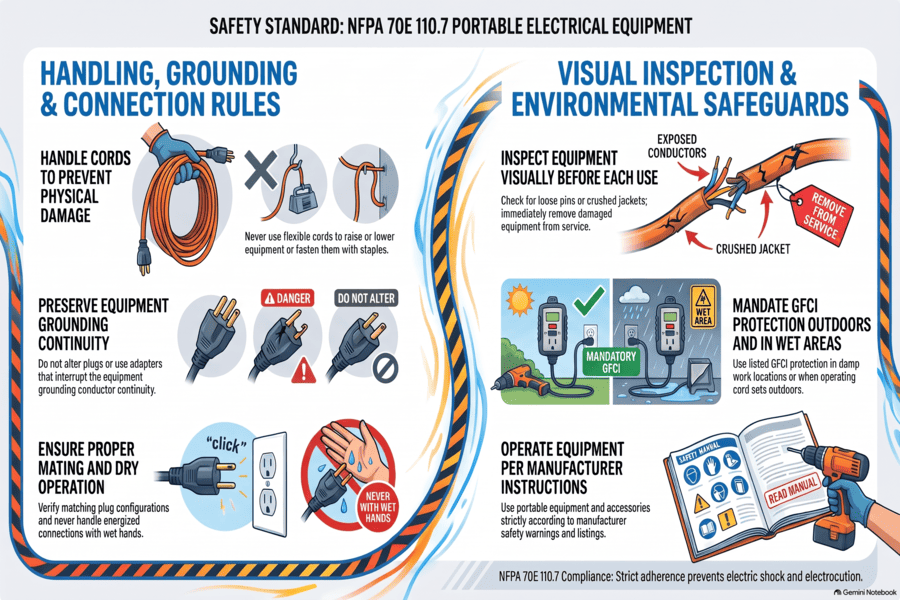
To prevent structural strain and internal wire breakage, safety rules strictly forbid utilizing flexible electric cords to raise, lower, support, or transport portable equipment. Cords must never be fastened with staples, hung with conductive wire, or suspended in any manner that could pinch, cut, or breach the outer insulation jacket. When temporary power is deployed, flexible cords and extension cables must be hard-usage or extra-hard-usage types, supported at regular intervals to protect them from physical damage. Furthermore, improper storage practices—such as leaving flexible cords loosely stowed on open utility trucks exposed to direct ultraviolet (UV) radiation and severe weather—cause rapid environmental degradation. Sun exposure breaks down synthetic cord jackets, inducing microscopic surface cracking, jacket embrittlement, and moisture intrusion.
Equipment grounding conductors (EGCs) inside flexible cords perform a vital protective function when supplying grounding-type utilization equipment. The EGC provides a low-impedance path back to the electrical source, ensuring that if an internal insulation breakdown energizes the metallic housing of a tool, high fault current flows immediately along the grounding path to trip the upstream overcurrent protective device. Unauthorized field modifications completely destroy this continuous protection loop. Clipping or removing an attachment plug’s grounding pin to force insertion into a two-slot receptacle, twisting or bending plug blades, and utilizing unauthorized field-fabricated adapters that interrupt grounding continuity are strictly prohibited practices. The sole exemption to the equipment grounding conductor requirement applies to tools protected by an approved system of double insulation. Double-insulated tools feature two distinct, non-conductive insulation barriers isolating internal live parts from user-accessible surfaces. Because no exterior metal components can become energized during a primary insulation fault, double-insulated tools do not require an equipment grounding conductor and must never be tied to supply grounding paths.
Prohibited Handling/Modification Practice | Corresponding Safety Hazards & Directives |
Raising, lowering, or supporting equipment by flexible cords | Mechanical Strain & Conductor Severance: Tensile stress pulls internal conductors out of terminal connections, strips mechanical strain relief fittings, and shears outer jackets. Directive: Equipment must always be carried by designated handles or hoisted using dedicated non-conductive rigging straps. |
Fastening cords with staples or hanging on sharp edges | Insulation Breach & Short Circuits: Metallic staples and sharp structural steel edges crush internal insulation, cut synthetic outer jackets, and cause arcing short circuits. Directive: Cords must be supported using smooth, non-conductive hangers or laid flat away from structural pinch points. |
Clipping plug grounding pins or twisting plug blades | Loss of Equipment Grounding Continuity: Removing the ground pin eliminates the low-impedance fault path, leaving tool frames energized upon an internal fault. Twisting blades defeats keying configurations. Directive: Plug configurations must remain unmodified. Plugs with damaged or missing pins must be removed from service immediately. |
Using adapters that interrupt grounding continuity | Ground Pathway Disruption: Ground-cheating adapters break the equipment grounding connection between the extension cord and the supply receptacle. Directive: Unauthorized field-fabricated or ground-interrupting adapters are strictly forbidden; proper matching grounding receptacles must be utilized. |
Routing flexible cords through doorways or pinch points without physical protection | Jacket Crushing & Severe Core Shearing: Closing doors, vehicle traffic, or sharp threshold pinch points crush outer jackets, sever internal insulation, and expose live conductors. Directive: Cords routed through doorways or openings must be physically protected using non-conductive blocking, door stops, or protective raceway sleeves. |
Preserving equipment design and physical handling integrity establishes a safe foundation, which must be verified through routine pre-use visual inspection protocols.
- Pre-Use Visual Inspection, Defective Equipment Protocol, and Mating Compatibility
Routine visual inspection conducted before every shift or use is vital for catching concealed or recent physical damage before equipment is energized. Portable tools and extension cords travel through dynamic work environments where crushed jackets, loose strain relief fittings, or bent plug pins can occur without warning. Relying solely on periodic or monthly safety audits is insufficient for portable equipment, as a cord damaged during an afternoon shift can present a fatal electrocution hazard to the operator on the following morning if energization occurs without prior inspection.
Non-stationary portable cord- and plug-connected equipment and extension cords must undergo a thorough pre-use visual inspection prior to each day’s use or prior to the start of each work shift. The visual inspection requires a systematic examination of the entire cord length, strain relief bushings, and attachment caps. Personnel must inspect for external defects, including loose or missing components, cracked tool housings, and deformed, loose, or missing plug pins and blades. Furthermore, workers must check for evidence of internal damage, such as pinched, flattened, or crushed outer jackets. A highly effective tactile field method involves passing the flexible cord through a gloved hand during visual examination to verify that the outer surface is smooth, continuous, and completely free of cuts, deep abrasions, or jacket separations.
An explicit exception to this mandatory pre-use inspection frequency exists for stationary cord-and-plug-connected equipment. Equipment that remains continuously plugged in once put in place—and is situated such that the supply cord and attachment plug are completely protected from physical damage during normal operations—does not require shift-by-shift visual inspections. However, this exception lapses immediately whenever the stationary equipment is relocated, serviced, or repaired, at which point a full visual inspection must be performed prior to re-energization.
+———————————————————————————–+
| DEFECTIVE EQUIPMENT PROTOCOL FLOW |
+———————————————————————————–+
| 1. IDENTIFY DEFECT –> External damage, crushed jacket, missing pin, or shock |
| + |
| v |
| 2. HALT USE –> Immediately cease operation & disconnect from source |
| + |
| v |
| 3. REMOVE SERVICE –> Quarantine equipment from active work areas |
| + |
| v |
| 4. APPLY TAG/LOCK –> Apply prominent “DANGER – DO NOT USE” Warning Tag/Lock |
| + |
| v |
| 5. QUALIFIED TEST –> Qualified personnel perform repairs & safety testing |
+———————————————————————————–+
When visual inspection reveals a defect, evidence of damage, or an indication of internal failure that could expose workers to electric shock or injury, a strict defective equipment protocol must be executed immediately:
- Cease Operation: The equipment or cord set must be shut down and disconnected from the power source instantly.
- Remove from Service: The defective item must be quarantined or physically segregated from active work areas to prevent accidental reuse.
- Apply Tag Out/Lockout: A prominent warning tag or label (e.g., “DANGER – DO NOT OPERATE”) must be attached directly to the cord or plug cap, clearly stating that the gear is defective.
- Qualified Testing & Repair: Defective gear must remain tagged out until a qualified person—possessing specific training and technical knowledge in electrical repairs and safety testing—renders the equipment safe and verifies its operational integrity through standardized testing.
In addition to physical integrity, operational readiness requires checking plug and receptacle mating configurations prior to connection. Personnel must inspect attachment plug caps and matching receptacles to verify that their contact configurations align correctly. Checking mating compatibility prevents forcing plugs into mismatched outlets, preserves designed circuit polarity, maintains correct system voltage separation, and ensures that the equipment grounding conductor mates securely before current-carrying phase contacts engage.
Verifying physical tool readiness and mating compatibility provides essential frontline defense, which must be paired with environmental controls when operating in high-risk locations.
- Special Safeguards for High-Risk Environments and Operational Controls
Conductive, damp, or wet work environments dramatically alter the electrical risk profile for portable equipment operators. When human skin becomes wet or drenched with conductive liquids, or when workers stand on wet soil, flooded concrete, or grounded metallic structures, human body electrical resistance drops dramatically. Under these low-resistance conditions, standard 120-volt AC circuits can drive lethal shock currents through the heart, and severe shock or electrocution can occur at voltage levels well below 50 volts.
+——————————————————————–+
| HIGH-RISK ENVIRONMENT SAFEGUARDS |
+——————————————————————–+
| |
| [Environmental Approval] –> Listed for damp/wet location use |
| + |
| v |
| [GFCI / AEGCP Protection] –> Mandatory 120V 15/20/30A GFCI; |
| >120V or >30A GFCI or AEGCP |
| + |
| v |
| [Hazard Substitution] –> Battery, Pneumatic, Hydraulic tools |
| (Hierarchy of Risk Controls) |
| + |
| v |
| [Operational Controls] –> Dry hands, Insulating PPE, Secured |
| Twist-Locking, Listing Rules |
+——————————————————————–+
Portable cord-and-plug-connected electrical equipment utilized in damp or wet work locations must be specifically approved and listed for environmental exposure in those locations. When construction, maintenance, or outdoor activities involve portable tools and extension cords supplied by 120-volt, 15-, 20-, or 30-ampere circuits, Ground-Fault Circuit-Interrupter (GFCI) protection for personnel is strictly mandatory. For supply circuits exceeding 120 volts or greater than 30 amperes, employers must implement either GFCI protection or an Assured Equipment Grounding Conductor Program (AEGCP)—a documented program involving periodic visual inspections and continuous grounding path testing.
All GFCI devices must be tested periodically in strict accordance with the manufacturer’s instructions (typically requiring a pre-use test button actuation) to verify internal sensing circuit functionality. Portable GFCI units designed for site setups must incorporate open-neutral protection. Standard panelboard Class A GFCI breakers rely on a solid upstream neutral connection to power their internal control electronics; if the supply neutral breaks upstream, a standard panelboard GFCI loses electronic control power and fails to trip during a ground fault. Listed portable GFCIs with open-neutral protection automatically de-energize the load side if the upstream neutral conductor breaks, eliminating ungrounded shock hazards.
During job safety planning, risk assessments should apply the Hierarchy of Risk Control Methods by prioritizing Substitution controls in high-risk locations. Substituting traditional 120-volt AC corded power tools with battery-powered units, pneumatic (compressed air) equipment, or hydraulic tools completely eliminates the 120V AC conductor path, removing electric shock hazards at the source.
When handling energized cord connections, strict operational safety rules must be enforced:
- Dry Hand Mandate: Employees’ hands must never be wet when plugging or unplugging flexible cords and cord-connected equipment.
- Insulating Protective Equipment: If a connection condition presents a conductive path to the worker’s hands—such as a cord cap or receptacle connector that has been submerged or drenched in liquid—the energized connection must be handled exclusively using rated insulating protective equipment (e.g., rubber insulating gloves).
- Securing Locking-Type Connectors: Mechanical locking connectors (such as twist-lock caps) must be fully inserted and rotated into their secured, locked position immediately following connection to prevent accidental disengagement, arcing, or strain on terminals.
- Adherence to Manufacturer Instructions: Portable equipment, extension cords, and protective devices must be operated strictly in accordance with manufacturer instructions, listed parameters, and safety warnings. Operating equipment outside listed parameters violates listing mandates and introduces unassessed risks into the workplace.