



What you’ll learn
After this post, you will be able to explain what grounding and bonding each do, why a grounded neutral protects a whole system, how the safety ground in an Edison system works on the day a fault happens, and why the quietest wires in the building are the ones that keep fault current away from people.
Two different jobs: ground and bond
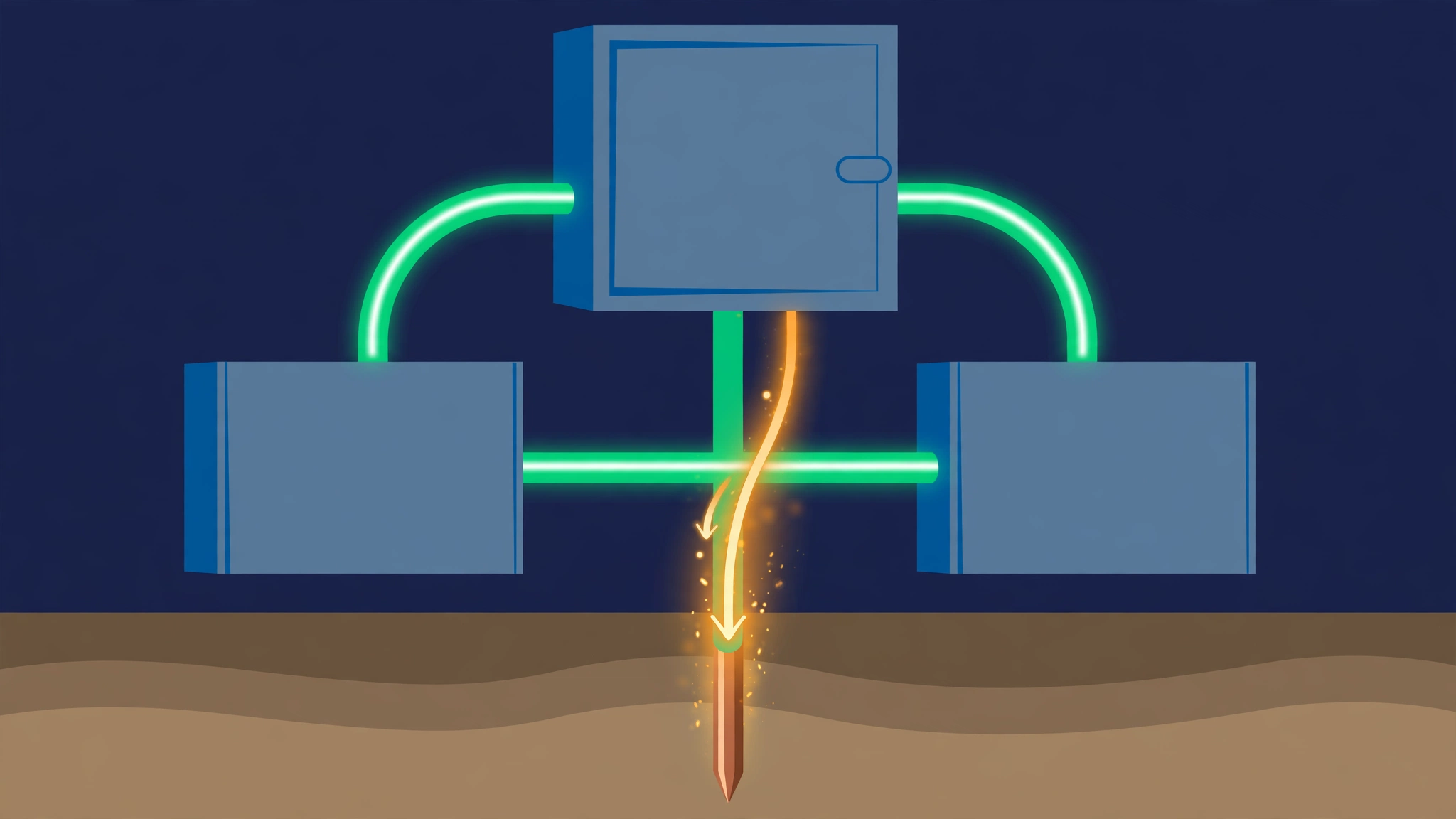
Grounding and bonding are spoken of together so often that they blur into one idea. The handbook keeps them separate, and the separation is the lesson. Ground is a conducting connection, intentional or accidental, between a circuit or equipment and the earth — a place of zero potential. Grounding connects the system to the earth itself: it gives the system a zero reference. A bond is the permanent joining of metallic parts or circuits, assuring electrical continuity and the capacity to safely conduct any likely current. Bonding connects the system’s metal parts to each other: it makes sure that if fault current appears anywhere, it has a continuous, low-resistance metallic path to follow — to the ground connection, and back to trip the protection. Ground is the destination; bonding is the road. A ground with no bonding leaves metal parts unconnected to it. Bonding with no ground leaves the road leading nowhere. You need both, and this post is the last in the series because everything before it — zones, breakers, wiring schemes — quietly assumes it.
Why the neutral is grounded at all
Start with the neutral grounding from Chapter 1 of this module. A neutral is a current-carrying conductor normally tied to ground so its electrical potential is zero. Why tie it down? Three threats, all named in the handbook: lightning, a primary-to-secondary breakdown inside a transformer, and contact between high-voltage and low-voltage lines. A grounded neutral answers all three. If lightning strikes or a high voltage finds its way onto the low-voltage side, the ground connection gives that energy a path to earth instead of letting it raise the whole low-voltage system to a dangerous potential. If a transformer’s primary breaks down into its secondary, the grounded neutral blows the primary fuses — the fault becomes a big, obvious overcurrent that the protection clears, instead of a silent energising of the low-voltage wiring at primary voltage. And grounding the neutral reduces the insulation the high-voltage lines themselves need, because their voltage to ground is pinned. The grounded neutral is the system’s anchor: it holds voltages where they belong and turns hidden faults into loud ones.
The Edison safety ground: doing nothing, until the day it matters
The Edison system shows the same idea at house scale. Its physical wiring is two insulated conductors plus one bare conductor. The current-carrying legs and neutral are insulated; the uninsulated conductor is the safety ground, bonded to the system ground point and to each junction box and device. In normal operation at 120 V, current goes supply leg → load → neutral, and the ground carries no current at all. It is not a return path; it is not part of the circuit. Its whole job happens on the day a fault occurs — a live conductor touches a metal case, a wire chafes through — when it carries the fault current safely to ground, hard enough and fast enough to trip the protection, while keeping the metal a person might touch at ground potential. Even in the 240 V arrangement, where on an unbalanced load or a fault the bare conductor does carry current, it stays at zero volts because it is tied to ground. A conductor that does nothing for years and then, in one bad second, carries the fault so a person does not: that is the safety ground.
Bonding across the schemes
The same pattern repeats in every scheme of the previous posts. In the Wye system, bonds are established between the grounded neutral and all system components — every piece of metal in the system is joined to the grounded neutral, so no component can float at a dangerous potential while its neighbour sits at zero. In corner-grounded Delta, the grounded phase acts like the Edison grounded neutral — carrying current, holding ground potential — and outdoors it can physically protect the other two phases from accidental grounding and lightning. And ungrounded Delta shows the idea by its absence: with no ground connection at all, every conductor sits at full phase voltage to ground, which is exactly why that scheme is confined to protected environments — fully enclosed ducts, overhead lines unreachable without extraordinary means. A three-phase system does not need a ground to operate; the handbook is explicit that all three- and four-wire systems can include an effective ground path for safety. Operating is not the point. Surviving a fault is.
This module gives no numeric worked example for grounding, so here is a walkthrough built from the chapter’s rules and flagged as such. A motor’s internal winding fails and touches its metal frame. In a bonded, grounded system, the frame is bonded to the safety ground, which is tied to the system ground point: the fault current rushes down the bond and the ground path, large and immediate, and the breaker or fuse clears the circuit in a fraction of a second — while the frame itself stays at or near zero volts, because it is tied to ground. A person touching that frame during the fault feels nothing; the current found the metallic path, not the person. Now remove the bond: the frame floats, energised at full voltage, silent and waiting. Nothing trips, because no fault current flows — until a person touches the frame and becomes the path to ground. Same fault, same motor. The difference is a bare conductor and a set of bonds that did nothing at all until the second they did everything.
Common mistakes
- “Grounding and bonding are the same thing.” They are not: ground connects the system to the earth, a place of zero potential; a bond permanently joins metallic parts, assuring continuity and the capacity to safely conduct any likely current. Destination and road.
- “The safety ground is a return path for load current.” In the Edison system at 120 V the ground carries no current unless a fault occurs. Normal return current goes through the neutral.
- “Grounding the neutral is optional decoration.” It answers lightning, primary-to-secondary breakdown, and high/low-voltage contact: it blows the primary fuses on a breakdown and reduces the insulation high-voltage lines need.
- “Bonding one device is enough.” In the Wye system, bonds are established between the grounded neutral and all system components — every device and junction box in the Edison system is bonded too. A single unbonded part is the one that can float at a dangerous potential.
- “An ungrounded system is just as safe — it runs fine.” Ungrounded Delta runs fine and is still confined to protected environments, because each conductor’s ground voltage equals the full phase voltage. Operating is not the same as surviving a fault.
- “If nothing trips, there is no fault.” An unbonded faulted frame draws no fault current and trips nothing — it waits, energised, for a person to become the path. Silence is not safety.
- “The bare conductor staying at zero volts while carrying fault current is a contradiction.” It is the point: because it is tied to ground, even when it carries current on an unbalanced load or a fault, it stays at zero volts.
Summary
Ground connects a system to the earth, a place of zero potential; bonding permanently joins its metallic parts so fault current always has a continuous path to that ground. The grounded neutral anchors the whole system — against lightning, against a primary breaking down into a secondary (blowing the primary fuses instead of silently energising low-voltage wiring), and against high-voltage contact. The Edison safety ground and the Wye bonds to every component are the same idea at different scales: conductors that carry nothing in normal operation, hold everything at zero potential, and on the day of a fault carry the current safely to ground so it never has to find its way through a person. That is the quiet system underneath every post in this series — and the right place for the series to end.
Quick-check questions
- What is the difference between ground and a bond?
- Why is the neutral grounded — what three threats does it answer?
- What does the Edison safety ground do in normal operation, and on a fault?
- How does bonding show up in the Wye system?
- Why is ungrounded Delta confined to protected environments?
Answers
- Ground is a conducting connection between a circuit/equipment and the earth, a place of zero potential — the destination. A bond is the permanent joining of metallic parts/circuits, assuring electrical continuity and the capacity to safely conduct any likely current — the road.
- Lightning, primary-to-secondary breakdown, and contact between high-voltage and low-voltage lines. A grounded neutral gives fault energy a path to earth, blows the primary fuses on a breakdown, and reduces the insulation high-voltage lines need.
- In normal 120 V operation it carries no current — return current goes through the neutral. On a fault it carries fault current safely to ground, tripping the protection while keeping touched metal at ground potential.
- Bonds are established between the grounded neutral and all system components, so no component can float at a dangerous potential.
- With no ground connection, each conductor’s ground voltage equals the full phase voltage — so it is confined to fully enclosed ducts and overhead lines unreachable without extraordinary means.
Based on DOE-HDBK-1011/92, Electrical Science, Module 15, paraphrased for study.

Report a question

Top 10 Scorers
| Pos. | Name | Score | Duration |
|---|---|---|---|
| There is no data yet |

What is ground?
What is a bond?
What is ground voltage?
Why is the neutral grounded? Name the threats it answers.
What does a grounded neutral do when a transformer's primary breaks down into its secondary?
In the Edison system, what does the bare conductor do in normal 120 V operation?
In the Edison system, what does the safety ground do on a fault?
How does bonding show up in the Wye system?
Why is ungrounded Delta confined to protected environments?
A motor winding fails and touches its metal frame. What happens in a bonded, grounded system — and without the bond?
