



What You’ll Learn
- Why every cell on an electrolytic cell line is a battery — and why it cannot be de-energized without removing its electrolyte
- Why establishing an electrically safe work condition is not, by itself, a viable way to avoid injury on a cell line
- Why the Table 130.4(E) approach distances do not apply to qualified persons working in the cell line working zone
- What must happen to battery-effect voltage before a cell line may be considered de-energized
- Why permanent signs must designate electrolytic cell areas
A Series of Batteries That Cannot Be Switched Off
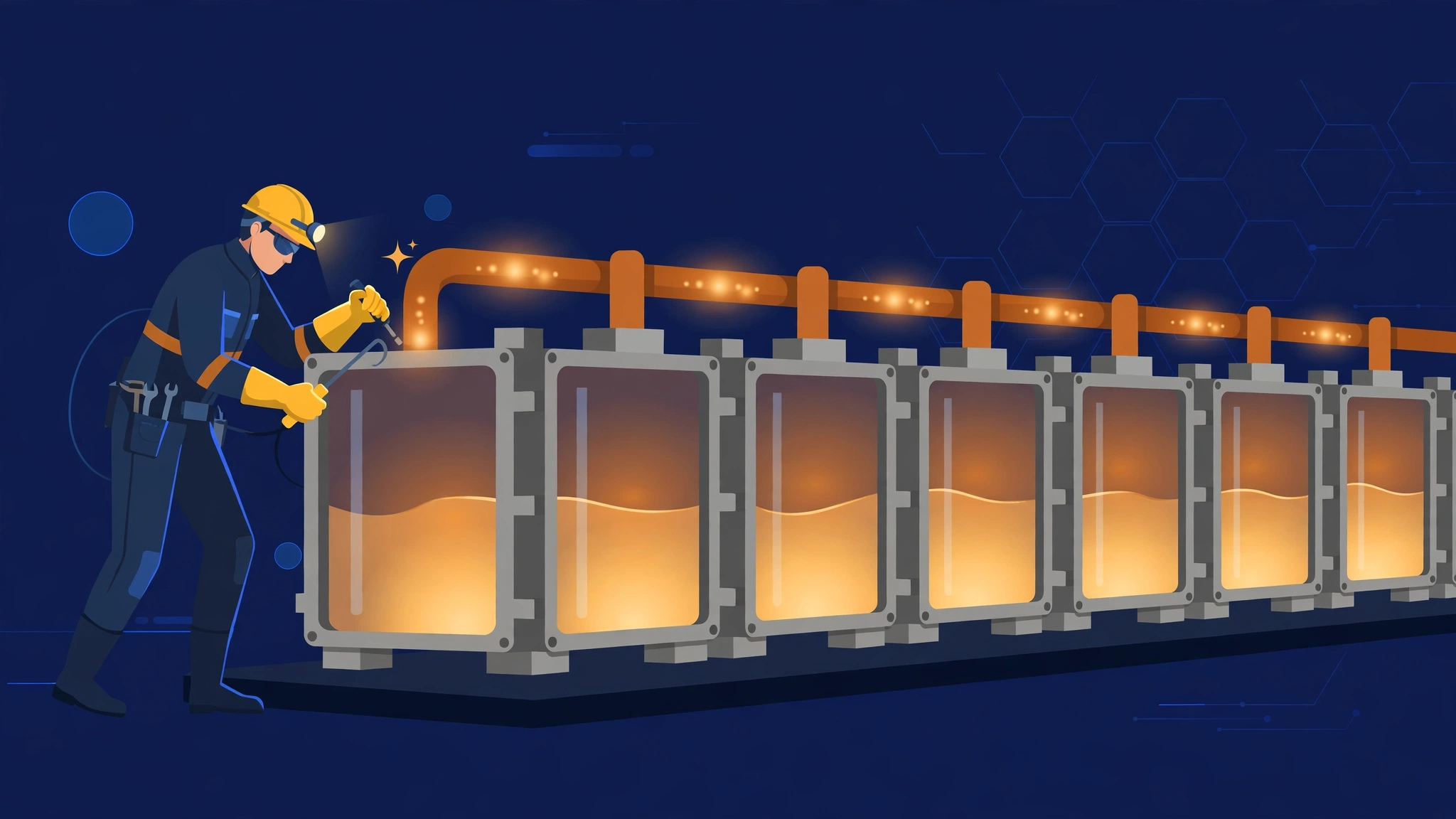
An electrolytic cell line is a series of individual cells connected electrically, carrying a significant amount of direct current, and operated ungrounded. Section 310.1 gives Article 310 its scope: its requirements apply to the electrical safety-related work practices used in electrolytic cell areas. The defining fact about these installations is stated plainly in the standard’s guidance: working on an electrolytic cell line is always considered energized electrical work. Each individual cell of the line is a battery — a self-contained source of electrical energy — and it cannot be de-energized without removing the electrolyte in the vessel. There is no disconnect that makes a cell stop being a battery. (For the surrounding references, the article points readers to Informative Annex L for a typical application of safeguards in the cell line working zone, to Article 668 of NFPA 70 for electrolytic cell information, and to IEEE 463 for cell line working zone practices.)
No Electrically Safe Work Condition to Hide Behind
Because the cells stay energized, an electrically safe work condition is not viable here — the standard’s guidance is explicit that establishing one is not, by itself, a viable method of avoiding injury in this scenario. That single fact reshapes the whole safety strategy. The Chapter 1 sequence — isolate, lock out, verify absence of voltage, then work unprotected — cannot be completed on a live cell line. Operation and maintenance of these lines might require employees to contact exposed energized surfaces such as buses, electrolytic cells, and their attachments. Protection therefore has to come from safeguards rather than from de-energization, and the Worker Alert behind the rule underlines the consequence: because workers cannot establish an electrically safe work condition and must rely on work procedures for their safety, cell line work demands a greater personal responsibility to work without human error.
Safeguards Matched to the Hazard
Section 310.5(A) sets the general safeguarding rule: safeguards shall protect employees in the cell line working zone, and they shall be consistent with the nature and extent of the related electrical hazards. Safety-related work practices and other safeguards are the protective system here. The rule also recognizes that one fixed safeguard set cannot fit every condition — safeguards might be different for energized cell lines and for de-energized cell lines. The employer’s electrical safety program carries the implementation: it addresses the Chapter 1 issues, but the work practices are modified as necessary to recognize the different types of exposure on a cell line, and it must define concrete actions — for example, exactly what an employee must do when a task requires contacting a dc bus structure. Those procedures must be consistent with the risk associated with the work task.
The Approach Tables Stay Outside the Zone
One of the most consequential modifications in the article concerns approach distances: the Table 130.4(E) approach distances do not apply in the cell line working zone — specifically, the approach distances in Table 130.4(E)(a) and Table 130.4(E)(b) shall not apply to work performed by qualified persons in that zone. The limited and restricted approach boundary system that governs ordinary energized work is set aside inside the zone, because the work itself may require contact with exposed energized surfaces. In its place, the cell line working zone itself must be defined: it functions as the limit of approach for unqualified persons, who may cross into it only when they have a need and only after being informed of the electrical hazards. Workers should also know the geography can surprise them — an employee might cross the arc flash boundary before entering the cell line working zone.
“De-Energized” Has a Condition Attached
Even when a cell line is taken out of production, the word “de-energized” is not free. Section 310.5(A) requires that hazardous battery-effect voltages shall be dissipated before a cell line is considered de-energized. A cell line that has been shut down can retain hazardous voltage from the battery effect of its cells — the same chemistry that makes each cell a battery does not vanish the moment the line stops producing. Until that residual voltage is dissipated, treating the line as dead repeats the exact error this article exists to prevent: assuming a switch position or a stopped process means the energy is gone. Safeguards for a de-energized line are still safeguards, and they are chosen for the hazards that remain, not the hazards that were switched off.
Signs That Never Come Down
Section 310.5(B) adds the article’s simplest rule: permanent signs shall clearly designate electrolytic cell areas. The permanence matters. A cell area’s hazard is not temporary — the cells are energized whenever electrolyte is in the vessels, which is effectively always — so the warning cannot be a tag hung for one job or a note in a briefing packet. A permanent sign tells every person approaching the area, including people with no cell line training and no reason to know the process, that they are entering a designated electrolytic cell area with its own rules, before they reach the zone itself.
Worked Scenario
A cell line crew is assigned to inspect and clean bus connections along an operating electrolytic cell line. The job planner’s first draft borrows the plant’s standard energized-work package, complete with limited and restricted approach distances measured from the tables. The designated qualified person in charge stops the review there: inside the cell line working zone, the Table 130.4(E)(a) and (b) approach distances do not apply to qualified persons, and no electrically safe work condition can be established on a line whose cells are still full of electrolyte — the work is energized work, planned as energized work. The package is rebuilt around safeguards matched to the actual hazards: the defined working zone, the program’s procedures for contacting dc bus structures, and the protective measures the risk requires. Later in the week, a second crew prepares to work on a section of line that has been taken out of service. Before anyone treats it as de-energized, the battery-effect voltage is dissipated and verified gone — only then is the section considered de-energized, with safeguards chosen for that condition. At the area entrance, the permanent sign designating the electrolytic cell area is what stops a visiting contractor from wandering in unbriefed.
Common Mistakes and Safety Notes
- Planning cell line work as ordinary de-energized work. Each cell is a battery; without removing the electrolyte, there is no electrically safe work condition to establish.
- Measuring limited and restricted approach distances inside the zone. The Table 130.4(E)(a) and (b) approach distances do not apply to qualified persons working in the cell line working zone.
- Assuming a stopped line is a dead line. Hazardous battery-effect voltages must be dissipated before a cell line is considered de-energized.
- Using one safeguard set for every condition. Safeguards must match the nature and extent of the hazards, and they may differ between energized and de-energized cell lines.
- Relying on temporary warnings for a permanent hazard. Cell areas are designated by permanent signs — the hazard does not come and go with the job.
- Forgetting the zone is the unqualified boundary. The cell line working zone must be defined; unqualified persons enter only with a need and after being informed of the hazards.
Summary
Article 310 begins from a fact that overturns normal electrical safety logic: an electrolytic cell line cannot be turned off. Each cell is a battery that stays energized unless its electrolyte is removed, so working on the line is always energized work, and an electrically safe work condition is not, by itself, a viable method of avoiding injury. Under 310.5(A), protection comes from safeguards — work practices and other measures consistent with the nature and extent of the hazards, differing as needed between energized and de-energized lines — and the Table 130.4(E)(a) and (b) approach distances do not apply to qualified persons in the cell line working zone. A line is considered de-energized only after hazardous battery-effect voltages are dissipated. Under 310.5(B), permanent signs clearly designate the cell areas, marking the hazard that never leaves.
Quick-Check Questions
- Why is cell line work always considered energized electrical work?
Answer: Each individual cell is a battery and cannot be de-energized without removing the electrolyte in the vessel, so the line’s energy source cannot be switched off. - Why can’t the crew simply establish an electrically safe work condition and work as usual?
Answer: Establishing an electrically safe work condition is not, by itself, a viable method of avoiding injury on a cell line, because the cells remain energized; protection must come from safeguards instead. - Do the Table 130.4(E) approach distances apply inside the cell line working zone?
Answer: No — the approach distances in Table 130.4(E)(a) and (b) shall not apply to work performed by qualified persons in the cell line working zone. - What must happen before a cell line is considered de-energized?
Answer: Hazardous battery-effect voltages shall be dissipated. - What does 310.5(B) require, and why must it be permanent?
Answer: Permanent signs shall clearly designate electrolytic cell areas — permanent because the cells are energized whenever electrolyte is in the vessels, so the hazard is continuous.
Based on NFPA 70E (2024), Article 310, paraphrased for study.
Quiz for this module is being prepared.
Flashcards for this module are being prepared.
