



What You’ll Learn
- Why electrolytic cell line work is different: a dc process area where the equipment cannot simply be de-energized
- The hazard in the annex’s example — an employee’s hands on an energized cell while standing on a grounded metal floor
- The seven typical safeguards Annex L lists, from insulating boots and gloves to voltage equalization and temporary bonding
- Why a safeguard can be defeated by how the work is done — the long reach that bypasses a pair of boots
- What Annex L says about power receptacles in the cell line area — and why it prefers pneumatic tools there
A Process Area That Stays Energized
Most of NFPA 70E is built around one preferred outcome: put the equipment in an electrically safe work condition, then work. The cell line working zone is the exception that proves the rule. Electrolytic cell lines — the rows of cells used in processes such as metal refining and chemical production — form a dc electrical system that cannot be de-energized for the routine adjustments and repairs the work demands. Informative Annex L addresses exactly that situation: it discusses and illustrates the application of typical safeguards in a process area associated with a dc system that cannot be turned off. The safeguards are not a substitute for de-energizing where de-energizing is possible; they are the annex’s answer for the area where it is not.
The Hazard in the Example
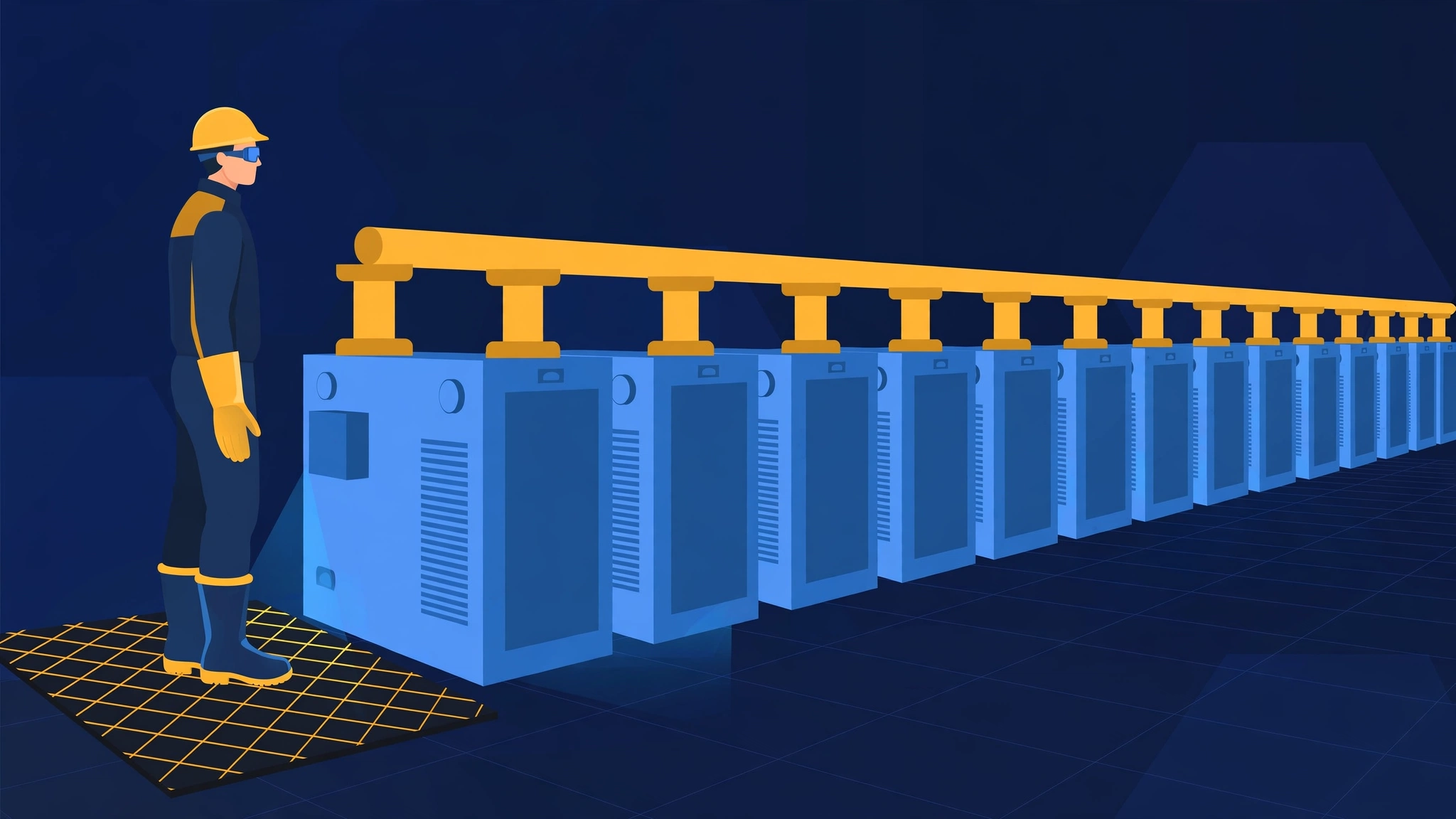
The annex’s example is deliberately ordinary. An employee working on an energized cell uses manual contact — his or her own hands — to make adjustments and repairs. The cell the employee is touching is energized, and the floor under the employee’s feet is grounded metal. That combination is the hazard: a conductive path can exist from the energized cell, through the employee’s body, to the grounded floor. Every safeguard that follows attacks that path at a different point — at the feet, at the hands, at the surface the employee stands on, in the way the work is performed, or by removing the voltage difference itself.
Safeguard 1: Protective Boots
Protective boots isolate the employee’s feet from the floor. If the current path needs the grounded floor to complete itself, breaking the path at the feet breaks the hazard: the employee can touch the energized cell without becoming the conductor between the cell and ground. Boots are the first safeguard listed because the floor is half of the hazardous combination in the example.
Safeguard 2: Protective Gloves
Protective gloves work at the other end of the path: they isolate the employee’s hands from the energized cell. Where boots interrupt the circuit at the floor, gloves interrupt it at the point of contact itself. For work done by manual contact — which is the work the annex describes — glove protection addresses the exact surface the employee is touching.
Safeguard 3: Both Together, When the Work Destroys PPE
The third safeguard is a combination with a condition attached. If the work task causes severe deterioration, wear, or damage to PPE, the employee might have to wear both protective gloves and protective boots. The reasoning is practical: a safeguard that is being worn away by the work can fail without announcing itself, and cell line work can be hard on equipment. Where one layer of isolation is being degraded by the task itself, isolation at both ends of the path gives the employee protection that does not depend on a single, deteriorating barrier.
Safeguard 4: An Insulating Surface to Stand On
Instead of insulating the employee, the fourth safeguard insulates the standing surface: a permanent or temporary insulating surface can be provided for the employee to stand on. The effect is the same as the boots — the path to the grounded floor is interrupted — but the protection is built into the workplace rather than worn, so it does not depend on the condition of a garment and it protects whoever stands there.
Safeguard 5: A Bonded Conductive Surface — Voltage Equalization
The fifth safeguard takes the opposite approach, and it is the cleverest of the seven. Instead of insulating the employee from the floor, the design of the installation can be modified to provide a conductive surface for the employee to stand on — and if that conductive surface is bonded to the cell, the safeguard works by voltage equalization. If the surface under the employee’s feet is at the same voltage as the cell the employee is touching, there is no voltage difference across the employee’s body to drive current through it. Insulation protects by blocking the path; equalization protects by removing the reason current would flow at all.
Safeguard 6: Safe Work Practices — and Training
Equipment is only part of the list. Safe work practices can themselves provide safeguards, and the annex gives the example that ties the whole list together: if protective boots are worn, the employee should not make long reaches over energized or grounded surfaces in a way that lets an elbow bypass the safeguard. Boots protect the path through the feet; an elbow resting on a grounded surface opens a new path the boots never covered. If such movements are required, protective sleeves, protective mats, or special tools should be used instead. And the annex closes the point broadly: training on the nature of electrical hazards and on the proper use and condition of safeguards is, in itself, a safeguard — because every other item on this list only works when the employee understands what it is doing and what defeats it.
Safeguard 7: Temporarily Bond the Cell to Ground
The seventh safeguard removes the hazard at the source for the duration of the work: the energized cell can be temporarily bonded to ground. Bonding the cell to ground brings the cell itself toward ground potential, collapsing the voltage difference between the cell the employee touches and the floor the employee stands on. It is the installation-level counterpart to the voltage equalization idea in the fifth safeguard — change the voltages, and the hazard the other safeguards manage is reduced before the work begins.
Power Receptacles in the Cell Line Area
Annex L closes with a short section on electrical power receptacles. Power supply circuits and receptacles in the cell line area, provided for portable electric equipment, should meet the requirements of 668.21 of NFPA 70, National Electrical Code. But the annex’s own recommendation goes further than compliance: it is recommended that receptacles for portable electric equipment not be installed in electrolytic cell areas at all, and that only pneumatic-powered portable tools and equipment be used. The logic matches the rest of the annex — in an area built around an energized dc system and grounded surfaces, the safest portable electric tool is the one that was never plugged in, and air-powered tools remove that exposure entirely.
Worked Scenario
An operator on an electrolytic cell line must adjust connections on an energized cell, working by hand while standing on the plant’s grounded metal floor — the annex’s example, on a real shift. The safeguards are layered deliberately. She wears protective boots, isolating her feet from the floor, and protective gloves, isolating her hands from the cell — both, because the abrasive work in this area is known to wear PPE hard. A temporary insulating mat is placed where she will stand for the longest part of the task. Her supervisor reviews the movements the job requires and flags one long reach across the cell that would put her elbow over a grounded surface; a protective sleeve is added for that step, and the reach is re-planned so her body never bridges the cell and the floor at two unprotected points. Before the next bay is worked, maintenance temporarily bonds that cell to ground while a longer repair is done. In the corner of the area there is no receptacle for her portable tools — by design. The grinder she uses is pneumatic, as Annex L recommends.
Common Mistakes and Safety Notes
- Assuming one safeguard is the safeguard. The annex lists seven typical safeguards, and its own examples combine them — gloves and boots when the work damages PPE, practices layered over equipment.
- Defeating boots with an elbow. A long reach that puts an elbow on an energized or grounded surface bypasses the protection at the feet. Sleeves, mats, or special tools are the annex’s answer when such movements are required.
- Treating training as paperwork. Annex L names training on the hazards and on the use and condition of safeguards as itself a safeguard.
- Forgetting the equalization option. A conductive standing surface bonded to the cell protects by voltage equalization — safety through removing the voltage difference, not blocking it.
- Bringing corded tools into the cell line. Annex L recommends against receptacles for portable electric equipment in electrolytic cell areas and recommends pneumatic tools instead.
Summary
Informative Annex L shows how safeguards are typically applied in the cell line working zone, where a dc system cannot be de-energized and an employee works by hand on an energized cell while standing on a grounded metal floor. Its seven safeguards are: protective boots isolating the feet from the floor; protective gloves isolating the hands from the cell; both together where the work severely deteriorates PPE; a permanent or temporary insulating standing surface; a conductive standing surface bonded to the cell, protecting by voltage equalization; safe work practices — including never letting a reach bypass a safeguard — together with training, which is itself a safeguard; and temporarily bonding the energized cell to ground. For portable equipment, the annex points to the receptacle requirements of NFPA 70 §668.21 but recommends going further: no receptacles for portable electric equipment in cell areas, and pneumatic tools only.
Quick-Check Questions
1. In the annex’s example, what two things combine to create the electrical hazard?
Answer: The employee’s manual contact with the exposed energized cell, and the grounded metal floor the employee stands on — together they can put the employee’s body in a conductive path.
2. How does a conductive standing surface bonded to the cell protect the employee?
Answer: By voltage equalization — the surface is at the same voltage as the cell, so there is no voltage difference across the employee’s body to drive current through it.
3. When might an employee need to wear both protective gloves and protective boots?
Answer: When the work task causes severe deterioration, wear, or damage to the PPE — one deteriorating barrier is backed up by isolation at the other end of the path.
4. How can a worker wearing protective boots defeat their protection?
Answer: By making a long reach over an energized or grounded surface so an elbow bypasses the safeguard — the fix is protective sleeves, protective mats, or special tools when such movements are required.
5. What does Annex L recommend about receptacles and portable tools in electrolytic cell areas?
Answer: Receptacles for portable electric equipment should meet NFPA 70 §668.21, but the annex recommends not installing them in cell areas at all and using only pneumatic-powered portable tools and equipment.
Based on NFPA 70E (2024), Informative Annex L, paraphrased for study.
Video lesson for this module is in production — coming soon.
Quiz for this module is being prepared.
Flashcards for this module are being prepared.
