



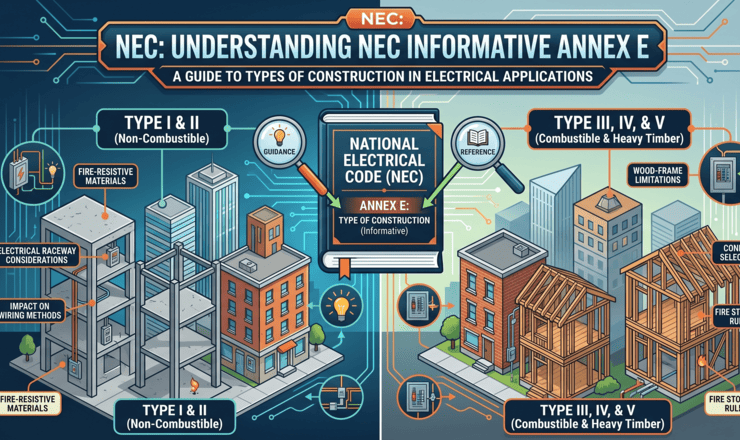
Understanding NEC Informative Annex E: A Guide to Types of Construction
When studying the National Electrical Code (NEC), most electricians focus intensely on the first nine chapters. While this is entirely appropriate for mastering installation rules and calculations, the back of the codebook holds a wealth of critical information that often gets overlooked. For anyone preparing for their electrical exams or working on commercial projects, Understanding NEC Informative Annex E is an absolute must. This specific annex bridges the gap between electrical installation requirements and general building construction standards, ensuring that electrical systems do not compromise a building’s structural fire resistance.
What Does Annex E Cover?
To put it simply, Understanding NEC Informative Annex E is all about learning the different “Types of Construction.” The NEC doesn’t invent these construction types; instead, this annex extracts its information directly from NFPA 220, the Standard on Types of Building Construction.
As an electrician, you might wonder why you need to care about building construction. The answer lies in how wiring methods interact with building materials. The NEC strictly dictates which types of cables and raceways can be installed in specific buildings based on how those buildings are constructed. If a building is designed to be highly fire-resistant, the electrical wiring run through its walls and ceilings must not undermine that safety rating. Therefore, Understanding NEC Informative Annex E gives you the foundational knowledge to know exactly why a particular wiring method is approved or rejected by the Authority Having Jurisdiction (AHJ).
The Five Types of Construction
To fully grasp the implications of this annex, you need to understand the five primary construction types it details. Building types range from the most fire-resistive to the most combustible.
Type I and Type II: Noncombustible Construction
Type I and Type II buildings are constructed almost entirely of noncombustible materials, such as steel, iron, concrete, and masonry.
-
Type I buildings are the most strictly regulated and heavily fireproofed. Think of high-rise skyscrapers, hospitals, and large commercial centers. The structural elements are designed to withstand high temperatures for extended periods without collapsing.
-
Type II buildings are also made of noncombustible materials, but their structural elements do not have the same rigorous fire-resistance ratings as Type I. Many modern strip malls and standard commercial warehouses fall into this category.
Type III, IV, and V: Combustible Construction
These buildings incorporate combustible materials, primarily wood, into their structural framework.
-
Type III construction, often called “ordinary construction,” features noncombustible exterior walls (like brick or masonry) but allows for wood or other combustible materials in the interior structural framework and roof. Historic downtown buildings often fit this description.
-
Type IV is “Heavy Timber” construction. It utilizes large, thick wooden beams and columns. Because thick timber chars on the outside but maintains its structural integrity for a surprisingly long time during a fire, this type has its own specific classification and fire rating.
-
Type V is standard wood-frame construction. Both the exterior walls and interior framing are made of combustible materials. The vast majority of single-family residential homes and small multi-family dwellings are Type V construction.
Why This Matters for Your Wiring Methods
The real value in Understanding NEC Informative Annex E comes when you cross-reference it with Chapter 3 of the NEC, which covers wiring methods.
The most common example is the use of Nonmetallic-Sheathed Cable (Type NM, commonly known as Romex). If you look at NEC Article 334, you will see that Type NM cable is generally permitted in Type III, IV, and V construction, provided it is concealed within walls, floors, or ceilings with a specific thermal barrier. However, Type NM cable is strictly prohibited as a general wiring method in Type I and Type II construction (with very few, highly specific exceptions).
If you don’t know the difference between a Type II and a Type V building, you might accidentally bid a commercial job planning to use NM cable, only to have the electrical inspector issue a massive red tag. You would then be forced to tear out the wiring and replace it with a compliant method, such as Metal-Clad (MC) cable or Electrical Metallic Tubing (EMT).
Conclusion
Passing your electrical exam and excelling in the field requires more than just memorizing ampacity charts; it requires a holistic view of how electrical systems integrate into the built environment. Understanding NEC Informative Annex E provides that crucial context. By familiarizing yourself with the five types of construction laid out in this annex, you protect the fire integrity of the buildings you wire, ensure your installations pass inspection the first time, and elevate your status as a knowledgeable, professional electrician.
Internal Link
