



What you’ll learn
After this post, you will be able to describe the difference between electron flow and conventional current flow, and, given a circuit showing current flow, identify the polarity of voltage drops.
A two-page chapter that saves you from sign errors
This is the shortest chapter in Module 2 — two pages — and it exists for one reason: to fix the sign convention before the multi-loop analysis in the next two chapters. Get polarity backwards and your meters connect backwards, and your Kirchhoff signs go wrong. Memorise this chapter and the next chapters’ plus-and-minus bookkeeping works.
Electron flow vs. conventional current
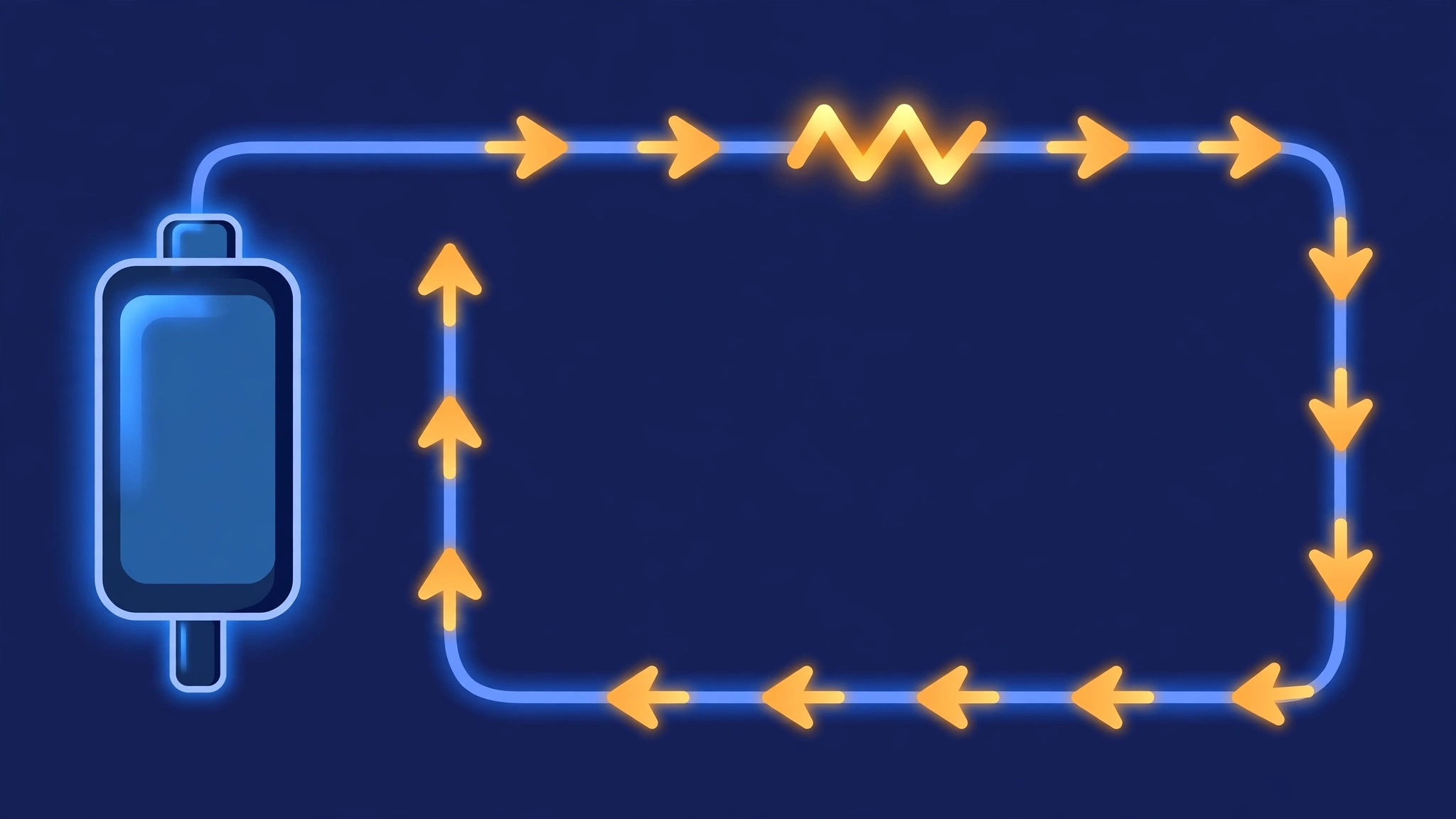
Electron flow runs from negative potential to positive potential: electrons leave the negative terminal of a source and return to the positive terminal. Conventional current, the older convention, runs opposite: from positive to negative. The handbook uses electron flow throughout. Every arrow in a schematic in this module shows electron flow, unless a passage says otherwise; the arrows along a conductor point in the direction electrons actually move.
The polarity rule for voltage drops
All voltages and currents have polarity as well as magnitude. The handbook’s rule, using electron flow, is: the end of a load where current enters is negative, and the end where current leaves is positive. Take a resistor carrying current from left to right: its left end, where electrons enter, is negative, and its right end is positive. Voltage drops across loads are therefore marked with the negative sign at the entry end and the positive sign at the exit end. The source does the opposite: its positive terminal is the one electrons return to, and its negative terminal is the one they leave.
Why this matters for the next chapters
Kirchhoff’s voltage law is a sum of signed voltages around a loop. If you mark a drop with the wrong sign, the sum does not add to zero, and your answer is wrong even if your magnitudes are right. This handbook’s electron-flow convention gives you one consistent rule: in a source, the positive terminal supplies current; in a load, the positive end is the exit. Remember it, and your loop equations will add up.
Common mistakes
- “Current flows from positive to negative.” That is conventional current. This handbook uses electron flow — from negative to positive.
- “The end where current enters a load is positive.” It is negative, by the polarity rule. Electrons enter at the negative end of an energy-consuming component.
- “Polarity does not matter as long as the magnitudes are right.” It does. Kirchhoff’s laws are sums with signs, and a flipped sign breaks the total.
- “Load drops add to the source voltage.” They oppose it. Each load uses energy, leaving less voltage available, so the total adds to zero.
Summary
Electrons flow negative to positive; conventional current points the other way, and this handbook uses electron flow. If you know a circuit’s current direction, the polarity rule tells you which end of a load is positive and which is negative. Get the signs right now and Kirchhoff’s laws will work; invert them and your signs will fail.
Quick-check questions
- Which way does electron flow run?
- Which way does conventional current flow?
- Where electron current enters a load, is the voltage positive or negative?
- Do load voltage drops add to or oppose the source voltage?
- Why does polarity matter for Kirchhoff’s laws?
Answers: 1. From negative potential to positive potential. 2. From positive to negative — the opposite direction. 3. Negative — electrons supply the negative charge to that end, with the positive charge taking the exit end. 4. They oppose it. The net of source voltage plus load drops around a loop is zero, and the load voltages fall in the opposite direction to the source. 5. Kirchhoff’s laws are sums with signs. If you get a sign wrong, the loop total does not add to zero and your answer is wrong even if the numbers are right.
Based on DOE-HDBK-1011/92, Electrical Science, Module 2, paraphrased for study.

Report a question

Top 10 Scorers
| Pos. | Name | Score | Duration |
|---|---|---|---|
| There is no data yet |

Which way does electron flow run?
Which way does conventional current flow?
In a series circuit, where does the single current run?
Where electron current enters a load, what is the voltage polarity?
Do load voltage drops add to or oppose the source voltage?
What does "polarity" mean for a voltage or current?
Which convention does this handbook use?
If you mark a voltage drop with the wrong sign in a Kirchhoff calculation, what happens?
In electron flow, which terminal do electrons leave the source from?
Why does each load in a series circuit leave less voltage for the remaining loads?
