



What you’ll learn
After this post, you will be able to explain what a motor controller does, how manual and magnetic controllers differ, what the three overload devices are, and — the real question — what LVP, LVR, and LVRE each do when the voltage dips and comes back, and which one to choose for which motor.
A controller controls — and protects
A controller is a device that starts and stops a motor and can also reverse it, speed it up, slow it down, and protect the motor from overloads and faults. It does two jobs at once: control and protection. Control is the start, stop, and direction. Protection is the overloads — the devices that open the circuit when the motor draws too much current for too long. Two kinds of controller cover the field. The manual controller starts and stops a motor by hand — you physically move a switch to ON or OFF. The magnetic controller uses a contactor and a master switch, which makes remote or automatic operation possible: the master switch commands the contactor, and the contactor does the heavy switching. Manual is simple and direct; magnetic is what you need when the motor is far away, or when starting and stopping must happen automatically.
Overloads: three ways to stop a motor drawing too much
Before the voltage question, the overload question. Three overload devices are commonly used: fuses, thermal overloads, and magnetic overloads. A fuse melts on overcurrent and must be replaced. A thermal overload uses a bimetallic element that bends on sustained overcurrent and trips the circuit — inverse-time, like the thermal trip in a breaker. A magnetic overload uses the magnetic force of the current to trip fast on short circuits. Whichever type, the overloads sit in the controller so that a motor working too hard gets disconnected before it burns. Overloads protect the motor; the low-voltage question is about what happens after the voltage itself fails.
The voltage dip: three answers, three letters
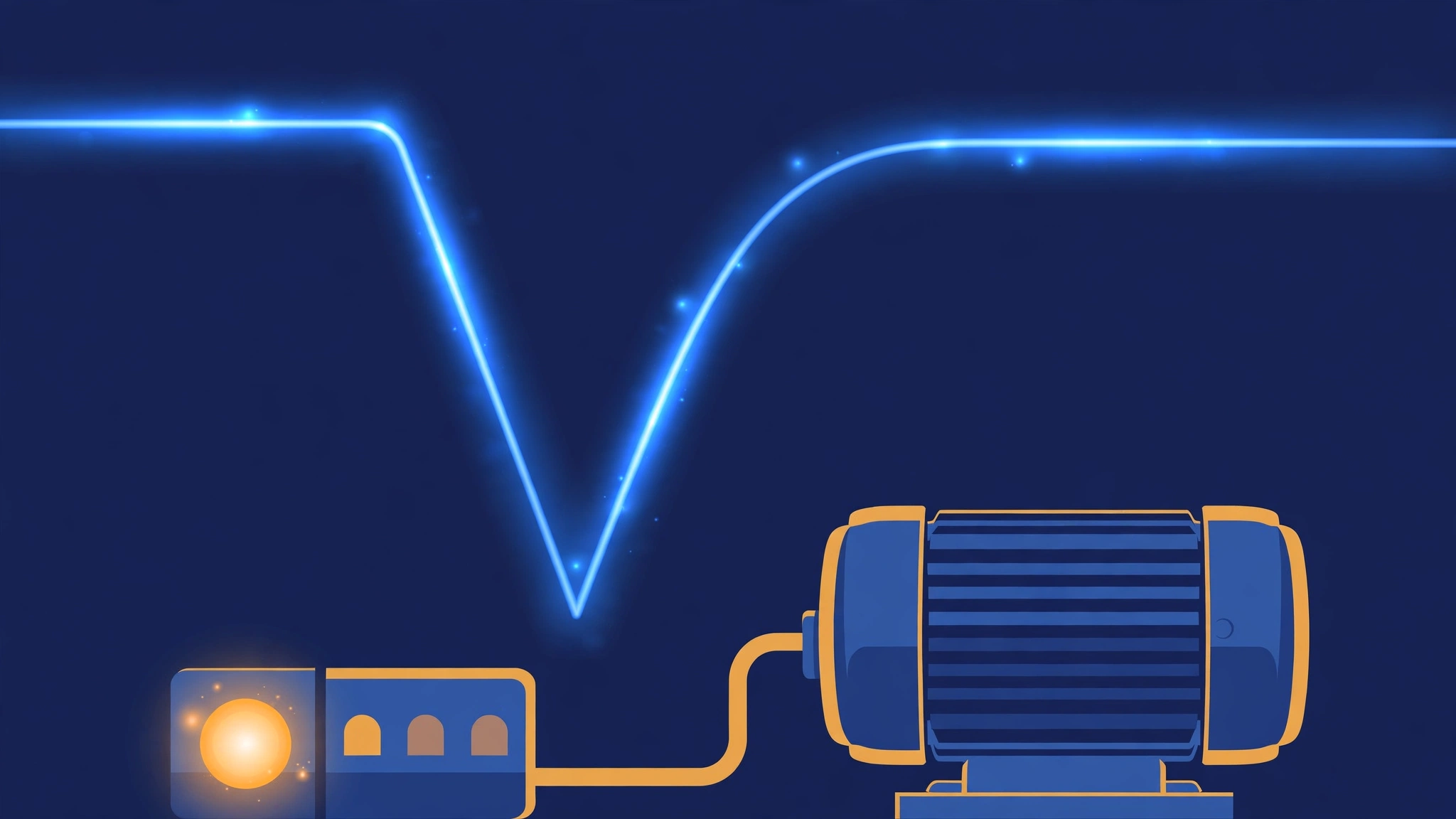
Now the real question. The voltage dips — a brownout, a brief outage, a sag — and the motor stops or drops out. When the voltage comes back, what should the motor do? There are three answers, and their initials are the whole lesson.
LVP — low-voltage protection. The controller drops the motor out on low voltage, and the motor stays out until someone presses START again. It needs a manual restart. That is the safe answer for a large or hazardous motor: you never want a big machine restarting itself unexpectedly while someone is standing next to it, wondering why it stopped.
LVR — low-voltage release. The controller also drops the motor out on low voltage — but when the voltage is restored, the motor restarts automatically, with no one pressing anything. That is the right answer for small or critical loads that must keep running — a cooling-water pump, for example, where a stopped pump is worse than an automatic restart.
LVRE — low-voltage release with emergency? No — the handbook’s third type is the manual controller’s answer: LVRE is a manual controller that maintains the motor across the line at all times, mostly for small loads. It has no low-voltage protection or release at all: the motor is connected across the line, and if the voltage dips and returns, the motor simply comes back with it, because nothing ever dropped it out. That is why the manual controller is fine for small loads and hazardous for large ones — a manual switch left ON will restart a big motor on power return with no warning at all.
The seal-in is what makes LVP work. In a magnetic controller with LVP, the closing relay’s auxiliary contact — the Ma contact — seals in the circuit: once you press START, the Ma contact closes and keeps the contactor energised after you release the button. When the voltage dips, the contactor drops out, the Ma contact opens, and the seal is broken — so when the voltage returns, nothing re-energises the contactor until someone presses START again. LVR has no such seal to break, or its circuit is wired so the contactor re-energises on voltage return. Same contactor, same motor — different wiring, different behaviour after a dip.
This chapter gives no numeric worked example, so here is a walkthrough built from the chapter’s rules and flagged as such. A cooling-water pump and a large conveyor motor both lose voltage in the same sag. The pump is on LVR: it drops out, the voltage returns, and the pump restarts itself — the cooling water keeps flowing, nobody had to walk to the pump room. The conveyor is on LVP: it drops out, the voltage returns, and the conveyor sits still, waiting for an operator to press START — because a conveyor restarting itself while a worker is clearing a jam on it would be dangerous. And a small bench grinder on a manual LVRE controller never dropped out at all — its switch was ON, the voltage returned, and it spun back up on its own, which is fine for a bench grinder and exactly why you would never put a large motor on a manual controller. Three motors, one voltage dip, three different answers — and each one is correct for its motor.
Common mistakes
- “LVP and LVR are the same thing.” They are opposites after a dip: LVP needs a manual START to restart; LVR restarts automatically when the voltage is restored.
- “Automatic restart is always better.” Not for a large or hazardous motor — an unexpected restart while someone is working on the machine is dangerous. That is why LVP exists.
- “A manual controller protects against low voltage.” It does not: a manual controller has no low-voltage protection or release, so a motor left ON restarts on power return. Fine for small loads, hazardous for large ones.
- “Overloads and low-voltage protection are the same job.” Overloads (fuses, thermal, magnetic) protect the motor from drawing too much current. Low-voltage protection/release is about what the motor does after the voltage dips and returns.
- “The contactor holds the motor on by itself.” In an LVP magnetic controller, the Ma auxiliary contact seals in the circuit after you press START. When the voltage dips, the contactor drops out, the Ma contact opens, and the seal is broken — that is why a manual START is needed.
- “LVR is for big motors.” LVR is for small or critical loads that must keep running — a cooling-water pump, for example — where a stopped motor is worse than an automatic restart.
- “The controller only starts and stops.” A controller also reverses, speeds up, slows down, and protects the motor from overloads and faults — control and protection in one device.
Summary
A controller starts, stops, reverses, and protects a motor. Manual controllers switch by hand and have no low-voltage protection — fine for small loads, hazardous for large ones, because a motor left ON restarts on power return. Magnetic controllers use a contactor and a master switch for remote or automatic operation. Overloads — fuses, thermal, magnetic — protect the motor from too much current. And after a voltage dip, three letters decide: LVP drops out and waits for a manual START (safe for large motors, sealed in by the Ma contact); LVR drops out and restarts automatically (right for small, critical loads like a cooling-water pump); LVRE is the manual controller that keeps the motor across the line at all times, mostly for small loads. The question is never just “did the motor stop?” — it is “what should it do when the voltage comes back?”
Quick-check questions
- What two jobs does a motor controller do, and what are its two kinds?
- What are the three overload devices?
- What does LVP do after a voltage dip, and when is it the right choice?
- What does LVR do after a voltage dip, and when is it the right choice?
- What is LVRE, and why is a manual controller hazardous for a large motor?
Answers
- Control (start, stop, reverse, speed up, slow down) and protection (overloads and faults). Manual controllers switch by hand; magnetic controllers use a contactor and a master switch for remote or automatic operation.
- Fuses, thermal overloads, and magnetic overloads.
- LVP drops the motor out on low voltage and needs a manual START to restart. Right for large or hazardous motors, where an unexpected automatic restart is dangerous. The Ma auxiliary contact seals in the circuit; a dip breaks the seal.
- LVR drops out on low voltage but restarts automatically when the voltage is restored. Right for small or critical loads that must keep running, e.g. a cooling-water pump.
- LVRE is a manual controller that maintains the motor across the line at all times, mostly for small loads. A manual controller has no low-voltage protection or release, so a motor left ON restarts on power return — fine for small loads, hazardous for large ones.
Based on DOE-HDBK-1011/92, Electrical Science, Module 15, paraphrased for study.

Report a question

Top 10 Scorers
| Pos. | Name | Score | Duration |
|---|---|---|---|
| There is no data yet |

What two jobs does a motor controller do?
How do manual and magnetic controllers differ?
What are the three overload devices commonly used in controllers?
What does LVP stand for, and what does it do after a voltage dip?
What does LVR stand for, and what does it do after a voltage dip?
When is LVP the right choice, and when is LVR?
What is the Ma contact, and what does it do in an LVP controller?
What is LVRE?
Why is a manual controller hazardous for a large motor?
A cooling-water pump and a large conveyor motor both lose voltage in the same sag. The pump restarts itself when voltage returns; the conveyor sits still until an operator presses START. Which is which?
