Essential Personnel Precautions for Electrical Hazard Mitigation: A Comprehensive Safety Guide
- Cultivating Operational Alertness and Managing Dynamic Work Scopes
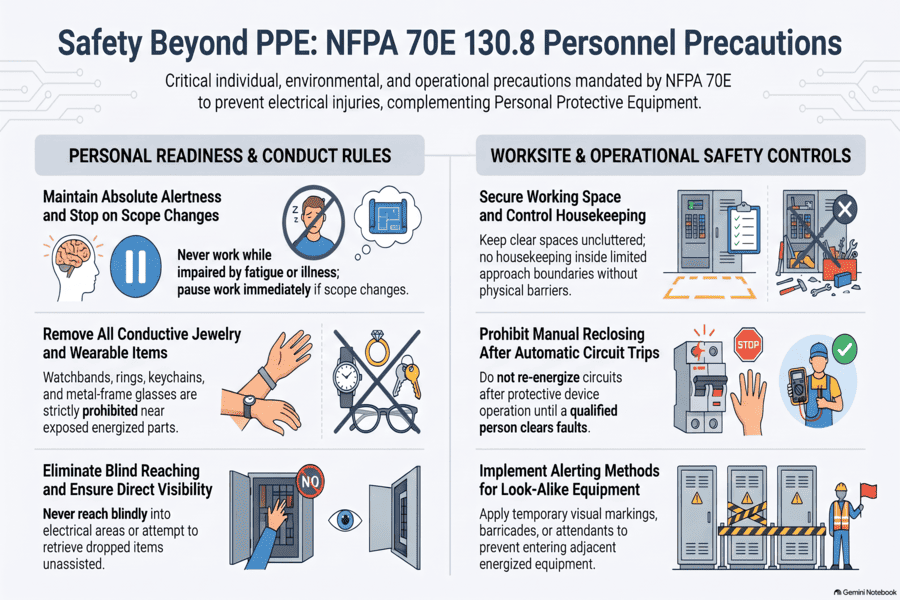
Human factors—specifically diminished mental focus, unaddressed physical impairment, and unchecked scope creep—represent primary root causes of electrical workplace injuries. While engineered physical controls and protective procedures provide vital defensive layers, technical controls are rendered entirely ineffective if personnel fail to maintain continuous situational awareness. When an individual operates within proximity to exposed electrical conductors or circuit parts, even a momentary lapse in concentration can collapse established safety margins, turning a controlled task into a catastrophic event. Establishing a rigorous culture of operational alertness is non-negotiable; human behavioral discipline serves as the absolute baseline upon which all physical safety protocols depend.
Continuous mental focus is mandatory whenever work is conducted near potential electrical hazards. Personnel operating within hazardous approach boundaries must remain fully attentive to their immediate surroundings, their personal physical movements, and the activities of team members. Distractions such as mobile device usage, non-essential conversation, or multi-tasking severely erode personal safety margins and significantly elevate the likelihood of human error. Maintaining operational alertness requires self-discipline and an acute awareness that high-energy electrical environments leave zero margin for oversight. Qualified and unqualified personnel alike must actively filter out field distractions, focusing entirely on the technical execution of the assigned task and the maintenance of established approach boundaries.
Identifying and managing physical or mental impairment caused by illness, acute fatigue, or extended work shifts is critical to preventing workplace incidents. Impairment directly degrades cognitive function, reaction time, and spatial judgment, rendering a worker incapable of recognizing dynamic field hazards. Managing this risk requires a structured, dual-responsibility protocol. First, during the mandatory pre-job briefing, supervisors must actively evaluate the physical and mental readiness of all assigned personnel. If an employee exhibits signs of fatigue or illness, work assignments must be adjusted or rescheduled. Second, employees carry a professional responsibility to self-report any physical or mental impairment that compromises their ability to work safely. Employers must maintain an organizational environment where personnel can self-report impairment without fear of retribution, discipline, or financial penalty. Forcing or allowing an impaired worker to perform tasks near electrical hazards introduces unmitigated operational risk.
Unapproved task deviations and field improvisations—commonly referred to as scope creep—present severe hazards to personnel. A pre-job briefing and an Energized Electrical Work Permit (EEWP) are valid only for the specific equipment, location, and scope of work explicitly defined in the initial job plan. When unexpected site conditions arise, or when personnel are requested to perform supplemental tasks, the original risk assessments become invalid. A minor, unapproved deviation—such as tightening an unexpected loose terminal while taking a routine diagnostic voltage measurement—introduces unassessed shock and arc flash exposure. Personnel must follow a strict mandate: whenever a work scope changes, when a task moves outside an established electrically safe work condition, or when unexpected hazards are encountered, work must be stopped immediately. Personnel must clear the boundary, notify supervision, and perform a comprehensive re-assessment to establish an updated work plan or permit before any physical work resumes.
Maintaining rigid personal behavioral vigilance provides the essential foundation required to effectively execute physical space controls and structural safeguards within the immediate operating environment.
- Managing Physical Working Spaces, Illumination, and Conductive Risk Vectors
Physical safety controls within the workplace are designed to establish rigid spatial boundaries and prevent accidental direct or indirect contact with exposed energized conductors and circuit parts. Controlling physical working spaces requires a multi-layered approach that includes managing visual contact, ensuring adequate workspace lighting, strictly enforcing prohibitions on wearable conductive items, controlling long conductive tools, managing elevated mechanical equipment, and maintaining clear working clearances. When physical space is compromised by clutter, inadequate illumination, or improper material handling, the probability of initiating an unintended phase-to-ground or phase-to-phase arc fault increases exponentially.
Executing tasks near exposed electrical hazards requires an unobstructed, direct visual line of sight. Performing tasks without clear visual confirmation—commonly referred to as blind reaching—is strictly prohibited. Personnel must never extend hands, tools, or material into obscured cubicles, enclosures, or structural recesses where exposed energized parts may exist. Furthermore, relying on mirrors to view behind structural obstructions or inside tight enclosures does not fulfill line-of-sight requirements; the use of mirrors or indirect reflective devices to manipulate components around obstructions is explicitly classified as dangerous blind reaching. Similarly, if a small hardware item such as a nut, bolt, washer, or hand tool is dropped into an enclosure near exposed energized parts, personnel must never attempt to retrieve it by reaching into the space or using improvised hooks, even if the item is clearly visible. Retrieving dropped objects requires an immediate work halt; physical entry for retrieval is strictly forbidden until the equipment is placed into an Electrically Safe Work Condition (ESWC) in full compliance with established lockout/tagout and voltage verification protocols.
Appropriate workspace illumination is a mandatory prerequisite for entering spaces containing electrical hazards. Personnel are prohibited from entering or performing work in hazardous electrical zones unless lighting levels are sufficient to enable safe task execution and clear observation of electrical components. Lighting assessments must account for the visual limitations introduced by personal protective equipment (PPE). Shaded or arc-rated face shields and arc flash hoods utilize energy-absorbing formulations that significantly reduce visual acuity and alter color perception. Prior to commencing work, personnel must evaluate task visibility while wearing the required protective face gear. If existing lighting is inadequate, or if physical structures cast shadows across the immediate work area, supplementary non-conductive temporary lighting must be installed as specified in the risk assessment. Personnel are strictly forbidden from substituting approved work area lighting with improvised, hand-held flashlights, as holding loose illumination devices alters the work plan, restricts hand availability, and introduces unassessed operational risks.
Wearable conductive items represent severe direct-contact vectors and must be managed through strict physical restrictions. Prior to crossing the restricted approach boundary, or entering any zone where an electrical contact hazard exists, personnel must remove all conductive articles of jewelry and clothing. Prohibited items include, but are not limited to:
- Watchbands and wristwatches
- Bracelets, rings, and keychains
- Necklaces and metal pendants
- Metalized aprons and garments woven with conductive thread
- Metal headgear and hard hat metallic accessories
- Metal-frame eyeglasses
In addition to wearable items, handling long conductive tools and structural materials presents extreme risk of bridging approach boundaries. Items such as metal pipes, structural tubes, ventilation ducts, conductive hoses, synthetic or wire ropes, metal-lined rules, steel measuring tapes, pulling lines, metal scaffolding, structural steel members, bull floats, and chains can easily swing out of control and contact energized lines. When transporting or positioning long conductive objects near limited approach boundaries, multi-person handling techniques are mandatory; specifically, an individual must be assigned to each end of the object to maintain positive physical control at all times. Conductive pulling items, such as metallic fish tapes, are strictly forbidden from being used in raceways or enclosures near exposed energized electrical conductors or circuit parts.
Special precautions must be extended to elevated vehicular and mechanical equipment operating near uninsulated overhead lines. Mobile structures—including derrick cranes, boom trucks, bucket trucks, and dump beds—must maintain a minimum clearance equal to the limited approach boundary distance (minimum 10 feet for overhead lines operating up to 50 kV). This clearance distance may be reduced by 6 feet (1.83 meters) only when the vehicle is in transit with its structure fully lowered in a resting position. Ground personnel face severe electric shock and electrocution hazards from touch and step potentials when standing near mobile equipment operating near overhead lines. Personnel on the ground are prohibited from contacting the vehicle structure or standing near temporary grounding connections while line contact is possible. Grounding conductors connected to temporary earth ground rods expand the hazard zone; physical barricades must isolate both the vehicle and its grounding point to protect ground workers from hazardous step potential gradients.
Maintaining dedicated working clearances and stringent workspace housekeeping is necessary to ensure safe physical mobility. Working spaces required by applicable electrical codes and standards must be kept completely clear at all times; using these spaces for temporary or permanent storage is strictly prohibited. Workspaces must not be cluttered with staging materials, material carts, or portable equipment on rollers. During workspace cleaning, personnel are prohibited from performing routine housekeeping duties within the limited approach boundary of exposed live parts unless physical barriers or insulating safeguards are deployed. Furthermore, electrically conductive cleaning materials are strictly forbidden inside the limited approach boundary. Prohibited cleaning agents include:
- Conductive solids such as steel wool, metalized cloth, and silicon carbide abrasives
- Conductive liquid cleaning solutions and water-based solvents
- Flammable aerosol propellants that leave conductive or ignitible residues
Strict management of physical working spaces and personal conductive vectors transitions directly into controlling environmental failure risks, handling specialized equipment conditions, and executing safe switching operations.
- Mitigating Environmental Risks, Impending Failure, and Switching Operations
High-energy electrical operations, work within confined spaces, and interacting with abnormal equipment require specialized operational risk controls. When electrical tasks are executed in complex physical environments, standard approach boundaries must be supplemented with atmospheric monitoring, failure-contingency planning, rigid circuit-switching discipline, interlock safety management, and clear alerting mechanisms. Proactive control over these dynamic factors prevents catastrophic equipment failures and safeguards both qualified workers and adjacent personnel.
Confined or enclosed work spaces—such as underground vaults, manholes, and restricted equipment compartments—present compounded environmental and electrical hazards. When personnel must enter confined spaces containing electrical hazards, the employer must provide, and personnel must deploy, approved protective shields, physical barriers, or rated insulating materials to isolate workers from accidental contact. Furthermore, confined spaces often harbor hazardous atmospheric conditions, including toxic gases, oxygen deficiency, or explosive atmospheres. The job safety planning procedure must integrate atmospheric testing, mechanical forced ventilation, and emergency evacuation protocols prior to entry. In environments where flammable materials are present on an occasional basis—such as flammable gases, volatile vapors, combustible dusts, or ignitible fibers—operating electrical equipment capable of igniting these atmospheric contaminants is strictly prohibited unless rigorous control measures (such as continuous ventilation and monitoring) are established to prevent hazardous atmospheric conditions from developing.
Electrical equipment typically exhibits distinct physical indicators prior to catastrophic operational failure. Personnel must be trained to recognize the primary warning signs of impending equipment failure, which include:
- Abnormal heat development or visibly scorched enclosures
- Unusual mechanical noises, intense buzzing, or unexpected humming
- Active equipment warning lights or unexpected protection alarms
- Unfamiliar, acrid, or burning insulation odors
If any indicator of impending failure is detected, normal equipment operation must cease immediately. Personnel are strictly prohibited from operating local disconnect switches, circuit breakers, or control buttons while standing in front of compromised equipment. The area surrounding the failing apparatus must be immediately isolated using physical barricades and alerting signs to prevent personnel access. Once the hazard zone is barricaded, the equipment must be de-energized remotely from an upstream supply point. Local manual switching under failure conditions is permitted only if the equipment is already in an electrically safe state or if personnel are fully isolated from potential explosive and thermal effects.
Routine circuit switching and emergency load shedding are governed by strict device-rating rules. Operating switches or circuit breakers under normal load conditions must be performed exclusively using load-rated devices specifically designed and tested for load-break service. Non-load-break devices—such as disconnect switches not rated for load, cable connectors, control fuses, terminal lugs, and cable splice connections—must never be used to interrupt load currents, except under extreme emergency conditions where load-rated disconnects are inaccessible.
Following an automatic circuit interruption caused by a protective device operation (such as a tripped circuit breaker or blown fuse), manually re-closing the circuit is strictly prohibited until a qualified person conducts a thorough inspection of the circuit and conclusively verifies that the fault has been cleared. Re-energizing a circuit into an uncleared short circuit or ground fault can cause severe arc flash explosions.
[Automatic Circuit Protective Device Operation / Trip Event]
│
▼
[Is the Trip Positively Proven to be an Overload?]
│ │
YES NO
│ │
▼ ▼
[Examine Circuit & Connected] [STRICT PROHIBITION: Do NOT Reclose]
[Equipment as Necessary] │
│ ▼
│ [Qualified Person Conducts]
│ [Detailed Inspection & Testing]
│ │
│ ▼
│ [Verify Fault is Cleared & System]
│ [is Safely Ready for Energy]
│ │
└─────────────────┬───────────────┘
│
▼
[Re-energize Circuit Safely]
Exception: Manually re-energizing a circuit without detailed circuit examination is permitted only when it is conclusively determined, from the specific circuit design and protective device operating characteristics, that the automatic operation was caused strictly by a known overload condition rather than a fault.
Electrical safety interlocks are engineered safeguards designed to protect personnel from high-voltage contact and arc exposure. Defeating or bypassing a safety interlock is strictly restricted to qualified personnel who are actively following restricted approach boundary procedures. The qualified person must maintain sole physical control over the bypassed interlock, and the bypass is permitted only temporarily while active diagnostic work is underway. As soon as the specific task is completed, the safety interlock system must be restored to a fully operable condition before the equipment is returned to service.
To protect unqualified workers and adjacent personnel from unexpected electrical hazards, comprehensive alerting protocols must be maintained. Safety signs, symbols, and tags meeting national consensus standards (such as ANSI Z535) must be posted at hazard access points. Physical barricades used to restrict area access must be non-conductive and positioned no closer than the limited approach boundary; if the calculated arc flash boundary is larger than the limited approach boundary, the barricade must be established at the larger arc flash boundary limit.
Where signs and barricades do not provide adequate physical warning, a dedicated attendant must be stationed at the boundary. The primary, exclusive duty of the attendant is to continuously warn and prevent unqualified personnel from entering the work zone. Attendants are strictly prohibited from taking on secondary duties—such as passing tools, pulling wire, or monitoring diagnostic readouts—that could distract them from continuous boundary monitoring.
Finally, critical alerting controls must be implemented when work is conducted on de-energized equipment that resides within a facility alongside energized equipment of similar size, shape, color, and physical appearance (look-alike equipment). In industrial switchgear installations, adjacent compartments often share identical construction—such as an upper compartment housing exposed live primary line switches and a lower compartment housing de-energized load distribution equipment. To prevent workers from inadvertently opening or entering adjacent energized enclosures, qualified personnel must apply visual alerting markers, temporary barricades, or physical locks directly to all look-alike energized equipment before work commences.