



What you’ll learn
After this post, you will be able to explain why your outlet is 60 Hz, use f = PN/120 to find frequency from speed and poles (or speed from frequency and poles), and say why a generator’s speed must be held constant.
Where 60 Hz comes from
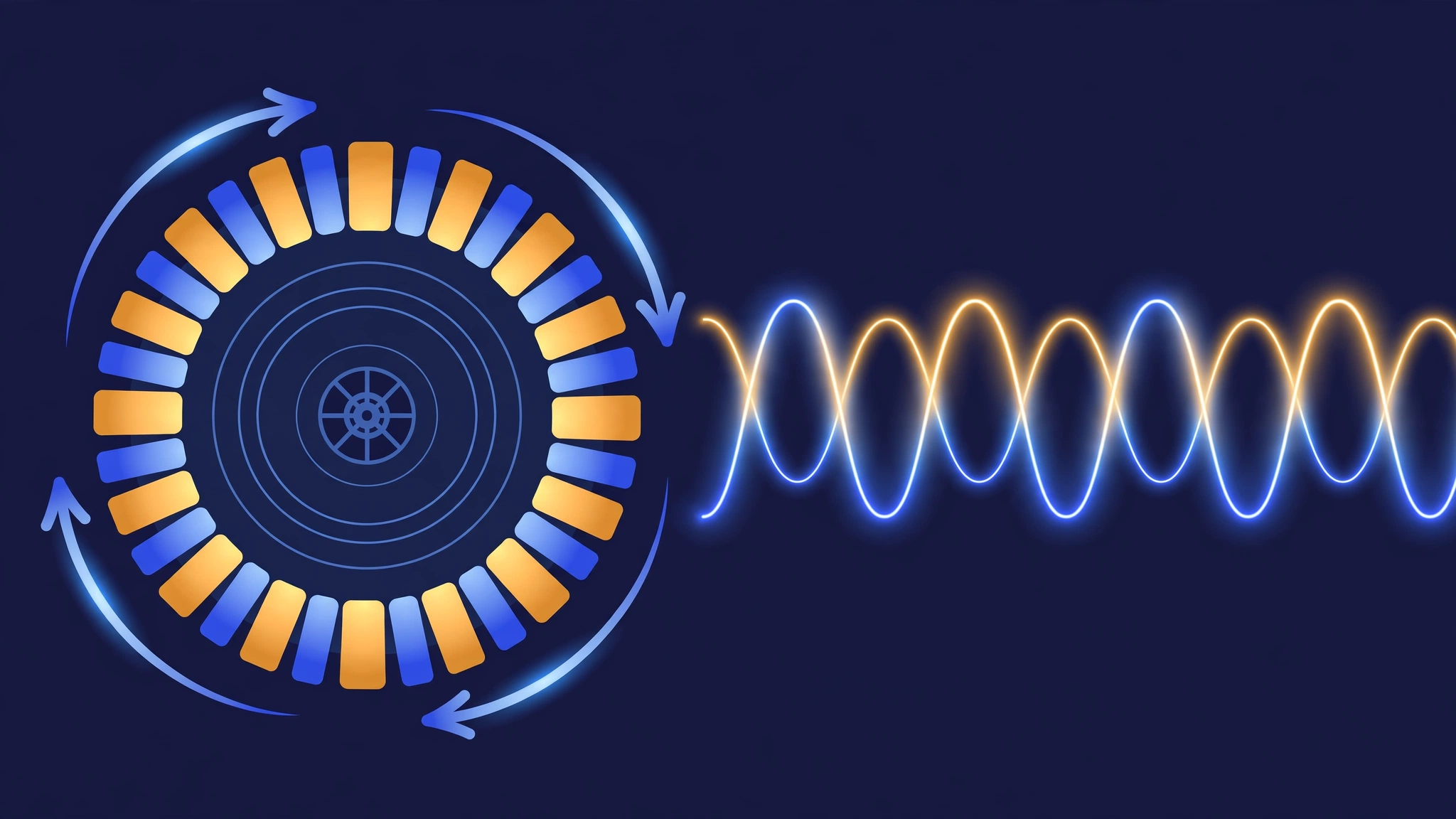
Your outlet is 60 Hz because the generators that feed it spin at a speed that makes 60 cycles per second. Frequency is not a property of the wires or the load — it is set by the machine: how fast the rotor spins, and how many magnetic poles its field has. One full turn of the rotor does not make one cycle unless the machine has two poles; every pair of poles makes one cycle per revolution.
The formula: f = PN / 120
Frequency f (Hz) = P × N / 120, where P is the number of poles and N is the rotor speed in revolutions per minute (rpm). The 120 comes from the units: there are 60 seconds in a minute, and each cycle needs one pair of poles — so 2 × 60 = 120. Turn it around and you get synchronous speed: N = 120f / P. A generator running at its synchronous speed holds its frequency exactly; if the speed drifts, the frequency drifts with it.
The worked examples: four machines, one frequency
All four of these make 60 Hz — same frequency, different machines:
- 2-pole machine: N = 120 × 60 / 2 = 3,600 rpm. f = 2 × 3,600 / 120 = 60 Hz.
- 4-pole machine: N = 120 × 60 / 4 = 1,800 rpm. f = 4 × 1,800 / 120 = 60 Hz.
- 6-pole machine: N = 120 × 60 / 6 = 1,200 rpm. f = 6 × 1,200 / 120 = 60 Hz.
- 12-pole machine: N = 120 × 60 / 12 = 600 rpm. f = 12 × 600 / 120 = 60 Hz.
More poles means a slower machine for the same frequency — which is why big hydro generators, with many poles, turn slowly, while small steam-turbine generators, with two poles, spin at 3,600 rpm. And the reverse check: a 4-pole machine spinning at 1,500 rpm makes f = 4 × 1,500 / 120 = 50 Hz — the standard in much of the rest of the world.
Why speed must be held constant
Frequency is the one thing the whole grid shares: every generator connected to it must run at the same frequency, or they fight each other. If a generator’s prime mover speeds up, its frequency rises; if it slows down, its frequency falls — and clocks, motors, and every other generator on the grid feel it. That is why generators have governors: devices that hold the prime mover’s speed constant as the load changes, keeping the frequency at 60 Hz. Frequency control is speed control.
Common mistakes
- “Frequency is set by the load.” It is not. Frequency is set by the generator: its speed and its pole count. The load draws current; it does not set the frequency.
- “One revolution makes one cycle.” It does only for a 2-pole machine. Every pair of poles makes one cycle per revolution — so a 4-pole machine makes two cycles per revolution, a 6-pole machine three.
- “The 120 in the formula is a constant of nature.” It is not. It is 2 × 60: two poles per cycle, sixty seconds per minute. It is a unit conversion, not a law of physics.
- “More poles means higher frequency.” It does not, by itself. Frequency is P × N / 120 — more poles at the same speed gives higher frequency, but more poles usually means a slower machine, so the frequency stays 60 Hz.
- “A 4-pole generator at 1,800 rpm makes 120 Hz.” It does not. f = 4 × 1,800 / 120 = 60 Hz. Forgetting to divide by 120 is the classic slip.
- “50 Hz and 60 Hz are the same thing.” They are not. 60 Hz is the North American standard; 50 Hz is the standard in much of the rest of the world — a 4-pole machine at 1,500 rpm makes 50 Hz.
- “Speed only matters for power output.” It matters for frequency too. If the speed drifts, the frequency drifts — and the whole grid feels it.
Summary
Frequency is f = PN/120: poles times speed, divided by 120. A 2-pole machine at 3,600 rpm, a 4-pole at 1,800, a 6-pole at 1,200, and a 12-pole at 600 all make 60 Hz — more poles, slower spin, same frequency. The 120 is just 2 × 60, a unit conversion. And because the whole grid shares one frequency, a generator’s speed must be held constant by its governor: frequency control is speed control.
Quick-check questions
- What sets the frequency of an AC generator’s output?
- What is the frequency formula, and what do P and N mean?
- What speed does a 4-pole machine need to make 60 Hz?
- What speed does a 12-pole machine need to make 60 Hz?
- Why must a generator’s speed be held constant?
Answers: 1. The rotor’s speed and the number of magnetic poles in its field. 2. f = PN / 120, where f is frequency (Hz), P is the number of poles, and N is rotor speed (rpm). The 120 is 2 × 60 (two poles per cycle, sixty seconds per minute). 3. N = 120 × 60 / 4 = 1,800 rpm. 4. N = 120 × 60 / 12 = 600 rpm. 5. Because frequency is set by speed — if the speed drifts, the frequency drifts, and every generator, motor, and clock on the grid feels it. Governors hold the speed constant.
Based on DOE-HDBK-1011/92, Electrical Science, Module 10, paraphrased for study.

Report a question

Top 10 Scorers
| Pos. | Name | Score | Duration |
|---|---|---|---|
| There is no data yet |

What sets the frequency of an AC generator's output?
What is the frequency formula?
Where does the 120 in f = PN/120 come from?
What is synchronous speed?
What speed does a 2-pole machine need to make 60 Hz?
What speed does a 4-pole machine need to make 60 Hz?
What speed does a 12-pole machine need to make 60 Hz?
What frequency does a 4-pole machine make at 1,500 rpm?
Why must a generator's speed be held constant?
How many cycles does a 4-pole machine make per revolution?
