Ground-Fault Circuit-Interrupter (GFCI) Protection
- Operational Mechanics and Essential Safeguards of GFCI Protection
Ground-Fault Circuit-Interrupter (GFCI) protection serves as a critical frontline defense against severe electric shock, electrocution, and electrical fatalities in high-risk operational environments. In temporary work areas, industrial facilities, and job sites where portable electrical equipment is heavily utilized, environmental stressors and physical wear can rapidly compromise basic electrical insulation. Listed GFCI protective devices are designed specifically to safeguard personnel from lethal shock hazards when operating cord- and plug-connected equipment. By continuously monitoring the current balance between circuit conductors, these safety devices automatically interrupt power before an electrical current passing through a human body can reach fatal thresholds.
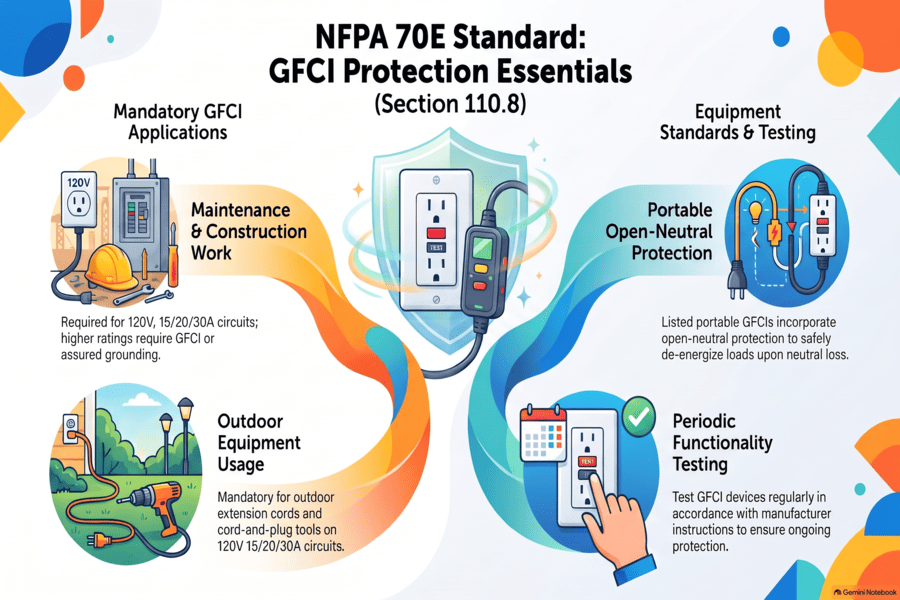
A vital technical distinction exists between standard Class A GFCI receptacles installed in premises wiring and listed portable GFCI devices designed for temporary power setups. Listed portable GFCI devices incorporate an advanced protective feature known as open neutral protection. While standard Class A GFCI receptacles provide ground-fault detection during normal operating conditions, they rely on an intact supply neutral conductor to power their internal sensing circuitry and tripping mechanisms. In contrast, portable GFCI units identified for portable use are engineered to de-energize the load automatically if the supply neutral conductor loses continuity—such as when a supply cord is severed, damaged, or disconnected upstream.
Understanding the mechanics of open neutral protection highlights its crucial role in worker safety. If a supply neutral conductor breaks upstream of a standard receptacle-type GFCI mounted in a portable cord box, the device loses its internal control power. However, the hot conductor remains energized, allowing lethal voltage to travel through the GFCI receptacle to the connected tool or extension cord. If a ground fault occurs while the neutral is open, a standard receptacle GFCI fails to trip, leaving the worker completely unprotected and vulnerable to severe shock or electrocution. Listed portable GFCI devices eliminate this hidden vulnerability by instantly opening the power contacts upon loss of neutral continuity, ensuring that power cannot reach the connected equipment without an intact neutral connection.
Understanding these foundational technical mechanics provides the foundation for examining the specific workplace operational conditions where GFCI protection is legally and practically mandated.
- Mandated Application Protocols: Construction, Maintenance, and Outdoor Operations
Tailoring electrical safety controls to specific operational environments is essential for mitigating risk, particularly in temporary, outdoor, and high-wear work settings. Construction and maintenance activities subject electrical equipment to severe mechanical abuse, moisture, and frequent repositioning, which significantly elevates the likelihood of insulation damage and grounding failures. Establishing mandatory application protocols ensures that protective hardware is deployed systematically wherever workers interact with temporary electrical distribution systems.
For all construction and maintenance activities, GFCI protection is strictly required when employees operate or use cord sets (extension cords) or cord- and plug-connected tools supplied by 120-volt, 15-, 20-, or 30-ampere circuits. This mandate applies across all temporary installations and field work involving building, remodeling, maintenance, repair, or demolition. When equipment is supplied by circuits operating at greater than 120 volts or at higher ampacities (exceeding 30 amperes, including 120-volt circuits rated above 30 amperes), employers must implement a compliant protection strategy: they must provide either GFCI protection or an Assured Equipment Grounding Conductor Program (AEGCP).
Outdoor work environments introduce heightened environmental hazards, including rain, standing water, and high-humidity conditions that drastically increase human body conductivity and decrease electrical resistance. When employees are working outdoors and operating cord sets or cord- and plug-connected equipment supplied by 120-volt, 15-, 20-, or 30-ampere circuits, GFCI protection is mandatory. For outdoor work involving supply circuits rated above 120 volts or exceeding 30 amperes, employers are similarly required to implement either GFCI protection or an AEGCP. Furthermore, in any work location where employees are likely to contact or be drenched with water or conductive liquids, GFCI protection for personnel must be enforced, and portable tools must be specifically approved for use in wet locations.
Evaluating the operational impacts of deploying GFCI devices versus maintaining an AEGCP demonstrates how safety selection prevents workplace fatalities. High-wear job sites frequently experience severe cord damage, such as missing equipment grounding pins, crushed jackets, or improperly wired replacement plugs that create reversed polarity conditions. As documented in fatal workplace incidents, plugging a portable tool into an ungrounded or reversed-polarity circuit without GFCI protection—especially in wet or conductive outdoor locations—creates an immediate, fatal path to ground through the operator. Implementing listed portable GFCI units with open neutral protection or enforcing an AEGCP eliminates these failure modes by verifying ground path continuity or cutting off power within milliseconds of a fault, neutralizing hazards caused by damaged flexible cords and ungrounded equipment.
While selecting the appropriate protective equipment for specific environmental conditions is vital, ongoing verification procedures are equally critical to maintain device reliability over time.
- Testing Protocols and Device Verification
Electrical safety hardware is only as effective as its ongoing maintenance and operational verification; relying on unverified safety controls creates a false sense of security that can prove catastrophic. GFCIs are sophisticated electronic safety devices containing internal sensing transformers, switches, and solid-state circuitry. Physical impacts, exposure to moisture, severe electrical surges, and normal component aging can degrade these internal elements without displaying any external physical evidence of failure.
To ensure continuous protection, all GFCI protective devices must be tested strictly in accordance with the manufacturer’s instructions. Installation and operational guidelines supplied by device manufacturers establish the baseline requirements for testing protocols and frequencies. In field operations, these guidelines typically require routine push-button functional tests (utilizing the integrated “Test” and “Reset” buttons on the device) before putting equipment into service and on a monthly basis at minimum. Actuating the test button injects an internal test current that simulates a ground fault, confirming that the internal sensing electronics and mechanical trip contacts respond correctly to clear the circuit.
Relying on untested GFCIs in high-stress work environments creates an unacceptably high risk profile. Internal component degradation—such as welded contacts from electrical short-circuit surges or damaged sensing transformers from physical dropping—can cause a GFCI unit to physically pass power to a tool while failing to provide any electronic ground-fault protection. In such a state, the tool remains powered, leading workers to falsely believe they are protected when the automatic safety mechanism is completely non-functional. Integrating thorough pre-use visual inspections of flexible cords—checking for loose parts, deformed or missing grounding pins, crushed outer jackets, or evidence of internal pinching—with routine GFCI push-button testing eliminates hidden failure modes. This dual-verification workflow confirms both the physical integrity of the equipment ground path and the active electronic responsiveness of the protective mechanism before workers are exposed to electrical hazards.
With these technical guidelines, application protocols, and maintenance requirements established, the following evaluation section provides a practical assessment to test comprehension of GFCI safety standards.