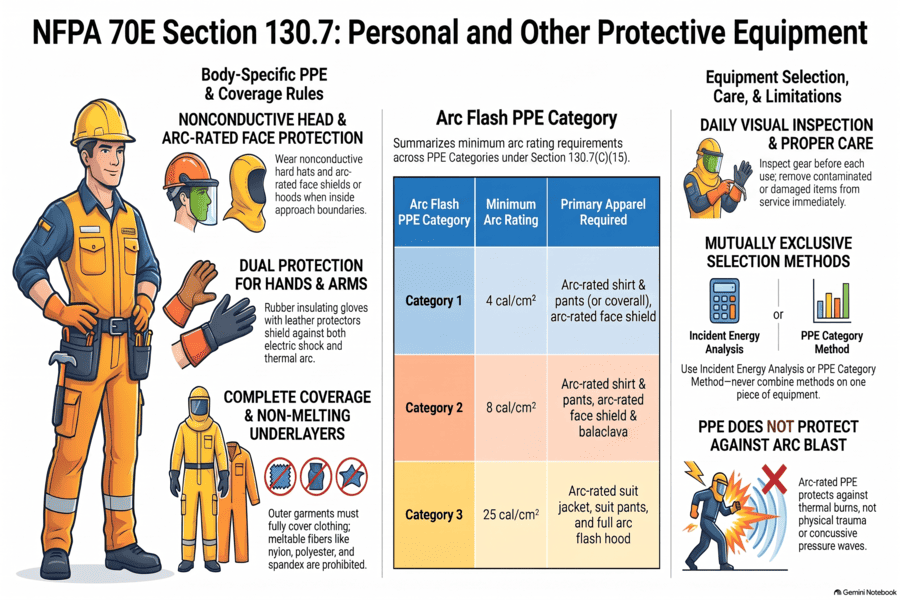
Master Program Guide: Personal and Other Protective Equipment (PPE) for Electrical Safety
- Fundamental Safety Principles and Organizational Responsibilities
Personal protective equipment (PPE) serves as a critical operational element within a comprehensive electrical safety program, functioning as the final line of defense within the hierarchy of risk controls. While the primary objective of electrical safety mandates the complete elimination of hazards through the establishment of an electrically safe work condition (ESWC), energized work is occasionally justified under strict regulatory exceptions (such as infeasibility or increased hazard creation per NFPA 70E Section 110.2(\text{B})). In these specialized scenarios, personal and other protective equipment mitigates residual exposure risks to personnel operating within established shock and arc flash boundaries. However, defaulting to PPE must never replace higher-level risk controls such as hazard elimination, substitution, engineering controls, or administrative procedures. Organizational leaders and compliance specialists must integrate protective gear as an interdependent safety measure that operates in tandem with rigorous risk assessments, documented job safety plans, and formal energized electrical work permits (EEWPs).
Core Protective Purpose & Limitations
The primary operational goal of arc-rated personal protective equipment is not the total prevention of arcing events or the elimination of electric shock hazards, but rather the mitigation of thermal burn injuries to a survivable, nonpermanent level. Properly selected arc-rated apparel is engineered to limit the total thermal energy transferred to the wearer’s skin to below the threshold for the onset of a second-degree burn, defined across industry standards as 1.2\text{ cal/cm}^2 (5\text{ J/cm}^2). When an individual is exposed to an arc flash incident while wearing correctly specified PPE, the expected thermal outcome is limited to a second-degree burn from which full physical recovery is achievable.
Despite its thermal insulating capabilities, electrical PPE possesses significant physical limitations that must be evaluated during hazard calculations and risk assessments:
- Thermal vs. Mechanical Protection: Standard arc-rated apparel provides a thermal barrier against radiant heat and convective plasma but offers no inherent protection against mechanical trauma, physical impact, or flying debris.
- Concussive Blast and Pressure Waves: An arcing fault converts electrical energy into an explosive plasma expansion, generating concussive pressure waves that can exceed 2,000\text{ lb/ft}^2. Unprotected eardrums can rupture at pressure differentials as low as 5\text{ psi} (720\text{ lb/ft}^2), while lung tissue damage occurs at thresholds between 1,728 and 2,160\text{ lb/ft}^2 (82,737\text{ to }103,421\text{ Pa}). Standard arc-rated PPE carries no pressure-wave or arc-blast rating.
- Shrapnel Ejection: Arcing faults can vaporize solid copper—which expands up to 67,000 times its original volume—and eject molten metal and shrapnel at velocities exceeding 1,100\text{ kph} (700\text{ mph}). Arc-rated garments are not engineered as ballistic armor and cannot prevent puncture injuries or blunt force trauma from high-velocity shrapnel.
Division of Responsibility
Achieving workplace electrical safety requires a structured division of responsibility between the employer and the employee.
┌──────────────────────────────────────────┐
│ Hierarchy of Risk Controls (HoRC) │
└────────────────────┬─────────────────────┘
│
┌────────────────────────────────┴────────────────────────────────┐
▼ ▼
┌──────────────────────────────────────┐ ┌──────────────────────────────────────┐
│ Employer Obligations │ │ Employee Obligations │
├──────────────────────────────────────┤ ├──────────────────────────────────────┤
│ • Provide compliant PPE & tools │ │ • Conduct daily visual & air tests │
│ • Verify ASTM / ANSI/ISEA standards │ │ • Adhere strictly to procedures/EEWP │
│ • Certify written risk assessments │ │ • Report fatigue, illness, impairment│
│ • Deliver mandatory donning/doffing │ │ • Maintain, clean, & store gear │
│ and limitation training │ │ in safe, non-contaminated state │
└──────────────────────────────────────┘ └──────────────────────────────────────┘
Employer Obligations
- Equipment Provision & Standards Compliance: Employers must supply all necessary personal protective equipment, voltage-rated insulating tools, and site safeguards designed for the specific body parts to be protected and the specific tasks performed. Employers are obligated to verify that provided gear conforms to applicable consensus standards, such as ASTM and ANSI/ISEA references detailed in safety regulations.
- Risk Assessment Verification: Employers must conduct and document written risk assessments for electric shock (identifying voltages, approach boundaries, and insulation needs) and arc flash hazards (determining incident energy or PPE categories and arc flash boundaries). Written certifications must state the workplace evaluated, the certifying official, and the assessment dates.
- Mandatory Training: Employers must provide comprehensive training ensuring that every employee required to use PPE understands:
- When protective equipment is necessary.
- Exactly what equipment is required for specific tasks.
- How to properly don, doff, adjust, and wear the equipment.
- The operational limitations of the protective gear.
- Proper care, maintenance, useful life, and disposal protocols.
Employee Obligations
- Daily Pre-Use Inspection & Verification: Employees must visually inspect all personal protective gear, insulating gloves, and tools prior to each day’s use and immediately following any suspected damage-causing event. Insulating gloves must undergo mandatory manual air testing before each shift.
- Adherence to Documented Procedures: Qualified workers must strictly follow established safe work practices, job safety plans, and issued energized electrical work permits. Personnel must refrain from field improvisations or expanding the scope of authorized work.
- Self-Awareness & Impairment Reporting: Employees are responsible for maintaining operational alertness and acknowledging physical or mental impairments. Workers must report fatigue, illness, or other debilitating factors to supervision and refrain from entering energized work zones when alertness is compromised.
- Care and Maintenance: Employees must maintain issued gear in a clean, reliable condition, ensuring apparel is stored away from physical damage, moisture, dust, and chemical contaminants.
The rigorous application of these baseline safety principles establishes the structural framework necessary for evaluating detailed anatomical equipment specifications.
- Comprehensive Body Protection: Technical Specifications and Equipment Selection
When energized electrical work is justified, complete anatomical coverage is required for any portion of an employee’s body that crosses into established electric shock boundaries or arc flash boundaries. Incomplete coverage creates exposed skin pathways that can lead to catastrophic thermal or electrical shock injuries.
┌────────────────────────────────────────────────────────┐
│ Anatomical Protection Requirements Inside │
│ Shock & Arc Flash Boundaries │
└───────────────────────────┬────────────────────────────┘
│
┌─────────────────────────────────────────┼────────────────────────────────────────┐
▼ ▼ ▼
┌────────────────────────┐ ┌────────────────────────┐ ┌────────────────────────┐
│ Head, Face & Eyes │ │ Torso, Arms & Hands │ │ Feet & Lower Body │
├────────────────────────┤ ├────────────────────────┤ ├────────────────────────┤
│ • Hard Hat (Nonconduct)│ │ • Arc-Rated Shirt/Pants│ │ • Heavy Leather Boots │
│ • Wrap Face Shield │ │ or Arc Suit │ │ (or Dielectric) │
│ • Balaclava or Hood │ │ • Rubber Insulating │ │ • Dielectric Overshoes │
│ (Hood >12 cal/cm²) │ │ Gloves + Protectors │ │ (Step/Touch Hazard) │
│ • Primary Eye Glasses │ │ • Nonmelting Underlayer│ │ • No Lightweight / │
│ (ANSI/ISEA Z87.1) │ │ (100% Cotton/Wool) │ │ Meltable Footwear │
└────────────────────────┘ └────────────────────────┘ └────────────────────────┘
Head, Face, Neck, and Eye Safeguards
Full protection of the head area requires nonconductive headgear combined with specialized arc-rated face and neck protection:
- Nonconductive Hard Hats: Employees exposed to electric shock, thermal burn hazards, or high-velocity flying debris must wear nonconductive protective helmets conforming to ANSI/ISEA Z89.1.
- Face Shields & Balaclavas: Wrap-around arc-rated face shields must protect the face, chin, forehead, ears, and neck area. An arc-rated balaclava must be worn in combination with an arc-rated face shield whenever the back of the head is positioned inside the arc flash boundary, or when using the arc flash PPE category method for Category 2 exposures.
- Arc Flash Suit Hoods: An arc-rated arc flash suit hood that completely encloses the head and neck is strictly mandated under two conditions:
- Whenever the estimated incident energy exposure exceeds 12\text{ cal/cm}^2 (50.2\text{ J/cm}^2).
- Whenever the back of the worker’s head is exposed within the arc flash boundary and a balaclava/face shield combination does not provide complete 360-degree coverage.
- Arc-Rated Head Accessories: Per NFPA 70E Section 130.7(\text{C})(3), if employees wear hairnets or beard nets inside approach boundaries or arc flash boundaries, these items must be arc-rated. Non-rated synthetic head coverings pose severe ignition and melting hazards.
- Primary vs. Secondary Eye Protection: Protective eyewear conforming to ANSI/ISEA Z87.1 (safety glasses or goggles) is defined as primary eye protection and must always be worn underneath face shields or arc flash hoods. Face shields and hood viewports are classified as secondary eye protection. Because face shields engineered with energy-absorbing formulations are tinted to absorb thermal radiation, they inherently reduce visual acuity and color perception. Supplemental task lighting must be provided when dark face shields impair visibility.
- Hearing Protection: Personnel inside the arc flash boundary must wear hearing protection. Ear canal inserts are the preferred form of hearing protection because they do not interfere with the proper fit and thermal seals of hard hats, balaclavas, and arc flash hoods. External earmuffs can compromise hood seals, stretch balaclava fabrics beyond thermal limits, or melt if exposed to intense heat.
Hand, Arm, and Foot Protection
Rubber Insulating Gloves and Sleeves
To protect against electric shock, workers crossing the restricted approach boundary must wear rubber insulating gloves paired with protective leather gauntlets. Rubber gloves must conform to ASTM D120 and are categorized into rigid voltage classes with maximum use limits:
Glove Class Designation | Maximum AC Use Voltage (\text{V}_{\text{rms}}) | Maximum DC Use Voltage (\text{V}_{\text{avg}}) | Minimum Clearance Distance Between Leather Protector Cuff and Rubber Glove Cuff |
Class 00 | 500\text{ V} | 750\text{ V} | 13\text{ mm} (0.5\text{ in.}) |
Class 0 | 1,000\text{ V} | 1,500\text{ V} | 13\text{ mm} (0.5\text{ in.}) |
Class 1 | 7,500\text{ V} | 11,250\text{ V} | 25\text{ mm} (1.0\text{ in.}) |
Class 2 | 17,000\text{ V} | 25,500\text{ V} | 51\text{ mm} (2.0\text{ in.}) |
Class 3 | 26,500\text{ V} | 39,750\text{ V} | 76\text{ mm} (3.0\text{ in.}) |
Class 4 | 36,000\text{ V} | 54,000\text{ V} | 102\text{ mm} (4.0\text{ in.}) |
Mandatory Pre-Use Air Testing: Per Section 130.7(\text{C})(7)(\text{c}), rubber insulating gloves must undergo a daily air test prior to use in addition to thorough visual inspection. The wearer must roll the glove cuff tightly toward the fingers to trap air inside, expanding the rubber to reveal micro-punctures, embedded pinholes, or ozone cracking that visual checks alone might fail to detect.
Retesting Protocols & Inventory Rules: Rubber insulating gear is subject to strict periodic electrical testing schedules per Table 130.7(\text{C})(7)(\text{b}):
- Rubber Insulating Gloves: Tested before first issue and every 6 months thereafter.
- Rubber Insulating Sleeves & Blankets: Tested before first issue and every 12 months thereafter.
- Unissued Inventory Storage Rule: Unissued, new rubber insulating equipment stored in inventory or warehouse stock cannot be placed into service unless it has undergone an electrical proof test within the preceding 12 months. Insulating gear that has been issued for service is no longer classified as new and must be retested according to standard in-service intervals (6 months for gloves).
Unprotected Rubber Glove Exceptions: Rubber insulating gloves may be used without leather protectors only if no activity is performed that risks cutting or puncturing the rubber, the gloves are electrically retested prior to reuse, and the voltage rating is derated by 50% for Class 00 and by one full class for Classes 0 through 4.
Leather Gloves & Thermal Protection
Heavy-duty leather gloves made entirely of leather with a minimum thickness of 0.03\text{ inches} (0.7\text{ mm}), unlined or lined exclusively with nonmelting fabrics, provide intrinsic thermal protection. These gloves demonstrate Arc Thermal Performance Values (ATPV) exceeding 10\text{ cal/cm}^2. Leather protectors worn over rubber insulating gloves provide secondary thermal arc flash protection in addition to primary shock insulation.
Footwear Distinction
- Dielectric Footwear (ASTM F1116/F1117): Engineered as primary insulation to protect the worker against hazardous step and touch potential differentials when walking near grounded structures or energized equipment.
- Electrical Hazard (EH) Shoes (ASTM F2413): Designed solely as a secondary source of electric shock protection under dry conditions. Insulated soles must never be relied upon as primary electrical protection against step and touch potentials.
- Arc Flash Footwear Rules: Heavy-duty leather shoes or dielectric footwear must be worn for all arc flash exposures exceeding 4\text{ cal/cm}^2 (16.75\text{ J/cm}^2). Non-leather/non-dielectric footwear is permitted only if certified by test data showing no ignition, melting, or dripping at the prospective incident energy.
Apparel System Integrity and Layering
The selection and arrangement of clothing materials directly dictate thermal protection performance:
┌────────────────────────────────────────────────────────────────────────┐
│ Apparel Layering Rules │
└───────────────────────────────────┬────────────────────────────────────┘
│
┌──────────────────────────┴──────────────────────────┐
▼ ▼
┌─────────────────────────────────┐ ┌─────────────────────────────────┐
│ Permitted Underlayers │ │ Prohibited Synthetics │
├─────────────────────────────────┤ ├─────────────────────────────────┤
│ • 100% Untreated Cotton │ │ • Acetate │
│ • Wool │ │ • Acrylic │
│ • Natural Nonmelting Fibers │ │ • Nylon │
│ • Arc-Rated Undergarments │ │ • Polyester │
│ (Provides superior system │ │ • Polypropylene │
│ thermal protection) │ │ • Spandex │
└─────────────────────────────────┘ └─────────────────────────────────┘
Fiber Selection Rules
Outer garments and protective layers must consist of certified arc-rated materials (e.g., flame-retardant treated cotton, meta-aramid, para-aramid, PBI). Underlayers worn directly against the skin must consist of nonmelting, flammable natural fibers (100% untreated cotton, wool, silk, or rayon) or arc-rated undergarments. Synthetics that melt at temperatures below 315^\circ\text{C} (600^\circ\text{F})—including acetate, acrylic, nylon, polyester, polypropylene, and spandex—are strictly prohibited as underlayers due to their tendency to fuse into human skin during thermal events. An incidental amount of elastic in nonmelting underwear waistbands is permitted.
Non-Linear Layering Mechanics
The total thermal protection afforded by a multi-layer clothing system is non-linear. The combined arc rating of two separate arc-rated garments cannot be calculated by mathematically adding their individual ATPV ratings. Air gaps trapped between distinct clothing layers act as effective thermal insulators, significantly increasing overall system performance. However, multi-layer systems must undergo combination testing in accordance with ASTM F1959 / ASTM F1506 to determine a verified system arc rating. Non-arc-rated underlayers cannot be used to mathematically increase the rating of an outer garment.
Garment Fit and Operational Coverage
Arc-rated garments must fit properly to optimize thermal performance. Tight-fitting apparel facilitates direct heat conduction through the fabric onto the skin, accelerating burn injuries. Conversely, loose-fitting clothing creates insulating air spaces that improve thermal performance, provided the garment is not so loose as to create snag hazards. Complete anatomical coverage mandates that:
- Shirt and coverall sleeves must be securely fastened at the wrists.
- Shirts must be fully tucked into pants.
- Shirts, coveralls, and outer jackets must be closed entirely at the neck.
Proper garment specification forms the core of body protection, leading directly into the operational maintenance of gear and site controls.
- Equipment Maintenance, Insulated Tools, and Site Safeguards
The protective validity of arc-rated apparel, voltage-rated tools, and physical barriers relies entirely upon continuous maintenance and correct field application. Contaminated garments, damaged tool insulation, or improperly placed site barriers compromise safety integrity and invalidate calculated hazard models.
Care, Laundering, and Repairs of Protective Apparel
Arc-rated apparel must be maintained in a clean, safe, and reliable condition in accordance with manufacturer instructions and consensus guidelines (ASTM F1449 for industrial laundering; ASTM F2757 for home laundering).
- Contamination Hazards: Garments contaminated with grease, oil, hydrocarbons, solvent residues, or flammable liquids suffer severe degradation in flame resistance. Flammable soilings ignite during an arc flash, acting as an external fuel source that destroys the underlying thermal barrier. Contaminated gear must be immediately removed from service.
- Repair Protocols: Any physical damage to arc-rated clothing—including tears, rips, or worn seams—must be repaired immediately. All garment repairs, replacement zippers, or affixed company logos/patches must utilize identical arc-rated fabrics and arc-rated sewing thread conforming to ASTM F1506. Using non-arc-rated thread or synthetic patches creates localized flame propagation points.
Insulated Tools and Auxiliary Protective Equipment
Qualified personnel working within the restricted approach boundary must utilize factory-manufactured insulated hand tools certified under ASTM F1505.
┌────────────────────────────────────────────────────────────────────────┐
│ Insulated Tools & Equipment Requirements │
├────────────────────────────────────────────────────────────────────────┤
│ • Factory Voltage Rating required (ASTM F1505) │
│ • Unrated rubber/plastic dipped handles are STRICTLY PROHIBITED │
│ • Visual pre-use checks for insulation cuts, cracks, or tip damage │
│ • Ropes & handlines in limited approach boundary must be nonconductive │
│ • Live-line tools must meet ASTM F711 (Fiberglass Reinforced Plastic) │
│ • Temporary grounds must meet ASTM F855 / ASTM F2249 standards │
│ • Arc protective blankets must conform to ASTM F2676 / ASTM F3272 │
│ • Portable ladders must have nonconductive side rails (ANSI A14.5) │
└────────────────────────────────────────────────────────────────────────┘
- Insulated Hand Tools: Insulated tools must feature clear factory markings indicating their specific voltage rating. Tools with non-rated plastic or rubber handles applied via dipping or wrapping are strictly prohibited from serving as electrical insulation. Tools must be visually inspected prior to each shift for cracks, cuts, abrasions, or tip damage that could bridge electrical potentials.
- Ropes and Handlines: Ropes, pulling lines, and handlines utilized inside the limited approach boundary must be constructed entirely of nonconductive synthetic or natural materials.
- Live-Line Tools: Fiberglass-reinforced plastic (FRP) rods and tubes used for live-line work must comply with ASTM F711 and undergo periodic visual and electrical verification.
- Temporary Protective Grounding Assemblies: Grounding jumpers and cluster bars deployed to establish an equipotential zone must comply with ASTM F855 (design and manufacture) and ASTM F2249 (in-service testing). Grounding cables must be sized to withstand maximum prospective fault currents for the duration of the protective device clearing time.
- Arc Protective Blankets: When deployed to suppress spatial arc energy, arc protective blankets must meet ASTM F2676 (testing method) and ASTM F3272 (selection, care, and use). These specialized blankets must never be confused with rubber insulating blankets (ASTM D1048) used for shock protection.
- Portable Ladders: Portable ladders used inside the limited approach boundary or near exposed energized parts must feature nonconductive side rails conforming to ANSI/ASC A14.5 (reinforced plastic/fiberglass). Metallic or metal-reinforced ladders are strictly prohibited.
Physical Barriers and Protective Site Guarding
Physical safeguards prevent unintentional contact with exposed conductors operating at 50\text{ volts} or higher. The selection and deployment of site safeguards must adhere to rigid boundary setbacks and functional standards:
Safeguard Type | Standard Reference | Required Setback Boundary | Core Deployment Criteria |
Temporary Rubber Insulating Blankets | ASTM D1048 / ASTM F479 | Restricted Approach Boundary | Provides direct voltage-rated electrical insulation against unintentional contact. Must be electrically retested every 12 months. |
Voltage-Rated Plastic Guards | ASTM F712 | Restricted Approach Boundary | Rigid or flexible plastic covers designed to enclose exposed conductors or circuit parts near active work zones. |
Rigid Physical Field Barriers | NFPA 70E 130.7(\text{D})(2)(\text{c}) | Restricted Approach Boundary | Solid, field-fabricated physical guards. Must be erected maintaining restricted approach distances or installed under de-energized conditions. |
Alerting Warning Barricades | NFPA 70E 130.8(\text{O})(2) / ANSI Z535 | Limited Approach / Arc Flash Boundary | Warning tape, chains, or portable stanchions used with hazard signs. Placed no closer than the Limited Approach Boundary or Arc Flash Boundary, whichever is greater. |
Manufacturer Conformity and Equipment Marking
To prevent the distribution of counterfeit or substandard safety equipment, employers must verify that all PPE suppliers demonstrate product compliance with applicable consensus standards through one of three recognized conformity assessment methods detailed in Section 130.7(\text{C})(14)(\text{b}):
┌────────────────────────────────────────────────────────────────────────┐
│ Product Conformity Assessment │
└───────────────────────────────────┬────────────────────────────────────┘
│
┌───────────────────────────┼───────────────────────────┐
▼ ▼ ▼
┌────────────────────────┐ ┌────────────────────────┐ ┌────────────────────────┐
│ Method 1 │ │ Method 2 │ │ Method 3 │
├────────────────────────┤ ├────────────────────────┤ ├────────────────────────┤
│ Supplier’s Declaration │ │ Self-declaration under │ │ Certification by an │
│ of Conformity (SDoC) │ │ registered QMS (ISO │ │ accredited independent │
│ │ │ 9000) & accredited lab │ │ third-party agency │
│ │ │ testing with an SDoC │ │ (ISO 17065 / Listed) │
└────────────────────────┘ └────────────────────────┘ └────────────────────────┘
Mandatory Product Markings
Compliant protective gear must feature clear, permanent markings provided on the product, smallest unit container, or manufacturer documentation containing:
- Manufacturer name.
- Product performance standard references (e.g., ASTM F1506, ANSI/ISEA Z87.1).
- Arc rating (ATPV or Breakopen Threshold E_{\text{BT}}), where applicable.
- Traceability identifiers (model, serial number, lot number, or code).
- Care and laundering instructions.
Invalid Equipment Markings
Equipment markings such as “NFPA Approved,” “NFPA 70E Certified,” or “OSHA Compliant” are invalid and non-compliant. Neither NFPA nor OSHA approves, certifies, or endorses specific commercial protective equipment products.