Application of Safety-Related Work Practices – Operational Overview and Assessment
- Scope and Regulatory Framework of Article 105
Article 105 serves as the foundational gateway to electrical workplace safety, establishing the regulatory architecture that bridges overarching statutory mandates with actionable, site-level work practices. Operating at the intersection of federal law and technical consensus, this article defines how legal requirements translate into a defensible compliance framework.
To evaluate the operational reach of Article 105, safety professionals must analyze the distinct relationship between the Occupational Safety and Health Administration (OSHA) electrical safety standards and NFPA 70E®, Standard for Electrical Safety in the Workplace®. OSHA standards represent performance-based statutory laws; they establish legally binding outcomes that employers are mandated to achieve. In contrast, NFPA 70E is an American National Standard providing prescriptive, consensus-based safety practices. It details the precise operational methodologies and technical criteria required to satisfy OSHA’s performance mandates, effectively defining the minimum industry standard of care. OSHA establishes the law, while NFPA 70E outlines the practical roadmap to achieve and maintain audit-ready compliance.
Section 105.1 defines a universal scope of application. The safety-related work practices detailed within the standard apply to any employee exposed to electrical hazards in work locations covered under Section 90.3. Crucially, applicability is entirely independent of an individual worker’s job title, craft, or trade classification—whether designated as a mechanic, electrician, maintenance worker, technician, contractor, or painter. Furthermore, coverage is not restricted by facility classifications (whether residential, commercial, institutional, or industrial), the employer’s line of business, or the worker’s training level. No industry segment or trade discipline is exempt. In addition, employers operating in workplaces outside the explicit scope of Section 90.3 may voluntarily elect to adopt these safety-related work practices to establish a robust baseline of care.
Rather than relying on legacy trade classifications, NFPA 70E evaluates risk through functional definitions, categorizing personnel as either a qualified person or an unqualified person. This operational shift ensures that protective measures, task authorization, and personal protective equipment (PPE) requirements are dictated by task-specific risk exposure and demonstrated competency rather than arbitrary job descriptions.
While this broad scope ensures comprehensive coverage across diverse facility types, fulfilling the standard’s core purpose requires examining how electrical hazards manifest during daily equipment interaction.
- Core Purpose and Risk Exposures in the Workplace
The primary objective of Article 105, as established in Section 105.2, is to safeguard personnel from electrical hazards across all potential modes of equipment interaction. Mitigating operational risk requires evaluating how hazard levels shift based on equipment condition, installation integrity, and maintenance status.
Section 105.2 mandates safety-related work practices to protect workers relative to electrical hazards (with general hazard categories outlined in Informative Annex K). A central analytical focus is differentiating between normal operating conditions—defined under Section 110.2(B) Exception 1—and abnormal or compromised conditions. When electrical conductors or circuit parts are operating outside normal parameters, or when equipment is improperly installed or inadequately maintained, the operational risk profile escalates significantly. Under abnormal or compromised conditions, even standard equipment operation (such as operating a breaker or switch) can expose personnel to unacceptable risk levels.
This technical framework reinforces federal statutory duties. Public Law 91-596 (the Occupational Safety and Health Act of 1970), Section 5(a)—commonly known as the “General Duty Clause”—mandates that each employer furnish a workplace free from recognized hazards causing or likely to cause death or serious physical harm. Crucially, NFPA 70E compliance is not designed merely to establish post-incident legal defense or documentation following an investigation; its primary design is real-time, proactive injury prevention.
Fulfilling this statutory mandate and achieving the safety objectives of Article 105 requires an explicit division of operational accountability between organizational leadership and site personnel.
- Division of Accountability: Employer vs. Employee Responsibilities
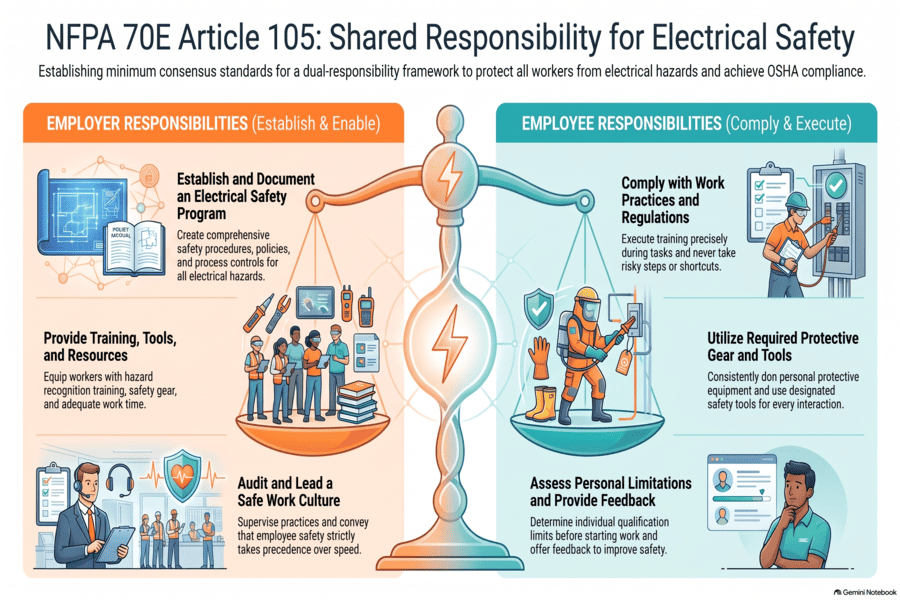
Electrical safety is a shared operational burden that requires synchronized commitment, clear boundaries of accountability, and a healthy safety culture. Section 105.3 structures workplace accountability into two distinct operational pillars: employer systemic management and employee procedural adherence.
Operational Category | Employer Responsibilities (Section 105.3(A)) | Employee Responsibilities (Section 105.3(B)) |
Primary Systemic Duty | Establish, document, and implement the Electrical Safety Program (ESP) under Sections 110.4 and 110.5; explicitly integrate the ESP into any overarching Occupational Health and Safety Management System (OHSMS). | Comply with all safety-related work practices, policies, and procedures established by the employer and mandated by the ESP. |
Statutory Mandate | Furnish an employment environment free from recognized hazards causing or likely to cause harm (OSHA Act Sec. 5(a)). | Adhere to occupational safety standards, rules, regulations, and orders applicable to personal actions and conduct (OSHA Act Sec. 5(b)). |
Implementation, Training & Oversight | Provide comprehensive safety training, maintain active supervisory oversight, and perform routine program auditing to ensure audit-ready compliance. | Put training into practice; utilize required tools, test equipment, personal protective equipment (PPE), and safety gear. |
Operational Support & Technical Expertise | Allocate necessary operational assets, time, and scheduling; leverage labor-management cross-functional teams and outside experts when internal expertise is lacking. | Provide operational feedback to management to continuously improve safety procedures, training efficacy, and work practices. |
Leadership Model & Cultural Boundaries | Demonstrate expected safety behaviors; convey and enforce that safety strictly takes precedence over task execution speed. | Exercise self-discipline, maintain hazard awareness, and assess personal limitations regarding qualifications before executing a task. |
A robust safety culture relies on management enforcement combined with worker self-discipline. Section 105.3(A) highlights that where an organization maintains an overarching Occupational Health and Safety Management System (OHSMS), the Electrical Safety Program (ESP) must not exist in isolation; it must be fully integrated into that enterprise safety management framework. Furthermore, developing and executing effective ESP procedures requires active collaboration between labor and management, utilizing cross-functional teams and engaging third-party experts when internal technical capacity is lacking.
From an operational perspective, leadership sets the organizational tone regarding speed versus safety. If supervisors implicitly or explicitly prioritize rapid task completion over safety protocols, workers perceive velocity as the true operational metric. This creates a psychological feedback loop that induces personnel to bypass voltage verification, omit Lockout/Tagout (LOTO) steps, or skip PPE donning. Conversely, while employers must provide training, assets, and auditing, real-time risk reduction ultimately depends on worker compliance. An employer can establish rigorous safety programs, but the individual worker makes the final behavioral decisions on the shop floor. Preventing electrical injuries requires both organizational commitment and individual discipline.
Understanding these shared operational responsibilities provides the necessary context to navigate the broader organization of Chapter 1 within NFPA 70E.
- Architectural Overview of Chapter 1 (Section 105.5)
Section 105.5 outlines the structural roadmap for Chapter 1 of NFPA 70E. The chapter is organized into five sequential articles designed to guide organizations through a systematic methodology for managing electrical hazards from definition to execution:
- Article 100 — Definitions: Establishes essential terms and specialized vocabulary required to accurately interpret and apply the standard across all covered functions.
- Article 105 — Application of Safety-Related Work Practices: Establishes the standard’s scope, core purpose, and explicit division of responsibility between employers and employees.
- Article 110 — General Requirements for Electrical Safety-Related Work Practices: Outlines the baseline practices, administrative controls, and program structures (including training and ESP mandates) required before employees interact with electrical equipment.
- Article 120 — Establishing an Electrically Safe Work Condition: Details the mandatory operational steps required to eliminate electrical hazards by de-energizing equipment, executing lockout/tagout, verifying zero voltage, and applying temporary protective grounds.
- Article 130 — Work Involving Electrical Hazards: Governs justified interaction with energized electrical conductors and circuit parts, outlining the technical requirements for energized work permits, approach boundaries, arc flash risk assessments, and personal protective equipment (PPE).
To evaluate your operational understanding of these foundational principles, regulatory relationships, and compliance mandates, complete the following diagnostic assessment.