


What You’ll Learn
- Why NFPA 70E by itself does not amount to a complete electrical safety program
- The two recognized management-system frameworks Annex P points to: ANSI/AIHA Z10 and ISO 45001
- How the Deming Plan-Do-Check-Act cycle drives continual improvement of an electrical safety program
- The shared management-system definitions of hazard, incident, and risk
- How the Z10 hierarchy of controls orders risk reduction — and why the highest practical control wins
- Why the strongest electrical safety programs are built jointly by electrical experts and safety professionals
A Standard Is Not a System
Injuries from electrical energy remain a significant cause of occupational fatalities in the United States, and NFPA 70E specifies requirements aimed squarely at the hazards of electrical energy. But an electrical safety program built on 70E alone is incomplete. Annex P states the point directly: by itself, the standard does not constitute a comprehensive and effective electrical safety program. Its requirements do their best work when they are implemented inside the framework of a recognized occupational health and safety management system — the kind of structure that wraps the technical rules in leadership, planning, evaluation, and review, and keeps them improving instead of merely existing.
The Frameworks: ANSI/AIHA Z10 and ISO 45001
An occupational health and safety management system is the organized structure an employer uses to manage safety the way it manages any other business function: deliberately, with assigned responsibility and feedback. ANSI/AIHA Z10, the American National Standard for Occupational Health and Safety Management Systems, defines the minimum basic requirements for an organization’s overall system. It addresses management leadership, employee participation, planning, implementation, evaluation, corrective action, and management review, and it covers basic activities such as incident investigation, inspections, and training. ISO 45001 provides comprehensive guidance on the same elements and is recognized internationally, much as ANSI/ISO 14001 does for environmental management. Some companies run proprietary systems of their own — but those are typically aligned with the key elements of Z10 and ISO 45001, so Annex P’s guidance on implementing 70E applies within them as well.
The Engine of Improvement: Plan, Do, Check, Act
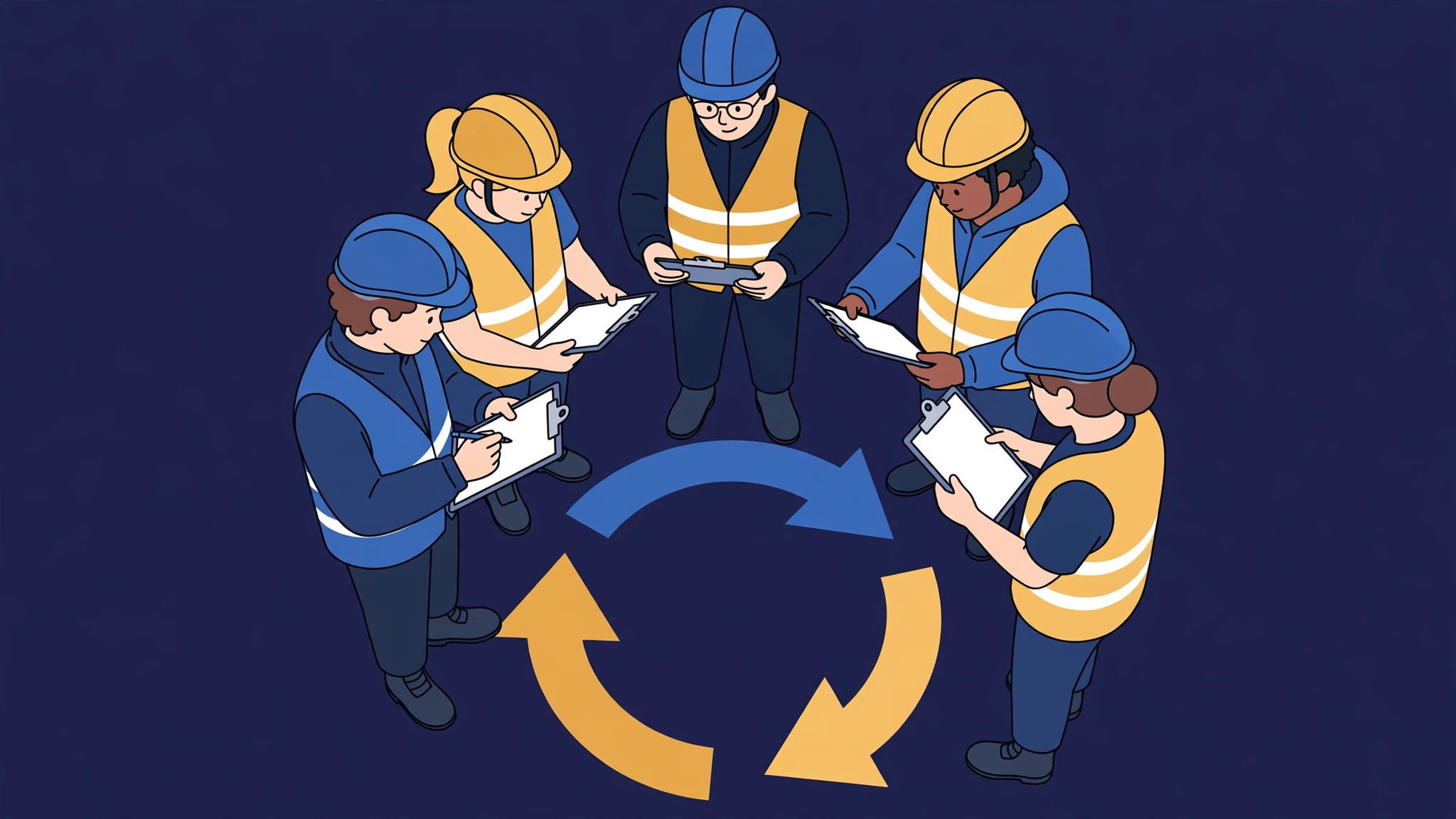
The Plan-Do-Check-Act cycle — the Deming Cycle, also known as the Shewhart Cycle or PDSA (plan-do-study-act) — is the iterative, four-step management process that Z10-style systems use for continual improvement, and it is the mechanism Annex P highlights for running an electrical safety program. In the Plan phase, the objectives and the processes necessary to deliver the expected result are established. In the Do phase, the new process is implemented on a small scale, to test its possible effects before committing the whole organization. In the Check phase, the new process is measured and the results are compared against the expected results, so any differences stand out. In the Act phase, those differences are analyzed to find their causes, and the changes to be made — and where they apply — are determined. If a pass through the four steps produces no improvement, the organization returns to the original base and runs the cycle again. The underlying principle is reiteration: the cycle repeats in ever-tightening circles of increasing knowledge about the system, converging on its goals. Small steps from a solid base generate feedback that tests assumptions, and if a small misstep is taken, repeating the previous iteration is easy. The power of the concept lies in its simplicity.
Speaking the Same Language: Hazard, Incident, Risk
A management system runs on shared definitions, and Annex P carries the Z10 meanings of three words every electrical program uses daily. A hazard is a condition, set of circumstances, or inherent property that can cause injury, illness, or death. An incident is an event in which a work-related injury or illness — regardless of severity — or a fatality occurred, or could have occurred; it is what many workplaces informally call a close call or near miss when nobody was hurt. Risk is an estimate of the combination of two factors: the likelihood of an occurrence of a hazardous event or exposure, and the severity of the injury or illness that event or exposure may cause. When the electrical program and the wider safety system define these words identically, electrical events can be investigated, recorded, and trended inside the same system as every other workplace event — instead of living in a separate vocabulary nobody else in the organization speaks.
The Hierarchy of Controls
The hierarchy of controls in Z10 offers a methodical approach to reducing the risk associated with a hazard, ordering the methods from most effective to least effective: elimination, substitution, engineering controls, warnings, administrative controls, and PPE. NFPA 70E specifically covers electrical safety controls, and it works within this same ordering. The governing rule is to use the highest level of control that is practical. In many cases that is a single control — but frequently a combination of controls is the most effective method, particularly where a higher-order control such as substitution is not practical or does not reduce the risk to an acceptable level by itself. In that case, lower-order controls combine: warnings and PPE, for example, might be most effective together when performing tasks such as testing equipment or creating an electrically safe work condition. The use of arc-resistant switchgear can be considered a substitution or an engineering control. Administrative controls include items such as job planning, training, work procedures and practices, and temporary barricades.
Built Together: Electrical Experts and Safety Professionals
The joint effort Annex P calls for pairs two kinds of expertise on purpose. Electrical subject matter experts know the hazards, the equipment, and the technical content of 70E. Safety professionals know safety management systems — the proven principles and practices, applicable to any hazard in the workplace, that make a program planned, checked, and corrected rather than merely written. Neither group produces the strongest program alone: technical experts can write correct rules the organization never quite manages into daily practice, and management specialists can build a tidy system that misses electrical specifics. The annex’s conclusion is that the most effective design and implementation of an electrical safety program is achieved through collaboration between the two — so that proven safety management principles are appropriately incorporated into the electrical safety program.
Worked Scenario
A manufacturing plant has competent 70E procedures — lockout/tagout, energized work permits, PPE requirements — but its incident reviews keep surfacing the same pattern: the procedures exist, while audits, training records, and corrective actions quietly drift. The plant folds the electrical safety program into its Z10-based management system and runs a PDCA cycle on its weakest point. Plan: it sets an objective that every energized diagnostic task be covered by a documented job plan, and names an owner. Do: a new job-planning form is piloted with one maintenance crew for a month. Check: completed forms are compared against the work actually performed, and the comparison shows the forms are being filled in after the job rather than before it. Act: the cause is traced to the form living in an office the crew rarely visits, so planning is moved into the pre-job briefing itself and the change is standardized for all crews. The next cycle starts from that improved base, and the electrical program is now examined in the same management review as the rest of the safety system — which is exactly the alignment Annex P describes.
Common Mistakes and Safety Notes
- Treating 70E compliance as the whole program. The standard supplies electrical requirements; the management system supplies the leadership, evaluation, and corrective action that keep those requirements alive.
- Running PDCA once and framing the result. The cycle is built on reiteration — if a pass produces no improvement, return to the base and process it again.
- Reaching for PPE first because it is fast. The hierarchy runs from elimination down to PPE; the highest practical control is the one to use, and combinations beat defaults.
- Using near-miss language loosely. Under the shared definitions, an incident includes events where injury or illness could have occurred — close calls belong in the system, not in hallway conversation only.
- Writing the electrical program in isolation. A program designed by electrical experts without safety-management input — or the reverse — misses half of what Annex P says makes it effective.
Summary
Annex P explains that NFPA 70E, by itself, does not constitute a comprehensive and effective electrical safety program — its requirements achieve their most effective application within the framework of a recognized health and safety management system such as ANSI/AIHA Z10 or ISO 45001. Those systems run on continual improvement through the Deming Plan-Do-Check-Act cycle: plan the change, do it small, check the results against expectations, and act on the causes of any difference, then repeat. They also share precise definitions — a hazard can cause injury, illness, or death; an incident includes events that could have caused harm; risk combines likelihood and severity. The Z10 hierarchy of controls orders risk reduction from elimination through substitution, engineering controls, warnings, and administrative controls down to PPE, with the highest practical control — or an effective combination — preferred. And the program itself is best designed and implemented jointly, by electrical subject matter experts working with safety professionals who know management systems.
Quick-Check Questions
1. Why does Annex P say NFPA 70E alone is not a complete electrical safety program?
Answer: Because the standard specifies requirements for electrical hazards but does not by itself constitute a comprehensive and effective program — it works most effectively inside a recognized health and safety management system.
2. What are the four phases of the Deming cycle, in order?
Answer: Plan (establish objectives and processes), Do (implement on a small scale), Check (measure and compare results against expectations), and Act (analyze differences and decide the changes).
3. How does Z10 define risk?
Answer: As an estimate of the combination of the likelihood of an occurrence of a hazardous event or exposure, and the severity of the injury or illness that may be caused by it.
4. In what order does the Z10 hierarchy of controls rank its methods?
Answer: From most effective to least effective: elimination, substitution, engineering controls, warnings, administrative controls, and PPE.
5. Who should build the electrical safety program together?
Answer: Electrical subject matter experts and safety professionals knowledgeable about safety management systems, working in a joint effort.
Based on NFPA 70E (2024), Informative Annex P, paraphrased for study.
Video lesson for this module is in production — coming soon.
Quiz for this module is being prepared.
Flashcards for this module are being prepared.
