



Standard Arrangement
- Introduction to the NFPA 70E Structural Blueprint
Article 90 serves as the operational baseline for NFPA 70E, establishing the administrative and structural rules required to develop, audit, and enforce workplace electrical safety programs. Within this introductory article, Section 90.4 functions as the master architectural blueprint for the standard. For safety directors, facility managers, and compliance inspectors, mastering Section 90.4 provides a foundational roadmap to navigate the document efficiently, interpret its mandate accurately, and apply its safety rules across diverse industrial and commercial environments.
To appreciate the design of NFPA 70E, one must understand its place within the broader national electrical safety ecosystem. The standard operates alongside two other foundational documents: NFPA 70® (National Electrical Code® / NEC®), which governs safe installation, and NFPA 70B (Standard for Electrical Equipment Maintenance), which governs preventive equipment maintenance. All three technical committees report to the NFPA via the NEC Correlating Committee. This tripartite structure ensures total consistency across installation, maintenance procedures, and safe work practices.
Within Article 90, the standard establishes its fundamental legal and practical scope:
- Purpose & Scope (Sections 90.1 & 90.2): Defines the ultimate objective of NFPA 70E—providing a practical safe working area for employees relative to electrical hazards through the execution of safety-related work practices.
- Workplace Boundaries (Section 90.3): Clarifies where the standard applies. NFPA 70E governs premises wiring on the load side of the service point. On the line side of the service point, utility-type rules (such as ANSI C2 / National Electrical Safety Code®) apply. On the load side, the employer maintains full responsibility for equipment safety across its entire life cycle.
- The Default AHJ Role: Because NFPA 70E is rarely incorporated directly into statutory law, employers voluntarily utilize its prescriptive requirements to fulfill performance-based OSHA mandates (such as 29 CFR 1910 Subpart S). Consequently, both the employer and employee act by default as the “Authority Having Jurisdiction” (AHJ) when proactively implementing and enforcing these safety provisions before an incident occurs.
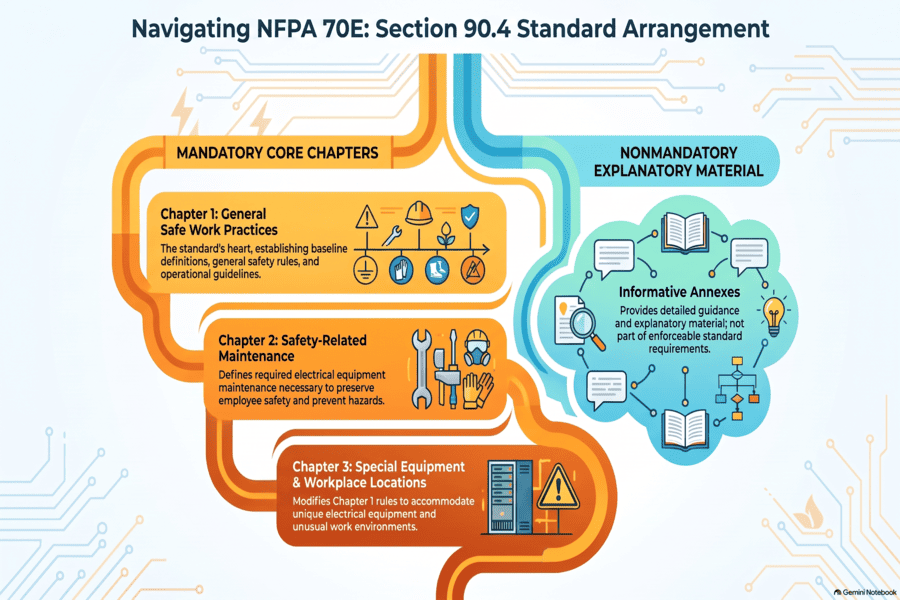
Once these administrative parameters are set, Section 90.4 establishes the structural organization of the standard into three primary divisions:
- Introduction: Article 90, establishing scope, purpose, standard arrangement, rule classification (mandatory, permissive, explanatory), and formal interpretation mechanisms.
- Three Core Chapters: Chapters 1, 2, and 3, which contain the enforceable work practices, safety maintenance protocols, and specialized equipment modifications.
- Informative Annexes: Supplementary materials that offer technical guidance, procedural matrices, and risk assessment models.
Understanding this macro-structure allows facility leaders to navigate the functional responsibilities assigned to each of the three core chapters.
- Functional Breakdown of Chapters 1, 2, and 3
The functional logic of NFPA 70E relies on a clear division of labor between baseline work procedures, equipment upkeep, and specialized exceptions. When auditing an electrical safety program, instructors and consultants emphasize that general safe work rules must remain uniform across an enterprise, while equipment maintenance and specialized machinery require dedicated procedural treatment.
Chapter 1: General Requirements
Chapter 1 is recognized as the “heart of the standard.” It establishes the universal definitions, core concepts, and primary safe work procedures required across all workplaces. Chapter 1 sets forth mandatory safeguards, including the process for establishing an Electrically Safe Work Condition (ESWC), conducting risk assessments, and applying the Hierarchy of Risk Control (HoRC) methods mandated in Section 110.3(H). Its provisions apply generally to all employee interactions with electrical equipment.
Chapter 2: Safety-Related Maintenance Requirements
Chapter 2 addresses the maintenance conditions necessary to protect workers from electrical hazards such as arc flash and shock. Proper installation and maintenance directly determine whether equipment will perform safely during routine operation. Chapter 2 dictates that electrical equipment must be maintained in accordance with the manufacturer’s specific instructions or, in their absence, the principles of NFPA 70B. Together, Chapters 1 and 2 establish the universal baseline for electrical safety in all employee workplaces.
Chapter 3: Special Equipment & Unique Occupancies
Chapter 3 modifies or supplements the general requirements of Chapter 1 when applied to specialized electrical equipment, unique systems, or specific occupancies (such as electrolytic cells, research labs, or battery rooms). When standard Chapter 1 practices might prove impractical or introduce additional hazards due to the unique physics or layout of specialized equipment, Chapter 3 adjusts the work procedures to maintain safety without compromising operational viability.
Chapter | Primary Focus & Function | Workplace Application |
Chapter 1: General Requirements | Serves as the heart of the standard; defines core terminology, general rules, and fundamental safe work practices. | Applies generally across all employee workplaces and electrical safety programs. |
Chapter 2: Safety-Related Maintenance Requirements | Establishes safety-related maintenance criteria for equipment, referencing manufacturer instructions or NFPA 70B when instructions are absent. | Applies generally to all workplace equipment to ensure maintenance-related hazards do not compromise worker safety. |
Chapter 3: Special Equipment & Unique Occupancies | Modifies or supplements Chapter 1 general rules for unique equipment, specialized systems, or specific workplace occupancies. | Applied selectively when specialized equipment or unique environments make general Chapter 1 rules unsafe or impractical. |
Moving beyond the enforceable chapters requires a clear technical understanding of how nonmandatory elements support compliance.
- The Enforceability and Purpose of Informative Annexes
Translating high-level mandates into daily workplace routines requires operational context. For facility engineers and safety managers, the background material and technical guidance included at the back of the standard are essential for constructing practical safety policies.
Under Section 90.4 and Section 90.5(D), Informative Annexes are explicitly designated as nonmandatory. They are provided strictly for informational and explanatory purposes and are not an enforceable part of the standard’s core requirements. They do not contain mandatory terminology (shall or shall not), and authority inspectors cannot cite facility managers for failing to follow an annex alone.
However, safety professionals must recognize a critical technical distinction outlined in Section 90.5(C) regarding explanatory material:
- Informational Notes & Informative Annexes: Explanatory only, non-enforceable, and containing no mandatory directives.
- Table Footnotes: Located beneath tables within the body of Chapters 1 through 3, footnotes are mandatory and fully enforceable. The contents and parameters of a table apply only within the boundaries defined by its footnotes.
Despite their nonenforceable legal status, Informative Annexes carry immense practical value. Each annex addresses a specific topic—such as Informative Annex F, which provides detailed guidance on implementing the Hierarchy of Risk Control (HoRC) methods. These annexes provide the frameworks, calculation methods, and administrative templates necessary to successfully execute the mandatory safety requirements established in Chapters 1, 2, and 3.
