



What you’ll learn
After this post, you will be able to explain what a synchroscope does, how its rotating field and unrestrained pointer work, what clockwise and counter-clockwise rotation tell you about the incoming generator’s speed, and why the pointer must be at 12 o’clock before two generators may be paralleled.
The dial that says when two generators may join
A synchroscope indicates when two AC generators are in the correct phase relation for paralleling, and whether the incoming generator is running faster or slower than the generator already on line. Paralleling two generators out of phase is not a small mistake — it can drive huge circulating currents and damage both machines — so the synchroscope is the instrument the operator watches before closing the paralleling breaker. It answers two questions at once: are the frequencies matched, and are the voltages in phase?
Inside it, a two-phase stator has two stator windings at right angles, with a phase-splitting network making one phase current lead the other by 90°, which generates a rotating magnetic field. The stator windings connect to the incoming generator, and a polarising coil connects to the running generator. The rotating element is unrestrained — free to rotate a full 360° — made of two iron vanes mounted in opposite directions on a shaft, top and bottom, magnetised by the polarising coil. The rotating field from the incoming machine drags those vanes around, and the pointer follows them.
Clockwise means faster, counter-clockwise means slower
If the two frequencies differ, the pointer rotates at the difference speed — the speed of the difference between the incoming and running frequencies. Clockwise rotation means the incoming frequency is higher than the running generator’s frequency: the incoming machine is running fast, so slow it down. Counter-clockwise rotation means the incoming frequency is lower: the incoming machine is running slow, so speed it up. The faster the pointer spins, the bigger the frequency difference; as you adjust the incoming machine’s speed toward the running machine’s, the pointer slows, then creeps, then stops. A stopped pointer means the frequencies match — but matching frequency is only half the job. The pointer must also be at the right place.
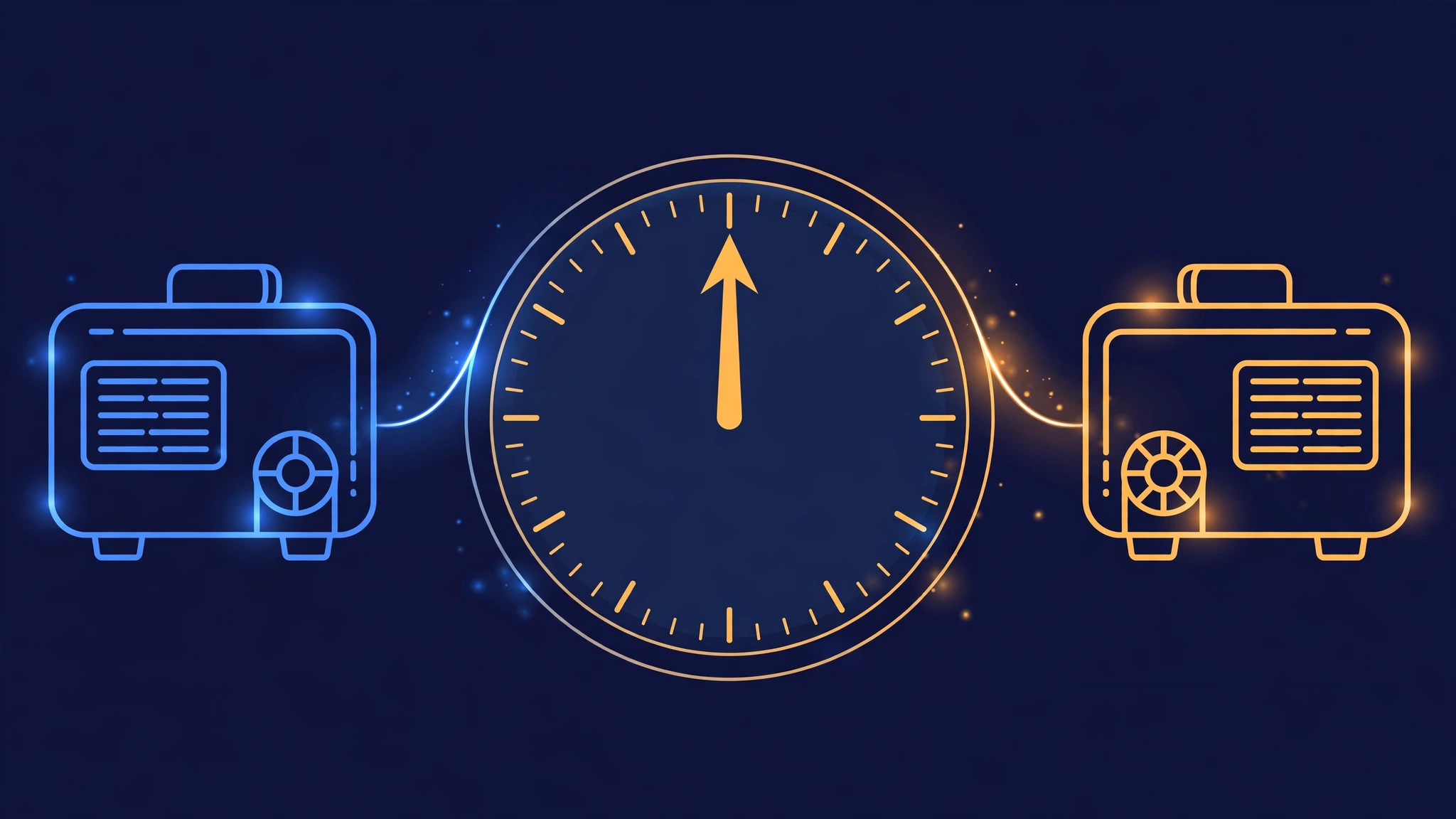
At 0° phase difference the pointer is at “12 o’clock” and the generators are in phase. That is the moment to parallel: same frequency, same phase, pointer sitting at the top of the dial. Close the breaker then — not while the pointer is sweeping past, not at 6 o’clock, and not while it is still rotating. This chapter gives no numeric worked example, so here is a walkthrough built from the chapter’s rules and flagged as such. Imagine the pointer is sweeping clockwise, fairly fast. The reading is: the incoming generator is running faster than the on-line machine, and the sweep speed is the frequency difference. You ease the incoming machine’s speed down; the sweep slows, then the pointer creeps clockwise, then stops — but it stops at 4 o’clock. Frequencies now match, but the phases do not: wait for the pointer to drift to 12 o’clock — a tiny speed nudge moves it — and close the breaker the moment it sits at the top. That is the whole procedure in one dial: direction tells you which way to adjust, speed tells you how far off you are, and 12 o’clock tells you when to close.
Common mistakes
- “Close the breaker as soon as the pointer stops.” A stopped pointer means the frequencies match — but the phases may still be apart. The pointer must be stopped at 12 o’clock, the 0° position, before paralleling.
- “Clockwise means the incoming machine is slow.” The opposite: clockwise rotation means the incoming frequency is higher than the running generator’s — the incoming machine is running fast, so slow it down. Counter-clockwise means it is running slow.
- “The pointer spins at the incoming generator’s speed.” It rotates at the difference speed — the difference between the incoming and running frequencies. The faster the sweep, the bigger the mismatch.
- “Paralleling out of phase is a small error.” It is the accident the synchroscope exists to prevent: closing on two generators out of phase can drive huge circulating currents and damage both machines. Wait for 12 o’clock.
- “The synchroscope measures voltage.” It indicates phase relation and relative frequency for paralleling. The stator connects to the incoming generator and the polarising coil to the running generator — it compares the two machines, it does not read a voltage value.
- “The pointer is spring-loaded back to zero.” It is unrestrained, free to rotate a full 360° — that is why it can sweep around the dial continuously while the frequencies differ, instead of pegging at one end.
Summary
A synchroscope tells you when two AC generators may be paralleled: its two-phase stator, fed by the incoming generator through a phase-splitting network, makes a rotating magnetic field that drags an unrestrained pair of iron vanes — magnetised by the polarising coil from the running generator — around the dial. Clockwise means the incoming machine is fast, counter-clockwise means it is slow, and the sweep speed is the frequency difference. Adjust the speed until the pointer slows and stops, then wait for it to sit at 12 o’clock — 0° phase difference, generators in phase — and only then close the breaker. Direction, speed, and 12 o’clock: that is the whole instrument in three readings.
Quick-check questions
- What does a synchroscope indicate?
- How does the synchroscope make its rotating magnetic field?
- What does clockwise rotation mean, and what does counter-clockwise mean?
- What does the pointer’s rotation speed tell you?
- When may two generators be paralleled, and what does 12 o’clock mean?
Answers
- When two AC generators are in the correct phase relation for paralleling, and whether the incoming generator is faster or slower than the on-line generator.
- A two-phase stator with two windings at right angles, with a phase-splitting network making one phase current lead the other by 90°, generating a rotating magnetic field. The stator connects to the incoming generator; a polarising coil connects to the running generator.
- Clockwise means the incoming frequency is higher than the running generator’s (incoming machine fast — slow it down). Counter-clockwise means the incoming frequency is lower (incoming machine slow — speed it up).
- The pointer rotates at the difference speed — the difference between the incoming and running frequencies. Faster sweep means a bigger frequency mismatch.
- When the pointer is at “12 o’clock” — 0° phase difference, the generators in phase — with matching frequency. Close the breaker then, not while the pointer is sweeping or stopped elsewhere.
Based on DOE-HDBK-1011/92, Electrical Science, Module 14, paraphrased for study.

Report a question

Top 10 Scorers
| Pos. | Name | Score | Duration |
|---|---|---|---|
| There is no data yet |

What does a synchroscope indicate?
How does the synchroscope generate its rotating magnetic field?
What connects to the stator windings, and what connects to the polarising coil?
What is the synchroscope’s rotating element made of, and how is it held?
What does clockwise rotation of the synchroscope pointer mean?
What does counter-clockwise rotation of the synchroscope pointer mean?
What does the pointer’s rotation speed tell you?
When may two generators be paralleled?
The pointer is sweeping clockwise, fairly fast. What is happening, and what should the operator do?
The pointer has stopped, but it stopped at 4 o’clock. May the operator close the breaker?
