



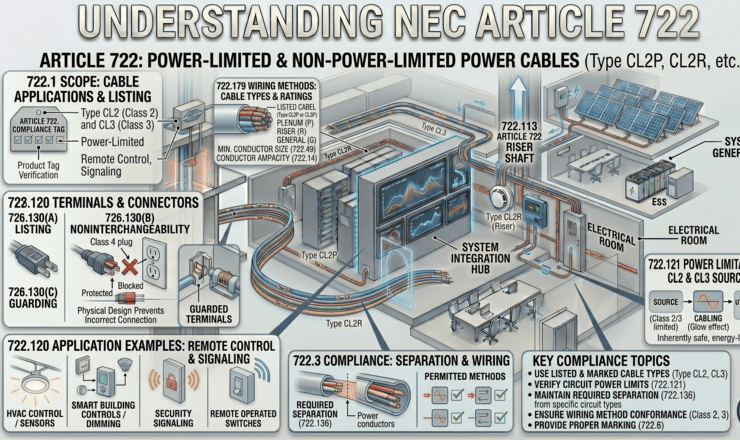
Understanding NEC Article 722: Cables for Power-Limited Circuits and Fault-Managed Power Systems
The National Electrical Code (NEC) is constantly evolving to keep pace with rapid advancements in electrical technology. One of the most significant structural changes introduced in recent code cycles is the consolidation of low-voltage and power-limited cable requirements into a single, unified location. For modern electricians, low-voltage technicians, and electrical engineers, Understanding NEC Article 722 is absolutely vital. This article serves as the central hub for the installation and listing requirements of cables used in Class 2, Class 3, Class 4, and Power-Limited Fire Alarm (PLFA) circuits.
The Purpose of Code Consolidation
Before this update, electrical professionals had to flip back and forth between multiple code sections—such as Article 725 for remote-control and signaling circuits, and Article 760 for fire alarms—to find cable specifications. Understanding NEC Article 722 simplifies this process. By extracting the cable routing, mechanical execution, and listing requirements from those various locations and placing them under one umbrella, the NEC has made it significantly easier to reference and apply safe wiring practices for power-limited systems.
The Scope of the Article
To properly apply these guidelines in the field, it is important to know exactly what this section covers. Understanding NEC Article 722 requires familiarization with the four primary types of cables it governs:
-
Class 2 and Class 3 Cables: These are the backbone of modern smart buildings. They include cables used for building automation, security systems, remote-control circuits, signaling, and Power over Ethernet (PoE) applications.
-
Class 4 Cables: This is an entirely new classification covering Fault-Managed Power Systems (FMPS). These innovative systems can deliver higher power levels over longer distances safely because they constantly monitor the circuit for faults and will shut down power in milliseconds if a human touch or short circuit is detected.
-
Power-Limited Fire Alarm (PLFA) Cables: These cables are specifically manufactured and listed for use in critical life-safety fire alarm systems.
Key Installation and Routing Guidelines
A major component of Understanding NEC Article 722 revolves around the physical installation of these cables. Low-voltage cables may not carry the same immediate shock hazards as traditional 120V or 277V power lines, but improper installation can lead to system failures, data corruption, or fire risks.
1. Mechanical Execution of Work The code mandates that all cables must be installed in a neat and workmanlike manner. Cables must be properly supported by the building structure using designated hardware such as J-hooks, cable trays, or raceways. They cannot simply be draped over drop ceiling grids, ductwork, or sprinkler pipes.
2. Separation from Power Conductors When Understanding NEC Article 722, one of the most critical safety rules is maintaining physical separation between power-limited cables and non-power-limited cables (like standard light and power circuits). In most cases, Class 2, Class 3, and PLFA cables must be separated by at least two inches from standard electric light or power conductors to prevent electrical interference and mitigate the risk of high voltage bleeding into low-voltage systems.
3. Cable Substitutions The article provides detailed hierarchy charts outlining which cables can be substituted for others. For instance, a Class 3 cable can typically be substituted for a Class 2 cable because it is built to handle higher voltage and power limits. However, the reverse is not allowed.
The Introduction of Class 4 (FMPS) Cables
Perhaps the most exciting reason for Understanding NEC Article 722 is the integration of Class 4 Fault-Managed Power Systems. Because FMPS technology is actively monitored for safety, it acts differently than traditional power-limited circuits. Article 722 provides specific listing requirements for Class 4 cables, ensuring they have the proper insulation thickness, voltage ratings, and copper gauge sizes to safely handle digital electricity distribution in commercial and industrial environments.
Conclusion
The electrical landscape is changing, with more buildings relying on PoE, smart lighting, and fault-managed power than ever before. Understanding NEC Article 722 is no longer just for specialized low-voltage technicians; it is a critical competency for any modern electrical professional. By centralizing the rules for Class 2, 3, 4, and PLFA cables, this article makes it easier to design, install, and inspect the complex communication and power-limited networks that keep today’s high-tech buildings running safely and efficiently.
