



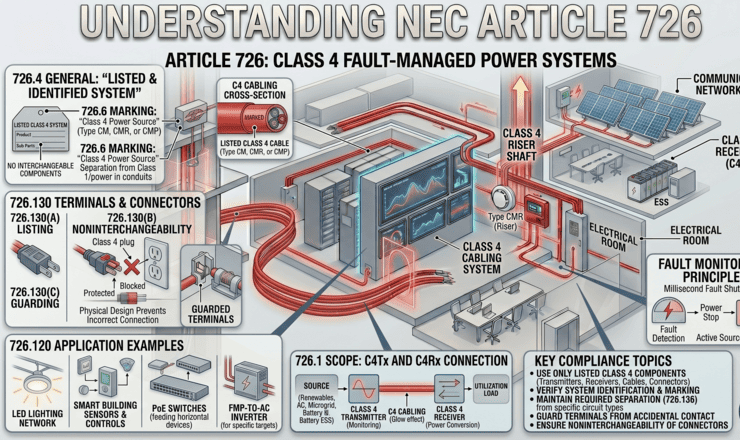
Understanding NEC Article 726: A Guide to Class 4 Fault-Managed Power Systems
The National Electrical Code (NEC) is constantly evolving to keep pace with groundbreaking technological advancements in the electrical industry. One of the most significant and revolutionary additions in recent years occurred in the 2023 edition with the introduction of Class 4 power systems. For modern electrical contractors, designers, and inspectors, Understanding NEC Article 726 is absolutely essential. This new article officially establishes the safety and installation framework for Fault-Managed Power Systems (FMPS), a technology that combines high-power delivery with unprecedented, touch-safe protection.
What is NEC Article 726?
At its core, Understanding NEC Article 726 means familiarizing yourself with an entirely new classification of power: Class 4 circuits. Before the 2023 NEC update, the code heavily relied on Class 2 and Class 3 circuits (found in Article 725) for low-voltage, power-limited applications like Power over Ethernet (PoE). While these classes are safe, they are severely restricted in both the amount of power they can deliver (typically capped at 100 watts) and the distance that power can travel due to voltage drops.
NEC Article 726 shatters those old limitations. It introduces guidelines for Fault-Managed Power Systems, which are permitted to operate at much higher voltages—up to 450 volts DC or AC—and deliver thousands of watts over extended distances (sometimes up to 2 kilometers). Despite these high power levels, Class 4 circuits do not require traditional heavy conduit or thick-gauge wiring. Instead, they rely on intelligent, active fault-monitoring technology to maintain safety.
How Fault-Managed Power Systems (FMPS) Work
The magic behind Class 4 circuits lies in the term “fault-managed.” When Understanding NEC Article 726, it is crucial to recognize that these systems do not limit power—they limit fault energy.
A typical FMPS setup includes a specialized transmitter and a receiver. The transmitter sends power across the cables in discrete, rapid pulses. Between every single pulse, the system monitors the line for any abnormalities or faults. According to the guidelines set out in the article, the system must actively monitor for:
-
Line-to-line short circuits
-
Ground faults
-
Overcurrent conditions
-
Unexpected human contact (shock hazards)
-
Series or parallel arc faults
If a person accidentally touches the bare wires, or if a short circuit occurs, the transmitter detects the change in the line’s electrical signature instantly. Within milliseconds, it completely halts the transmission of energy. Because the shutdown happens so incredibly fast, the energy delivered into the fault is kept below the threshold that could cause a fire or an electric shock. This sophisticated “touch-safe” technology allows for high-voltage power distribution to be treated with the same ease of installation as traditional low-voltage cabling.
Installation and Wiring Requirements
A major focus of Understanding NEC Article 726 involves the specific installation protocols required for Class 4 systems. Although FMPS operates at high voltages, the active safety mechanisms allow installers to use wiring methods similar to those used for telecommunications or Class 2/3 circuits, greatly reducing labor and infrastructure costs.
Key installation requirements outlined in the article include:
-
Listed Cables: Conductors used in these systems must be specifically listed and rated for Class 4 applications (e.g., CL4P for plenum spaces, CL4R for riser shafts). These cables must also comply with UL 1400-2 standards.
-
Separation of Circuits: To prevent interference and accidental voltage crossovers, Class 4 cables must be properly separated from traditional Class 1 power and lighting circuits.
-
System Certification: The transmitter, receiver, and all associated equipment must be rigorously tested and listed under UL 1400-1 functional safety standards.
Real-World Applications
Why is the industry so excited about Understanding NEC Article 726? Because it perfectly addresses the growing power demands of modern infrastructure. Traditional AC power distribution requires expensive copper, heavy steel conduit, and highly complex panelboard setups. Meanwhile, traditional PoE cannot deliver enough power for heavy loads.
Class 4 FMPS bridges this gap perfectly. It is ideal for powering intelligent smart buildings, extensive LED lighting grids, 5G cellular nodes, data center server racks, and advanced IoT (Internet of Things) sensor networks. By running a single, easily routed hybrid cable, facilities can deliver both high-speed data and massive amounts of reliable DC power across vast warehouse floors or high-rise office buildings.
Conclusion
The introduction of Class 4 systems represents a massive leap forward in electrical engineering. By thoroughly Understanding NEC Article 726, electrical professionals can stay ahead of the curve and embrace a faster, safer, and much more cost-effective method of power distribution. As smart buildings and energy-hungry technologies continue to dominate the landscape, Fault-Managed Power Systems will undoubtedly become a foundational pillar of modern electrical installations.
