



Understanding NEC Article 750: A Comprehensive Guide to Energy Management Systems
In today’s rapidly evolving electrical industry, energy efficiency and smart technology are at the forefront of building design. As facilities increasingly rely on automated systems to monitor and control electrical usage, Understanding NEC Article 750 has become an essential skill for electricians, engineers, and facility managers. This vital section of the National Electrical Code focuses specifically on Energy Management Systems (EMS). By Understanding NEC Article 750, electrical professionals can ensure that while a building operates at peak energy efficiency, it never does so at the expense of human safety or critical infrastructure reliability.
The Scope of Energy Management Systems
What exactly does this article cover? At its core, Understanding NEC Article 750 requires knowing the definition and scope of an EMS. An Energy Management System is a comprehensive network of devices, sensors, controllers, and software designed to monitor, manage, and optimize the electrical energy consumption within a facility.
These systems are tasked with controlling power from both the primary utility grid and alternate power sources, such as solar panels, battery storage systems, or standby generators. They achieve energy efficiency primarily through “load shedding”—the automated process of turning off non-essential electrical loads when overall demand peaks. However, while saving energy and reducing utility costs are excellent operational goals, the NEC prioritizes human safety above all else. This hierarchy of safety over savings is exactly where the strict rules of this article come into play.
The Golden Rule: What an EMS Cannot Control
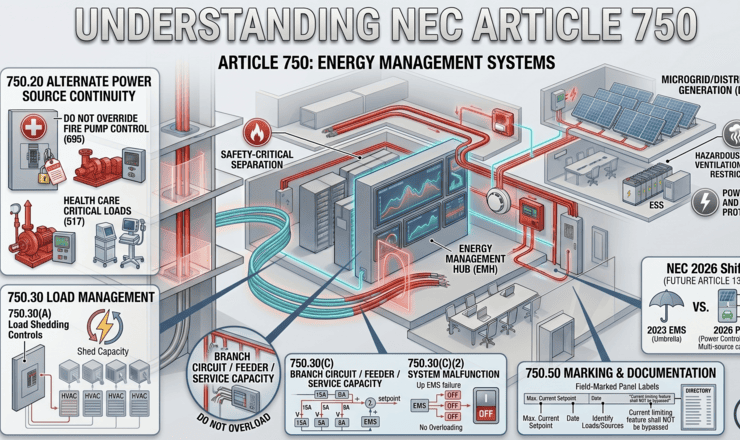
The most critical aspect of Understanding NEC Article 750 is recognizing the hard limits placed on what an EMS is allowed to control or disconnect. The NEC makes it abundantly clear: energy management must never compromise life safety. Therefore, an Energy Management System is strictly prohibited from overriding or shedding loads connected to vital emergency infrastructure.
When Understanding NEC Article 750, you must remember that an EMS cannot disconnect power to systems covered by Article 700 (Emergency Systems), Article 701 (Legally Required Standby Systems), or Article 708 (Critical Operations Power Systems). Furthermore, an EMS is not permitted to shed the load of a fire pump (covered under Article 695), elevators used for emergency egress, or any other equipment essential for human safety and emergency evacuation. If a building’s power capacity reaches its absolute limit, the EMS must shed optional loads like HVAC units, water heaters, or decorative lighting—it must never shed the exit signs, emergency lighting, or life-safety machinery.
Load Management and Service Capacity
Another significant benefit of Understanding NEC Article 750 is realizing how it applies to electrical service sizing and complex load calculations. In many modern residential and commercial installations, upgrading a building’s main electrical service to accommodate new heavy loads—such as an array of Level 2 Electric Vehicle (EV) chargers—can be prohibitively expensive or physically impossible.
By utilizing an EMS as described in Article 750, a facility can dynamically manage these loads. The EMS continuously monitors the total current drawn through the service or feeder. If the electrical load approaches the maximum safe capacity of the conductors or the main breaker, the EMS will automatically shed non-essential loads or throttle down EV charging speeds to prevent an overload condition. Understanding NEC Article 750 allows designers to use these smart systems to maximize existing electrical infrastructure safely, avoiding overloaded neutral wires, excessive heat buildup, or tripped main disconnects.
Interaction with Alternate Power Sources
As the traditional power grid becomes more decentralized, buildings are incorporating multiple local sources of power. Understanding NEC Article 750 is vital for integrating these diverse energy sources safely. An EMS is often the “brain” that decides whether a building should draw power from the utility grid, a localized Battery Energy Storage System (BESS), or a photovoltaic (solar) array.
Article 750 dictates that the EMS must be properly rated and listed for this complex task. It ensures that the system safely switches between power sources without improperly backfeeding the utility grid, which could create incredibly hazardous, life-threatening conditions for utility line workers attempting to repair downed power lines during an outage.
Conclusion
As we move further into an era of smart grids, green energy, and fully automated buildings, the rules governing how we manage electrical loads will only become more prominent. For anyone involved in the design, installation, or inspection of modern electrical systems, thoroughly Understanding NEC Article 750 is not just about basic code compliance. It is about striking the perfect, code-compliant balance between maximum energy efficiency and uncompromising electrical safety. By adhering strictly to these guidelines, we can build smarter, greener, and safer electrical infrastructures for the future.
