



Understanding NEC Article 760: A Comprehensive Guide to Fire Alarm Systems
When it comes to electrical installations, few things are as critical to life safety as a properly functioning fire alarm system. For electricians, inspectors, and facility managers, Understanding NEC Article 760 is not just about passing an exam; it is about ensuring that a building’s early warning system operates flawlessly during a catastrophic emergency. This pivotal section of the National Electrical Code (NEC) governs the installation of wiring and equipment for fire alarm systems.
In this guide, we will break down the essential components of the code, making Understanding NEC Article 760 clearer and easier to apply in your everyday electrical projects.
The Scope and Purpose of Article 760
To begin Understanding NEC Article 760, you must first know what it covers. This article applies strictly to the installation of wiring and equipment for fire alarm systems, including all circuits controlled and powered by the fire alarm system itself. This includes fire detection and alarm notification, guard’s tour, sprinkler waterflow, and sprinkler supervisory systems.
It is important to note that Article 760 does not cover the building’s main power wiring that supplies the fire alarm control panel (FACP). That power supply is covered by standard Chapters 1 through 4 of the NEC. Instead, Article 760 focuses entirely on the circuits radiating out of the panel to the detectors, pull stations, and horns/strobes.
The Two Main Categories: NPLFA and PLFA
A core component of Understanding NEC Article 760 is differentiating between the two primary classifications of fire alarm circuits. The NEC divides these into Non-Power-Limited Fire Alarm (NPLFA) circuits and Power-Limited Fire Alarm (PLFA) circuits.
1. Non-Power-Limited Fire Alarm (NPLFA) Circuits
NPLFA circuits can operate at higher voltages and power levels (up to 600 volts). Because they carry more power, they present a higher risk of shock and fire initiation if damaged. Consequently, Understanding NEC Article 760 requires you to treat NPLFA circuits much like standard light and power circuits.
-
Wiring Methods: NPLFA circuits must be installed using Chapter 3 wiring methods, such as Electrical Metallic Tubing (EMT), Rigid Metal Conduit (RMC), or Type MC cable.
-
Overcurrent Protection: These circuits require specific overcurrent protection, usually located at the point where the conductor receives its supply, ensuring that the heavy power load does not melt the wires during a short circuit.
2. Power-Limited Fire Alarm (PLFA) Circuits
Most modern commercial and residential fire alarm systems utilize PLFA circuits. These circuits have their power output strictly limited by a listed PLFA power source (like a specialized transformer or an internal power supply in the FACP). Because the power is limited, the risk of shock or fire is drastically reduced.
-
Wiring Methods: The rules for PLFA are more relaxed. You can often run these cables exposed without conduit, provided they are supported by the building structure and protected from physical damage.
-
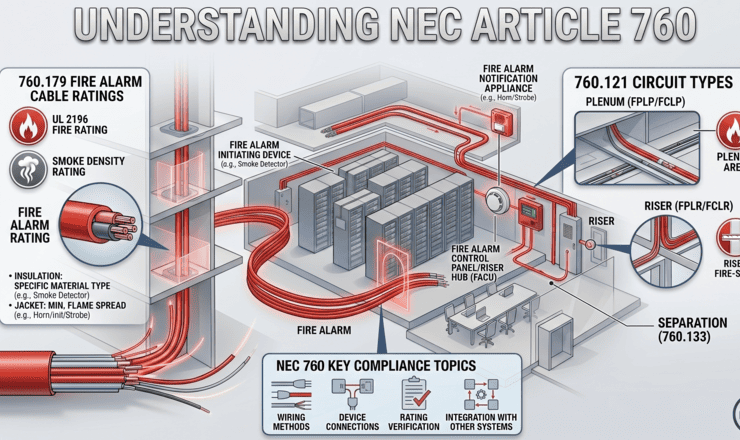
Separation: A critical rule when Understanding NEC Article 760 is that PLFA conductors must be strictly separated from NPLFA and standard power/lighting circuits by at least 2 inches, unless separated by a physical barrier like conduit or wire raceways. This prevents a high-voltage fault from crossing over into the sensitive low-voltage fire alarm system.
Fire Alarm Cable Types and Hierarchy
Another vital aspect of Understanding NEC Article 760 involves selecting the right type of cable for the specific environment. The NEC designates three primary types of power-limited fire alarm cables, along with a strict substitution hierarchy:
-
FPLP (Plenum): These cables are highly fire-resistant and produce very little smoke. They are legally required when running fire alarm wires through environmental air spaces, such as above suspended ceilings used for return air.
-
FPLR (Riser): These cables are designed to prevent the spread of fire from floor to floor in a building. They are required for vertical runs in shafts or penetrating multiple floors.
-
FPL (General Purpose): This is the standard fire alarm cable used in general applications where plenum or riser ratings are not required.
If you are out of a specific cable, Understanding NEC Article 760 allows you to substitute a “higher” rated cable for a “lower” one. For example, you can safely use FPLP (Plenum) in place of FPLR (Riser) or FPL, but you absolutely cannot use standard FPL in a plenum airspace.
Proper Installation and Physical Support
Beyond choosing the right wire, Understanding NEC Article 760 dictates how that wire is physically hung in the building. Fire alarm cables must be installed in a neat and workmanlike manner. Cables must be supported by the structural components of the building using approved hangers, staples, or cable ties. You are strictly prohibited from strapping fire alarm cables to the exterior of other conduits or plumbing pipes for support. Furthermore, where cables pass through floors or fire-rated walls, they must be properly fire-stopped to maintain the integrity of the building’s fire barriers.
Conclusion
Ultimately, Understanding NEC Article 760 is about preserving the integrity of a building’s most critical life-safety system. By mastering the differences between NPLFA and PLFA circuits, adhering strictly to circuit separation rules, and utilizing the correct cable classifications for plenums and risers, electrical professionals ensure that when a fire breaks out, the alarm system will perform exactly as designed. Memorizing and applying these guidelines is the ultimate mark of a responsible, safety-conscious electrical contractor.
