



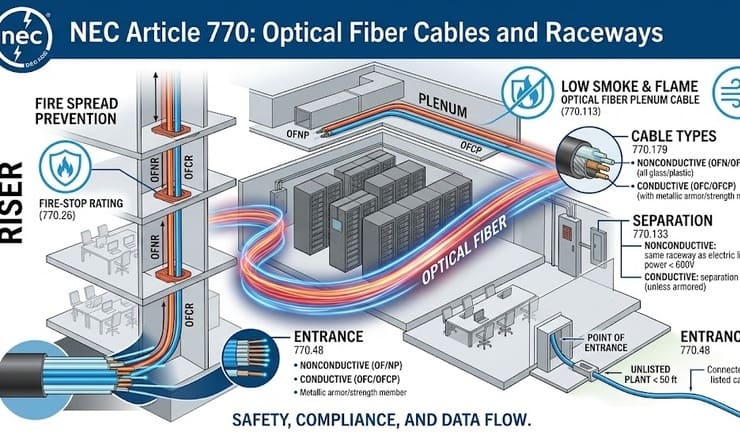
Understanding NEC Article 770: A Comprehensive Guide to Optical Fiber Cables and Raceways
As modern telecommunications and high-speed internet continue to evolve, fiber optic technology has become the backbone of both commercial and residential infrastructure. For electricians, network installers, and systems integrators, navigating the rules surrounding these installations is absolutely critical. Understanding NEC Article 770 is the key to ensuring that optical fiber cables and raceways are installed safely, legally, and efficiently. This section of the National Electrical Code specifically addresses the unique characteristics and hazards associated with transmitting light for control, signaling, and communications.
The Scope of the Code
When you begin Understanding NEC Article 770, the first thing to recognize is its specific scope. Unlike traditional copper wiring that carries electrical current to power devices, optical fiber cables transmit data using pulses of light. Because these cables do not carry electrical energy for power, they are generally immune to electromagnetic interference.
However, they still present unique physical and fire-related hazards that the NEC must regulate. Article 770 covers the installation of optical fiber cables, optical fiber raceways, and the cable routing assemblies used to support them. It applies to both indoor and outdoor installations, ensuring that the integration of fiber optics does not compromise the structural or electrical safety of a building.
Classifications of Optical Fiber Cables
A major component of Understanding NEC Article 770 is learning the three primary classifications of optical fiber cables. Recognizing these distinctions is vital because the installation rules—particularly regarding grounding and separation from power lines—change drastically depending on the cable type:
-
Nonconductive Cables: These cables contain no metallic members and no electrically conductive materials. Because they cannot conduct electricity, they pose the lowest risk of electrical shock or accidental energization.
-
Conductive Cables: These cables contain non-current-carrying conductive members, such as metallic strength members, metallic vapor barriers, or metallic armor. Even though the fiber itself uses light, the metallic components can accidentally become energized or carry lightning strikes, requiring strict grounding protocols.
-
Composite Cables: These cables contain both optical fibers and current-carrying electrical conductors. They are legally treated as electrical cables and must adhere to the rules governing the specific type of electrical circuit they carry, in addition to Article 770.
Fire Resistance and Cable Hierarchies
Another essential element of Understanding NEC Article 770 involves fire safety and cable substitution hierarchies. The NEC strictly dictates where certain cables can be installed based on their fire resistance and smoke-producing characteristics.
-
Plenum Cables (OFNP/OFCP): These have the highest fire-resistance rating and are designed for use in environmental air-handling spaces (plenums). They restrict the spread of fire and produce minimal smoke.
-
Riser Cables (OFNR/OFCR): Designed for vertical runs in shafts or between floors, these cables prevent fire from spreading upward from one floor to another.
-
General-Purpose Cables (OFNG/OFCG): Suitable for standard, horizontal runs where plenum or riser ratings are not required.
The code features a strict substitution hierarchy. A higher-rated cable (like OFNP) can always be substituted for a lower-rated cable (like OFNR or OFNG), but you can never substitute a lower-rated cable into a space that requires a higher fire rating.
Grounding and Bonding Requirements
For installers working with conductive optical fibers, Understanding NEC Article 770 is quite literally a matter of life and safety due to its grounding mandates. When conductive optical fiber cables enter a building from the outside, the metallic members within the cable must be bonded and grounded as close as practicable to the point of entrance.
This prevents dangerous voltage surges—such as those from lightning strikes or accidental contact with high-voltage power lines—from traveling deep into the building’s infrastructure. The grounding conductor must be adequately sized, routed in a straight line, and connected to an approved grounding electrode system.
Separation from Electrical Power Conductors
To prevent accidental energization and interference, Article 770 enforces strict separation rules. Optical fiber cables must be kept separate from the conductors of electric light, power, Class 1, and non-power-limited fire alarm circuits. Generally, a minimum separation of 2 inches is required unless the electrical power conductors are enclosed in a raceway or cable armor, or if the optical fiber is housed within a nonconductive raceway. Understanding NEC Article 770 ensures that you do not inadvertently route delicate optical fibers in a way that creates a hazardous fault condition.
Conclusion
As fiber optic networks become a standard utility in virtually every new building, the importance of code-compliant installations cannot be overstated. Understanding NEC Article 770 protects buildings from fire hazards, safeguards networking equipment from electrical surges, and ensures the safety of the occupants inside. By mastering the classifications, grounding rules, and environmental ratings detailed in this article, electrical professionals can confidently install state-of-the-art optical fiber systems that stand the test of time and inspection.
