



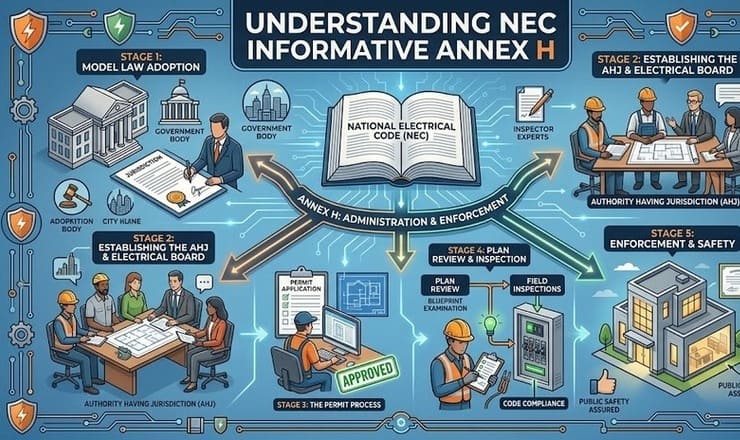
Understanding NEC Informative Annex H: Administration and Enforcement
The National Electrical Code (NEC) is the definitive standard for safe electrical design, installation, and inspection. Its primary goal is to protect people and property from electrical hazards. While the main body of the NEC deals extensively with technical requirements, the administrative side of applying these rules is equally crucial. For municipalities, contractors, and inspectors, Understanding NEC Informative Annex H is essential because it provides a comprehensive, ready-made model for administering and enforcing the code at the local governmental level.
What is NEC Informative Annex H?
Unlike the mandatory chapters of the National Electrical Code (Chapters 1 through 9), the annexes are generally included for informational purposes and are not enforceable unless specifically adopted by local law. However, Annex H offers an incredibly valuable administrative framework. By Understanding NEC Informative Annex H, city councils, building departments, and state governments can establish standardized rules for electrical permits, inspections, and dispute resolution without having to draft complex legal language from scratch. It essentially acts as a “plug-and-play” model ordinance for jurisdictions looking to enforce the NEC legally and uniformly.
The Role of the Authority Having Jurisdiction (AHJ)
The Authority Having Jurisdiction (AHJ), often the Chief Electrical Inspector or the local building department, is the cornerstone of electrical safety enforcement. When Understanding NEC Informative Annex H, one quickly sees how the text clearly outlines the duties, responsibilities, and powers of the AHJ. This individual or entity has the authority to interpret code rules, grant special permission for alternative installation methods, and enforce strict compliance.
Furthermore, the annex details the inspector’s right of entry to premises, their power to issue stop-work orders on unsafe or unauthorized installations, and their critical ability to order the immediate disconnection of power in emergency situations where severe hazards to life or property exist.
The Establishment of an Electrical Board
Another critical element covered in this annex is the establishment and operation of an Electrical Board. For those focused on Understanding NEC Informative Annex H, the creation of this board provides a necessary democratic layer to electrical code enforcement. The board typically consists of experienced industry professionals—such as master electrical contractors, electrical engineers, and building officials.
Their primary function is to review appeals of the inspector’s decisions, ensuring that the AHJ’s rulings are fair and technically sound. They also assist in recommending local amendments to the NEC to suit regional needs and often oversee the licensing of electricians, ensuring that only qualified, competent individuals are performing electrical work in the jurisdiction.
Permits, Inspections, and Approvals
No electrical system can be verified as completely safe without a rigorous permit and inspection process. Understanding NEC Informative Annex H requires familiarization with how, when, and why permits are issued. The annex clearly stipulates that no electrical work should commence without an approved permit, though it does outline sensible, practical exceptions for minor repair work or routine maintenance.
Furthermore, it details the necessary stages of inspection—from the initial rough-in to the final approval. It mandates that work must not be concealed by drywall or insulation before the inspector has the opportunity to verify its compliance with the NEC. This systematic approach guarantees that every phase of an electrical project meets stringent safety standards before the building is occupied.
Connection to the Power Supply
A vital administrative control point detailed in the annex is the connection to the electrical utility. Utility companies are generally prohibited from energizing a new or altered electrical service until the AHJ has issued a certificate of approval. By Understanding NEC Informative Annex H, contractors recognize that passing the final inspection is the absolute gateway to getting the power turned on, reinforcing the authority of the local inspection department.
Violations and Penalties
To give the code teeth, Annex H outlines the procedures for handling violations. It establishes the legal framework for issuing notices of violation and setting timelines for the correction of unsafe work. It also paves the way for jurisdictions to establish penalties, fines, or even the revocation of contractor licenses for individuals who repeatedly ignore safety standards or work without required permits.
Conclusion
In summary, the technical brilliance of the National Electrical Code would be highly ineffective without a strong, organized system of legal enforcement. Understanding NEC Informative Annex H gives electrical professionals, civic leaders, and inspectors a crystal-clear view of how electrical safety is managed on an administrative level. By adopting and adhering to these model guidelines, jurisdictions can ensure a fair, consistent, and rigorous approach to electrical safety, ultimately leading to safer homes, businesses, and communities for everyone.
