



Understanding NFPA 70E Section 90.3: Workplaces Covered and Not Covered
- Introduction and Architectural Scope of Section 90.3
Section 90.3 of NFPA 70E, Standard for Electrical Safety in the Workplace®, serves as the foundational regulatory compass for electrical safety compliance. It defines the boundary conditions of the standard’s scope, delineating where safety-related work practices must be deployed and clarifying how NFPA 70E interacts with Occupational Safety and Health Administration (OSHA) regulations, federal safety mandates, and technical standards established by the National Fire Protection Association (NFPA). Specifically, NFPA 70E forms part of a triad of core electrical standards: NFPA 70®, the National Electrical Code® (NEC®), governs safe installation; NFPA 70B, Standard for Electrical Equipment Maintenance, governs preventive maintenance; and NFPA 70E establishes safety-related work procedures, administrative controls, and human work practice safeguards. All three standards report to the NFPA NEC Correlating Committee to ensure complete alignment across design, installation, maintenance, and workplace operation.
To establish compliance boundaries, safety professionals must understand the fundamental jurisdictional distinction defined in Section 90.3. The NEC applies to electrical installations and premises wiring systems—encompassing any combination of buildings, structures, or grounds. In contrast, NFPA 70E applies directly to employee workplaces located on premises containing those wiring systems. The cross-agency authority of NFPA 70E extends beyond traditional industrial and commercial spaces; for instance, the U.S. Department of Labor’s Mine Safety and Health Administration (MSHA), in formal agreement with OSHA, explicitly endorsed NFPA 70E for “Arc Flash Accident Prevention Best Practices,” extending its protective framework to mining industry workplaces. Because NFPA 70E itself is rarely codified directly into statutory legislation, employers voluntarily adopt its prescriptive requirements to satisfy performance-based OSHA obligations (such as the General Duty Clause and 29 CFR 1910 Subpart S). Because regulatory enforcement often occurs retroactively after a safety incident, both the employer and the employee must function as the de facto Authority Having Jurisdiction (AHJ) to proactively implement, audit, and enforce NFPA 70E safe work procedures before hazards result in harm.
Key Jurisdictional Definitions
- Premises Wiring Systems (NEC Scope): The physical installation of electrical conductors, equipment, raceways, and signaling/communications components across buildings, structures, or grounds.
- Employee Workplace (NFPA 70E Scope): Any premises location containing premises wiring systems where employees perform work tasks, triggering mandatory or permissive safety-related work practices, maintenance requirements, and administrative risk controls.
- De Facto Authority Having Jurisdiction (AHJ): The joint administrative role assumed by both employers and employees to proactively execute and enforce NFPA 70E rules to fulfill performance-based OSHA standards prior to workplace injuries.
Having established the foundational distinction between physical installation standards and workplace safety rules, the following section examines the specific environments and employee activities governed under Section 90.3(A).
- Analysis of Covered Workplaces and Activities [Section 90.3(A)]
Section 90.3(A) establishes an expansive operational mandate designed to safeguard personnel across direct electrical work, incidental operational tasks, and specialized multi-use facilities. The standard covers both planned, direct interactions with electrical distribution equipment—such as installation, removal, inspection, operation, maintenance, and demolition of electrical conductors, equipment, raceways, and communications components—and secondary or unanticipated exposures. Unanticipated interactions occur when non-electrical workers perform tasks in proximity to electrical hazards; common examples include painters, tree trimmers, or personnel operating aerial lifts and ladders near overhead power lines, as well as operators utilizing electrically powered tools, machinery, and appliances.
A critical regulatory mechanism established under Section 90.3(A) is the Service Point—defined as the point of connection between a utility power system and the customer’s electrical system. The Service Point marks the precise operational and legal division between line-side utility ownership and load-side facility ownership across the full life cycle of the electrical equipment.
Line Side (Utility Jurisdiction) | Load Side (NFPA 70E Scope) |
• Owned and controlled by the electric utility entity. | • Owned and managed by the facility owner or employer. |
• Governed primarily by utility safety codes (e.g., ANSI C2 / National Electrical Safety Code®). | • Governed by NEC (installation), NFPA 70B (maintenance), and NFPA 70E (workplace safety practices). |
• Utility company maintains full responsibility for system maintenance and operational safety. | • Employer/facility owner holds complete life-cycle responsibility: design review, installation, operation, maintenance, decommissioning, and disposal. |
• Applies to utility service drops, service laterals, overhead lines, and utility-controlled generation/substations. | • Applies to customer-owned substations, distribution switchgear, branch circuits, utilization equipment, and internal generation. |
In addition to standard commercial premises, complex industrial campuses (such as chemical plants, paper mills, and university complexes) often feature private, internal power generation and high-voltage distribution networks. Under OSHA 29 CFR 1910.269(a)(1)(i)(A) (Note), industrial establishments that operate equivalent generation, transmission, and distribution systems and strictly adhere to OSHA utility-type safety rules are legally treated as utility companies for those specific installations. However, standard utilization systems connected to those networks remain fully subject to general industry rules and NFPA 70E.
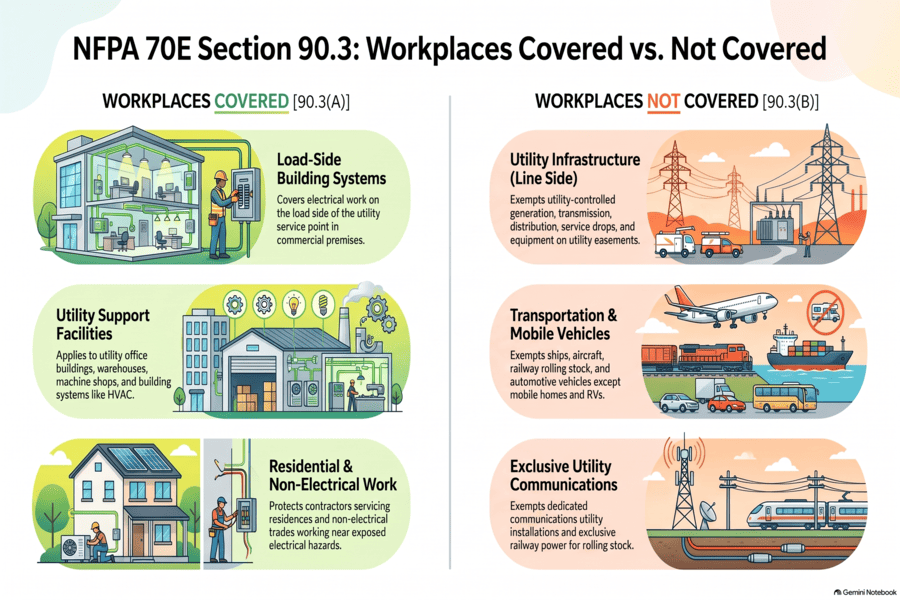
Section 90.3(A) explicitly brings several specific operational environments within the scope of NFPA 70E:
- Utility Support Facilities: Utility-owned premises that are not integral components of a power generating plant, substation, or control center—such as administrative office buildings, warehouses, repair garages, machine shops, and recreational facilities—are fully covered by NFPA 70E.
- Non-Integral Power Plant Utilization Systems: Electrical distribution systems providing building utility services within power generation plants—including facility lighting, heating, ventilation, and air conditioning (HVAC)—fall directly under NFPA 70E because they function as utilization premises wiring rather than integral power generation process circuits.
- Dwelling Units under Contractor Operations: While permanent, existing residential wiring is not covered by OSHA general industry standards, dwelling units become covered employee workplaces whenever commercial contractors or hired personnel work on site. Servicing backup generators, installing rooftop solar PV systems, repairing HVAC units, or conducting structural renovations using portable tools and extension cords triggers full compliance with OSHA and NFPA 70E work practices.
While Section 90.3(A) defines a comprehensive footprint of covered workplaces, Section 90.3(B) establishes explicit statutory exemptions where the standard does not apply.
- Statutory Exemptions and Non-Covered Workplaces [Section 90.3(B)]
Section 90.3(B) outlines four specific categories of workplaces and electrical installations that are statutory exemptions from NFPA 70E. These exemptions acknowledge specialized transport design constraints, dedicated utility infrastructure, and distinct legal jurisdictions governed by alternative safety codes.
The four non-covered workplace categories under Section 90.3(B) are defined as follows:
- Vehicular and Transportation Equipment [90.3(B)(1)]: Exempts electrical installations in ships, watercraft (other than floating buildings), railway rolling stock, aircraft, and automotive vehicles (other than mobile homes and recreational vehicles). These mobile environments possess specialized structural and operational characteristics governed by marine, aviation, or transit authorities. Employers are nevertheless permitted to voluntarily adopt NFPA 70E practices within these environments if doing so enhances worker protection.
- Railway Utility Installations [90.3(B)(2)]: Exempts electrical installations of railways used exclusively for the generation, transformation, transmission, or distribution of power dedicated to operating rolling stock, as well as installations dedicated exclusively to railway signaling and communications. Premises Wiring Distinction: General premises wiring in railway facilities—such as maintenance shop lighting, yard area illumination, or administrative offices—is not exempt and remains fully subject to NFPA 70E.
- Communications Utility Installations [90.3(B)(3)]: Exempts installations of communications equipment under the exclusive control of communications utilities, provided the equipment is located outdoors or in building spaces reserved exclusively for utility communications operations. Private Systems Distinction: Communications systems controlled by private, non-utility entities, as well as general premises power wiring located within utility communications spaces, do not qualify for this exemption and must comply with NFPA 70E.
- Electric Utility Controlled Infrastructure [90.3(B)(4)]: Exempts installations under the sole ownership and exclusive control of an electric utility, including:
- Service drops, service laterals, and associated utility metering equipment.
- Installations located within legally established easements or rights-of-way designated or recognized by public service commissions or utility regulatory bodies.
- Installations on property owned or leased by the electric utility for communications, metering, generation, control, transformation, transmission, or distribution of electric energy.
- Utility-controlled installations located on property governed by written agreements recognized by public service commissions (where legal easements cannot be obtained), strictly limited to federal lands, Native American reservations (via the U.S. Department of the Interior Bureau of Indian Affairs), military bases, port authority lands, state agency properties, and railroad rights-of-way.
Critical Safety Caveat: Unqualified Workers in Utility Environments
Although electric utilities operating on the line side of a service point or within utility easements are exempt from NFPA 70E and follow specialized utility codes (such as ANSI C2 / NESC), non-utility or unqualified workers performing work in these areas are strictly regulated by OSHA.
Under OSHA Subpart S (29 CFR 1910.399 and 1910.331–335) and 29 CFR 1910.269, unqualified workers performing non-utility tasks (e.g., painting, civil excavation, tree trimming, or structural maintenance) on utility property or near utility lines are legally barred from operating under utility safety procedures. Employers of unqualified workers must enforce standard general industry work practices and NFPA 70E requirements. Compliance officers and safety managers should refer to the OSHA 29 CFR 1910.269 Appendix A-2 Flowchart as the official decision-tree reference matrix for determining whether Subpart S / NFPA 70E or 1910.269 applies based on worker qualification and job task.
