



What You’ll Learn
- The four hazards F.7 says may be encountered when working on batteries: electric shock, arc flash, chemical, and thermal
- Why battery work cannot be assessed one hazard at a time — the hazards arrive together, on the same task, at the same terminals
- How PPE selection changes when it must answer all four hazards at once instead of only the electrical ones
- What Figure F.7 is for: a flow chart that assists in assessing all hazards associated with work on batteries
- How the battery assessment connects back to the general risk assessment process of Annex F
One Task, Four Ways to Be Hurt
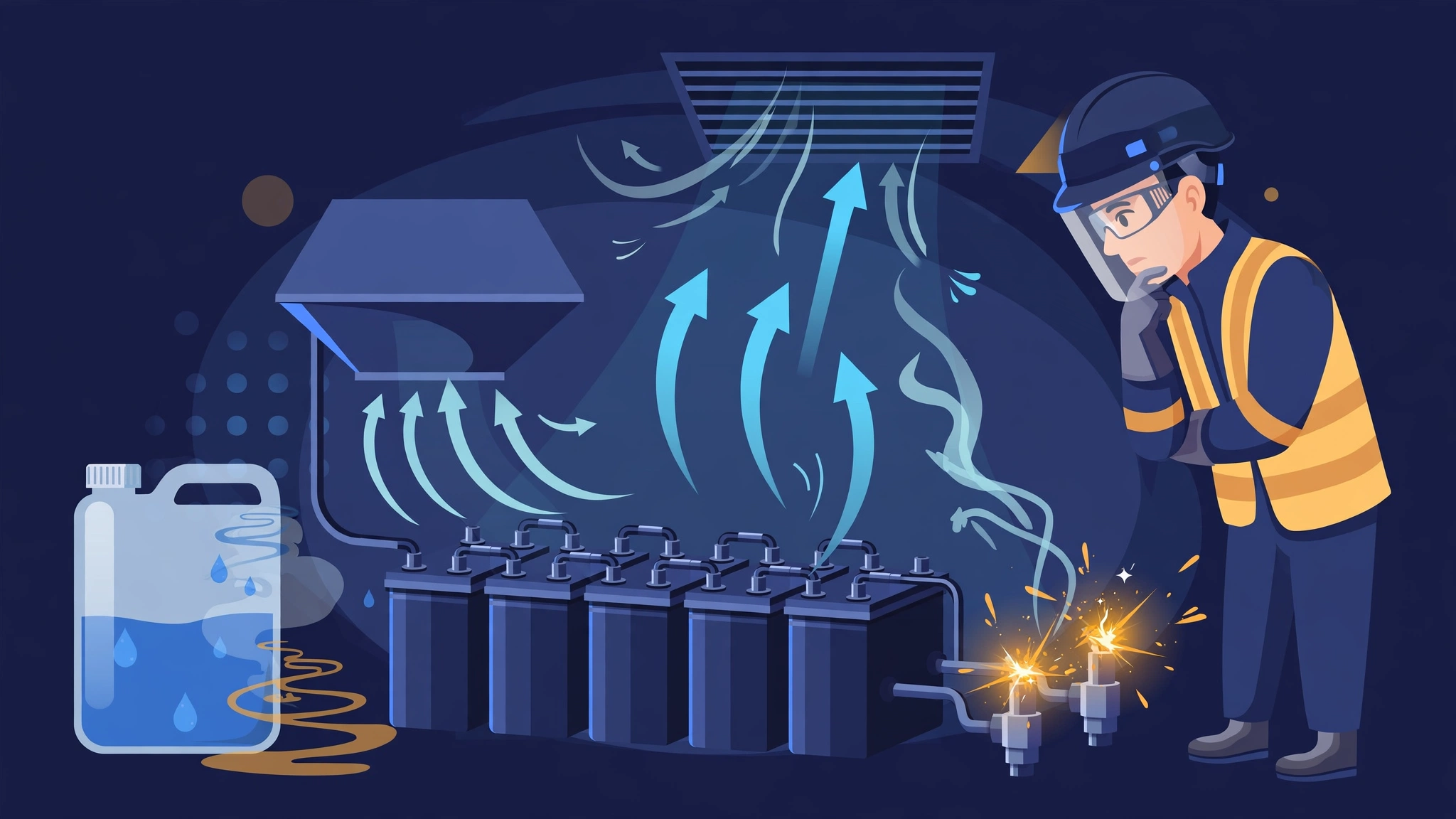
Battery work tempts a narrow assessment. The terminals are electrical, so the shock and arc flash questions get asked — and the assessment stops there. Section F.7 exists to break that habit. It states the problem in one sentence: multiple hazards may be encountered when working on batteries, and it names four — electric shock, arc flash, chemical, and thermal. A battery bank is an electrical source, an energy source capable of a high-energy arc, a container of corrosive electrolyte, and a device that can generate serious heat, all in the same cabinet. The worker kneeling at the terminals is exposed to whichever of those hazards the task releases, and a real event can release more than one at once: the arc that burns also spatters electrolyte; the fault that heats a connection is an electrical fault first. Assessing the hazards separately, in separate documents, by separate habits, is how one of the four gets missed.
Hazard One and Two: Shock and Arc Flash
The electric shock hazard of a battery system behaves differently from the shock hazard of an ac distribution panel, and the difference matters to the assessment. A battery string holds its voltage continuously — there is no upstream disconnect that makes the string itself dead, and the voltage is present at the terminals whether or not any work is underway. The arc flash hazard follows from the same stored energy: a battery bank can deliver very high short-circuit current into a fault, so a dropped tool or a slipped wrench across terminals can produce an arc event at equipment that has no moving parts and makes no noise. Both hazards are assessed with the same likelihood-times-severity logic as the rest of Annex F — but they are only half of the F.7 list, and stopping the assessment here is exactly the failure F.7 warns against.
Hazard Three and Four: Chemical and Thermal
The chemical hazard is the electrolyte. Battery electrolyte is corrosive, it is present wherever cells are opened, filled, or damaged, and it reaches the worker through splashes, spills, and contaminated surfaces rather than through the electrical event the other hazards describe. The thermal hazard completes the set: batteries and their connections can produce burns from hot surfaces and overheated components, and thermal injury can arrive without any arc at all — a loose, high-resistance connection under load is a heating element bolted to the string. Neither of these hazards appears in a shock-and-arc-flash-only assessment, because neither is produced by contact with an energized part or by an arcing fault. They belong to the battery as a chemical and thermal device, which is precisely why F.7 gives battery work its own section instead of leaving it inside the general electrical discussion.
PPE Selected Against All Four
The second sentence of F.7 is the working rule: PPE selection should take into account all of the hazards depending on the task. Read it as a completeness test applied to the PPE ensemble. Arc-rated clothing and shock protection answer the electrical hazards — and say nothing about electrolyte reaching eyes or skin. Chemical-resistant gloves, eye and face protection, and protective apparel answer the electrolyte — and say nothing about incident energy. The F.7 selection process runs the task against all four hazards and builds the ensemble from the union of what each hazard demands, not from whichever hazard was assessed first. “Depending on the task” does real work in that sentence: a task that never opens a cell and never breaks a connection presents a different hazard mix from a task that does both, and the PPE follows the task’s actual exposure — but every hazard the task does present must be accounted for in the selection, not just the electrical pair.
Worked Scenario
A two-person crew is assigned to replace a damaged cell in a stationary battery string and torque-check the intercell connections while they are in the room — one job, worked through the all-hazards assessment F.7 requires, using the flow chart of Figure F.7 as the guide for making sure every hazard associated with the work is assessed.
The assessment opens with the hazards F.7 names, taken one at a time against this specific task. Shock: the string is energized at its terminals throughout the job — cells can be isolated for handling, but the string’s voltage does not switch off, so shock exposure exists for the full duration of the connection work. Arc flash: the string can deliver high fault current, and the task involves tools on terminals and connections — exactly the interaction that can initiate an arc — so incident energy at the working position must be established, not assumed away because the equipment is “only batteries.” Chemical: the job’s central act is removing and replacing a cell, which means electrolyte is handled, moved, and at risk of splash — the chemical hazard is not incidental to this task, it is built into it. Thermal: the torque-check half of the job exists because connections overheat; the crew treats hot surfaces and the possibility of a heat-damaged connection as live hazards of the task, including the damaged cell itself.
With all four hazards assessed, PPE selection follows the F.7 rule — the ensemble must answer every hazard the task presents. Shock protection and arc-rated PPE cover the electrical pair; chemical-resistant hand protection and eye and face protection cover the electrolyte work of the cell swap; and the thermal hazard shapes both the inspection sequence and the protection worn while handling components whose temperature is unknown until checked. No single hazard’s gear is allowed to stand in for the whole set: the arc-rated ensemble alone would leave the electrolyte unaddressed, and the chemical gear alone would leave the crew unprotected at the terminals. The flow chart’s purpose in the room is the discipline it imposes — the crew does not get to the PPE decision until each of the four hazards has been walked through for this task, and the finished assessment, not habit, is what dresses the crew.
Common Mistakes and Safety Notes
- Assessing only the electrical hazards. F.7 lists four hazards for battery work — electric shock, arc flash, chemical, and thermal. A shock-and-arc-flash assessment of a battery task is half an assessment.
- Selecting PPE hazard by hazard, then wearing only one set. F.7 requires PPE selection to take into account all of the hazards depending on the task — the ensemble is the union of the demands, not the winner of them.
- Assuming “de-energized” applies to a battery string. The string holds its voltage at its terminals continuously; the shock and arc flash hazards are assessed on an energized source for as long as the string is connected.
- Treating the chemical hazard as housekeeping. Electrolyte exposure is one of the four named hazards of the work itself, and a cell replacement puts it at the center of the task.
- Forgetting the thermal hazard because nothing arced. Burns from hot surfaces and overheated connections require no arc event at all, and connection work is where the thermal hazard concentrates.
Summary
Section F.7 gives battery work its own place in Annex F because batteries concentrate four hazards in one task: electric shock from a string whose terminals stay energized, arc flash from the high fault current a bank can deliver, chemical exposure from the electrolyte, and thermal burns from hot surfaces and overheated connections. Its rule for protection follows directly: PPE selection should take into account all of the hazards depending on the task, so the ensemble is built from everything the task presents rather than from the electrical hazards alone. And it supplies a tool for the discipline — the flow chart in Figure F.7, provided to assist users in assessing all hazards associated with work on batteries, so that no one of the four is skipped on the way to the PPE decision.
Quick-Check Questions
- What four hazards does F.7 name for work on batteries?
Answer: Electric shock, arc flash, chemical, and thermal hazards. - What does F.7 require of PPE selection?
Answer: PPE selection should take into account all of the hazards, depending on the task — not only the electrical hazards. - Why can’t a battery string simply be treated as de-energized for the assessment?
Answer: The string holds its voltage at its terminals continuously and can deliver high fault current, so the shock and arc flash hazards are present for as long as the string is connected. - What is the purpose of the flow chart in Figure F.7?
Answer: It assists users in assessing all hazards associated with work on batteries — the full set, not a single hazard. - Why does a cell replacement task put the chemical hazard at the center of the assessment?
Answer: Replacing a cell means the electrolyte is handled and moved, with splash and spill exposure built into the task itself — the chemical hazard is not incidental to that work.
Based on NFPA 70E (2024), Informative Annex F, paraphrased for study.
Video lesson for this module is in production — coming soon.
Quiz for this module is being prepared.
Flashcards for this module are being prepared.
