



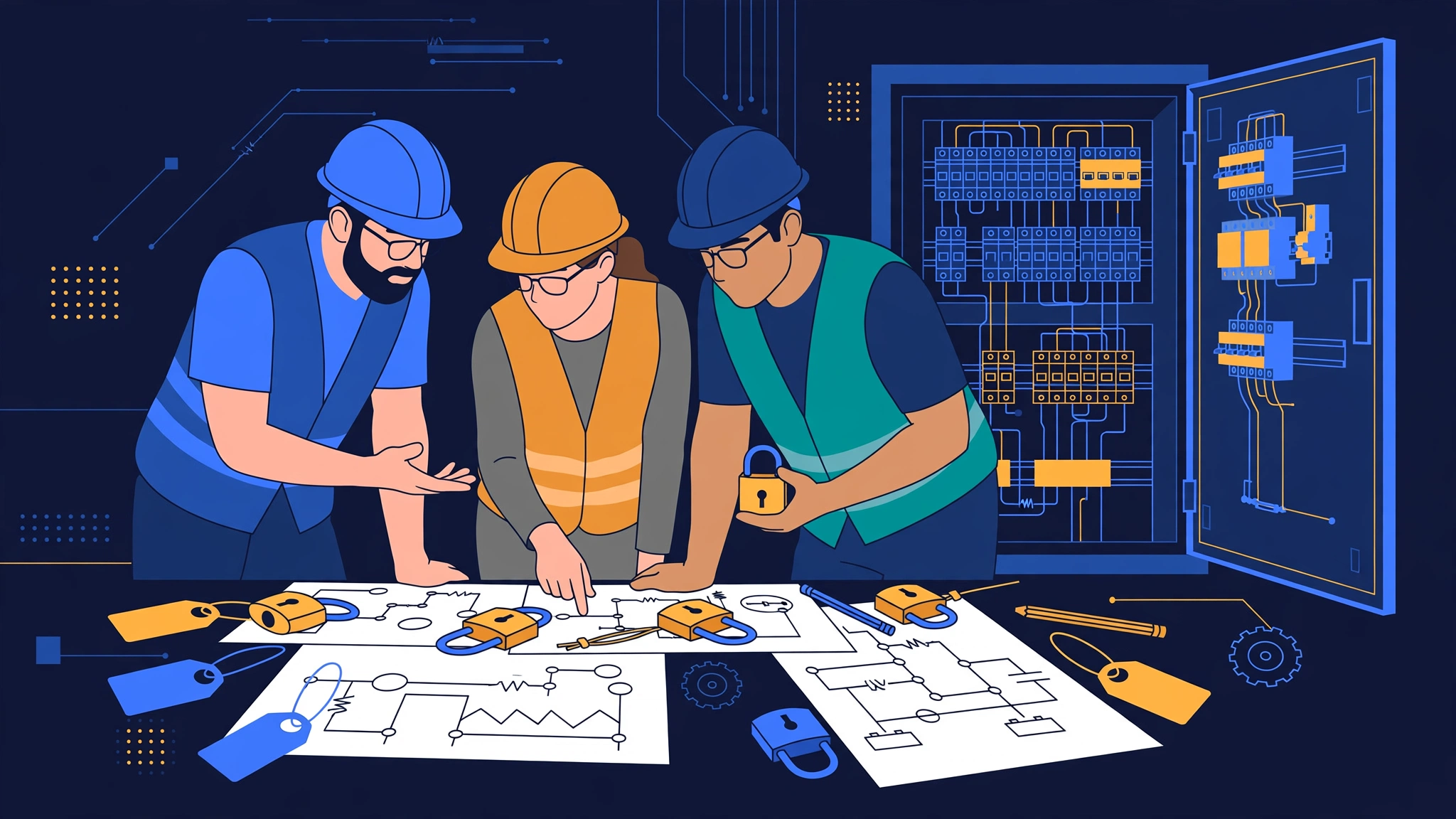
What You’ll Learn
- What Informative Annex G actually is — a fill-in-the-blank model program — and how to use it without copying it blindly
- Why lockout is the preferred method and tagout is the alternative, and what separates a simple lockout/tagout from a complex one
- What the Purpose section (G.1.0) commits your program to, including stored energy that has to be relieved and kept from coming back
- Who carries responsibility under G.2.0 — instruction for everyone who works in the area, and a signature on every tag
- The five preparation steps of G.3.0: drawings and a disconnect inventory, interrupting-ability and visible-open checks, other energy in the area, the test instrument, and grounding
A Model Program, Not a Photocopy
Informative Annex G is a sample lockout/tagout program — a template with blanks where your company’s name, your responsible people, and your equipment choices belong. The annex itself says what it is for: it illustrates how a program can be published, and an employer can fill in the blanks and publish the result for their own organization. That makes the annex a starting framework, not a finished program. The value is in the structure — purpose, responsibility, preparation, sequence, restoration, and the administrative sections that follow — and in the decisions each blank forces you to make. This article covers the front of the program: the introduction’s ground rules, the Purpose in G.1.0, Responsibility in G.2.0, and the Preparation steps in G.3.0. The working sequence, the complex cases, and program administration are covered in the companion articles in this series.
Lockout First, Tagout as the Alternative
The annex opens with a hierarchy: lockout is the preferred method of controlling personnel exposure to electrical energy hazards, and tagout is an alternative method available to employers. That ordering matters when you adapt the template. A lock physically prevents operation of the disconnecting means; a tag warns against it. Where a disconnect accepts a lock, the sample program is built around locking it, and the tag rides along as identification. The introduction also draws the line that organizes the whole program: the sample procedures can be used for a simple lockout/tagout, or as part of a complex lockout/tagout — but a complex job needs a more comprehensive procedure developed, documented, and used for it. One source, one disconnect, one crew is the simple case. Multiple sources, crews, crafts, locations, employers, or shifts push the job into complex territory, where a written plan of execution and a person in charge take over. Knowing which side of that line your work sits on is the first decision the program asks you to make.
G.1.0 Purpose: What the Program Promises
The Purpose section states the minimum requirements the rest of the program exists to meet. In the sample’s framing, the procedure ensures that conductors and circuit parts are disconnected from sources of electrical energy, locked (or tagged), and tested before work begins wherever employees could be exposed to dangerous conditions. Three commitments hide in that one sentence, and each deserves a decision when you fill in your own version. First, disconnection comes before work — not during it, not after the first task. Second, the state is verified by testing, not assumed from the position of a handle. Third, the program reaches beyond the supply conductors: sources of stored energy, such as capacitors or springs, must be relieved of their energy, and a mechanism must be engaged to prevent the energy from reaccumulating while people work. A program whose purpose clause mentions only the disconnect switch has quietly left the capacitor bank and the tensioned spring outside its protection.
G.2.0 Responsibility: Everyone Instructed, Every Tag Signed
Responsibility under G.2.0 starts wider than most people expect. All employees shall be instructed in the safety significance of the lockout/tagout procedure — and the sample names who that includes: all new or transferred employees, and all other persons whose work operations are, or might be, in the area. The operator who never touches a disconnect still needs to know what a lock and tag mean and why they are never to be bypassed, because that operator is the person most likely to be asked to “just restart it.” The template leaves a blank for the names or job titles of the employees responsible for making sure appropriate personnel actually receive instruction on their roles — filling in that blank with real titles is what turns the sentence into an assignment. The section closes with traceability: all persons installing a lockout/tagout device shall sign their names and the date on the tag, or the program must state how the name of the individual or person in charge will be available. An unsigned tag is an anonymous warning; a signed and dated one tells the next shift exactly who holds the job and since when.
G.3.1 Preparation Starts on Paper: Drawings and the Disconnect List
Preparation begins before anyone touches a switch. Under G.3.1, the first step is to review current diagrammatic drawings (or their equivalent), tags, labels, and signs to identify and locate all disconnecting means — and to determine that power is interrupted by a physical break, not merely de-energized by a circuit interlock. That distinction is the step’s real lesson: a control interlock can stop a machine while leaving its conductors energized, and only an opened disconnect gives the physical separation lockout is built on. The output of the step is concrete: a list of the disconnecting means to be locked (tagged). When you adapt the template, this is where your program decides how current the drawings must be and what happens when the drawing and the field disagree — because the list the crew locks against is only as good as the drawing it came from.
G.3.2 Can It Interrupt, and Can You See It Open?
The disconnecting means themselves get examined in G.3.2. Two questions are asked of each device on the list. First, is its interrupting ability adequate — can this device safely break the load it will be asked to break? Second, will it be possible to verify a visible open point, or will other precautions be necessary? Some devices show their blades; others — draw-out breakers, enclosed switches — prove their state differently, and the preparation step forces that determination to be made in advance rather than discovered at the equipment with the work already started. If a visible open cannot be verified, the program has to say what compensates, because “we think it opened” is not a verification method.
G.3.3 The Other Energy in the Room
Other energy sources are the subject of G.3.3, and the step looks in two directions. It reviews other work activity to identify where and how other personnel might be exposed to electrical hazards — the crew in the next aisle is part of your lockout problem. And it reviews other energy sources in the physical area to determine employee exposure to those sources of other types of energy, then establishes energy control methods for them. A motor disconnect can be perfectly locked while a pneumatic line, a hydraulic accumulator, a gravity load, or a second electrical source in the same area remains live and uncontrolled. Preparation is where the program widens its lens from “the disconnect for this machine” to “every energy source a person in this work area can meet.”
G.3.4 The Test Instrument Is Part of the Preparation
A test instrument is provided during preparation, not fetched after the locks go on. G.3.4 calls for an adequately rated test instrument to test each phase conductor or circuit part and verify it is de-energized — rated, meaning matched to the voltage and the environment it will be used in — and for a method to determine that the test instrument is operating satisfactorily. That second half is the live-dead-live discipline in embryo: an instrument that has not been proven working cannot prove anything else dead. The sample cross-references its Equipment section for the instrument specification, which is a reminder that the template’s sections lean on each other — preparation names the need, and the equipment list names the actual device by type and model.
G.3.5 Grounding Decided Before Hands Go On
Grounding is decided in G.3.5, again before contact. Where the possibility of induced voltages or stored electrical energy exists, the preparation calls for grounding the phase conductors or circuit parts before touching them — induced voltage from parallel energized runs and charge stored in capacitance do not announce themselves, and both can be present on conductors that test dead from their own supply. The step adds a second call: where contact with other exposed energized conductors or circuit parts could reasonably be anticipated, ground connecting devices are to be applied. Writing your own program, this is the place to decide who makes the induced-voltage judgment and what fault duty the grounding equipment must be rated for, rather than leaving both questions to the moment.
Worked Scenario
A maintenance supervisor at a packaging plant is adopting Annex G as the skeleton for the plant’s first written lockout/tagout program. She works the front sections in order. In the Purpose, she keeps the sample’s three commitments — disconnect, lock, and test before work — and adds nothing that waters down the stored-energy clause, because the plant’s power-factor correction capacitors are exactly the hazard it names. In Responsibility, she fills the blank with job titles: the maintenance manager ensures instruction, and she writes the plant’s rule that every tag carries the installer’s name and date, no exceptions for “quick jobs.” For Preparation, she walks one representative job — a rooftop exhaust fan — through G.3.1 to G.3.5 as a rehearsal: the drawings show a single disconnect (and reveal that a second fan on the same drawings is fed through a control interlock only, which she flags for a disconnect upgrade); the disconnect’s interrupting rating checks out and its blades are visible when open; the roof area holds a second energy source, a refrigerant line worked on by an outside contractor, so coordination goes into the prep notes; the crew’s meter is rated for the voltage and gets a proving check; and because the fan’s run capacitor stores charge, the prep calls for a discharge-and-ground step before anyone touches the terminals. The rehearsal takes an afternoon — and produces the plant’s first real disconnect list.
Common Mistakes and Safety Notes
- Photocopying the sample without filling the blanks. The annex is a model with decisions embedded in it — unnamed responsible persons and unspecified equipment leave the program unenforceable.
- Treating tagout as equal to lockout. The annex names lockout the preferred method and tagout the alternative; where a lock fits, the tag is not a substitute of equal standing.
- Writing a purpose clause that forgets stored energy. Capacitors and springs must be relieved, with a mechanism preventing reaccumulation — a disconnect-only purpose leaves them out.
- Instructing only the people who install locks. G.2.0 reaches new and transferred employees and everyone whose work is or might be in the area.
- Accepting an interlock as disconnection. G.3.1 requires a physical break; a circuit interlock can stop motion while conductors stay energized.
- Skipping the instrument check. The preparation provides both the rated test instrument and a method to prove it operates satisfactorily — one without the other proves nothing.
Summary
Annex G is a fill-in-the-blank model lockout/tagout program, and its front sections set the terms for everything after them. Lockout is the preferred method, tagout the alternative; the sample serves simple lockout/tagout directly and complex work only as part of a more comprehensive documented procedure. The Purpose (G.1.0) commits the program to disconnecting, locking (tagging), and testing before work begins, and to relieving stored energy such as capacitors and springs while preventing its reaccumulation. Responsibility (G.2.0) requires instruction for all employees — new, transferred, and anyone working in the area — names who ensures that instruction happens, and requires every tag to carry its installer’s name and date or an equivalent way of identifying them. Preparation (G.3.0) then works five steps: review drawings and build the disconnect list, confirming a physical break rather than an interlock (G.3.1); check each disconnect’s interrupting ability and whether a visible open can be verified (G.3.2); review other work and other energy sources in the area and establish controls for them (G.3.3); provide an adequately rated test instrument and a way to prove it works (G.3.4); and call for grounding where induced voltage or stored energy is possible, and ground connecting devices where contact with other energized parts is possible (G.3.5).
Quick-Check Questions
- Which method does Annex G name as preferred, and what is the other method’s standing?
Answer: Lockout is the preferred method of controlling exposure to electrical energy hazards; tagout is an alternative method available to employers. - What three things does the Purpose section say must happen before work begins, and what else must be done about stored energy?
Answer: Conductors and circuit parts must be disconnected from sources of electrical energy, locked (tagged), and tested. Stored energy sources such as capacitors or springs must be relieved of their energy, with a mechanism engaged to prevent reaccumulation. - Who must be instructed in the procedure under G.2.0?
Answer: All employees — including all new or transferred employees and all other persons whose work operations are or might be in the area. - Why does G.3.1 insist on a physical break rather than a circuit interlock?
Answer: An interlock can de-energize a function while leaving conductors energized; preparation must confirm power is interrupted by a physical break at the disconnecting means. - What two things does G.3.4 require the program to provide?
Answer: An adequately rated test instrument to test each phase conductor or circuit part, and a method to determine that the test instrument is operating satisfactorily.
Based on NFPA 70E (2024), Informative Annex G, paraphrased for study.
Video lesson for this module is in production — coming soon.
Quiz for this module is being prepared.
Flashcards for this module are being prepared.
