



What You’ll Learn
- How a simple lockout scales when more than one person works the job: a personal device for every exposed worker
- What changes when a lockout outlasts a single shift: verification the next day, and why a multi-shift lockout becomes complex by definition
- The eight conditions in the sample program that trigger a complex lockout/tagout plan
- What the person in charge owes the crew: a written plan of execution, accountability, and verified understanding
- The four methods for accounting for every person exposed — personal devices, the lock box, the sign-in/sign-out log, or an equally effective alternative
One Lock Protects One Person’s Certainty
A complex lockout/tagout is what the model program in Informative Annex G calls for when the job stops being one worker, one disconnect, one shift. The sample program builds in layers: the simple sequence handles the straightforward case, and then three short sections — procedures involving more than one person, more than one shift, and the complex lockout itself — scale the same discipline up to the jobs where coordination, not hardware, is the real hazard. This article walks those three layers and shows how they fit together into a single written plan.
More Than One Person: A Personal Device for Each
Section G.7.0 covers the first scaling step, and its rule is short enough to memorize: for a simple lockout/tagout where more than one person is involved in the job or task, each person installs his or her own personal lockout/tagout device. The logic is physical, not bureaucratic. A lock is a guarantee that the disconnect cannot be operated while it is on. If four electricians share one worker’s lock, then three of them are protected only by a colleague’s memory — and the colleague can end the job, remove the lock, and re-energize while the others are still exposed. A personal device for each person means nobody’s protection can be surrendered by anyone but its owner. The same principle reappears inside the complex plan as one of the personnel-accounting methods, so treat G.7.0 as the default habit the rest of the program builds on.
More Than One Shift: Verify Daily, and Transfer Deliberately
Section G.8.0 addresses the lockout that outlives the day. When a lockout/tagout extends for more than one day, it must be verified that the lockout/tagout is still in place at the beginning of the next day — a fresh confirmation, not an assumption that yesterday’s devices survived the night untouched. When the lockout continues on successive shifts, the sample program classifies it as a complex lockout/tagout outright: shift change is itself a complexity trigger. For that case, the person in charge must identify the method for transfer of the lockout/tagout and the method of communication with all employees. The incoming crew never inherits a lockout by rumor; the transfer method and the communication method are named in advance, so the protection crosses the shift boundary as deliberately as it was first applied.
The Eight Triggers: When a Plan Becomes Mandatory
Section G.9.0 lists the conditions that require a complex lockout/tagout plan. A plan is required where one or more of the following exist:
- Multiple energy sources (more than one)
- Multiple crews
- Multiple crafts
- Multiple locations
- Multiple employers
- Unique disconnecting means
- Complex or particular switching sequences
- Lockout/tagout for more than one shift — that is, new shift workers
Read the list as eight ways a job can outgrow one person’s head. Any single trigger is enough: a lone electrician working a second shift on equipment fed from two sources has already tripped two of them. The written plan that follows is the program’s answer to the coordination problem — the job is too tangled to hold in working memory, so it gets held on paper instead.
The Written Plan of Execution
All complex lockout/tagout procedures require a written plan of execution. The plan is not a new document invented from nothing: it incorporates the requirements of the program’s earlier sections — purpose, responsibility, preparation, the lockout sequence, restoration to normal, the multi-shift provisions, and the sections on discipline, equipment, and review. In other words, the complex plan is the whole program, pointed at one specific job, with the job’s particulars filled in. A person in charge is involved with every complex procedure and is at the procedure location — not reachable by phone from another site, but present where the work is.
The Person in Charge: Duties That Cannot Be Delegated Away
Section G.9.3 loads the accountability onto that one role. The person in charge develops the written plan of execution and communicates it to all persons engaged in the job or task, and is held accountable for its safe execution. The plan must address the concerns of all employees who might be exposed, and those employees must understand how electrical energy is controlled. The person in charge ensures that each person understands the electrical hazards they are exposed to and the safety-related work practices they are to use. Two further permissions come with the role. Under G.9.5, the person in charge can install locks and tags, or direct their installation, on behalf of other employees. Under G.9.6, the person in charge can remove locks and tags, or direct their removal, on behalf of other employees — but only after all personnel are accounted for and ensured to be clear of potential electrical hazards. Removal on someone else’s behalf is the sharpest authority in the program, and it is gated on the accounting step that follows.
Accounting for Every Person: The Four Methods
Section G.9.4 requires every complex plan to identify the method to account for all persons who might be exposed to electrical hazards during the lockout/tagout, and offers four options:
- Each individual installs his or her own personal lockout or tagout device — the G.7.0 rule, scaled up: the count of devices on the disconnects is the count of people protected.
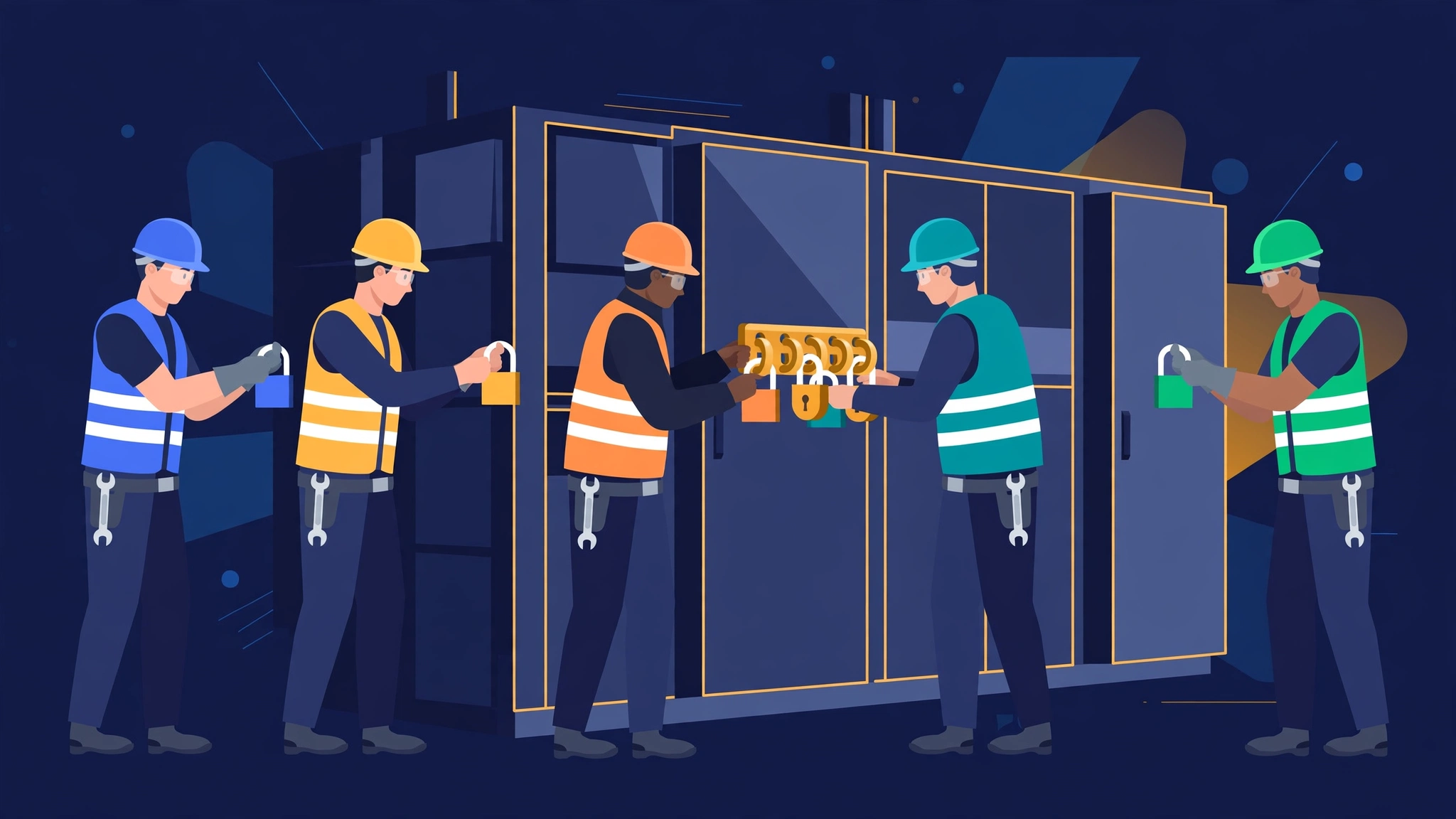
- The person in charge locks his or her key in a lock box — the job’s locks are applied with keys secured in the box, and the box is held by the person in charge’s personal lock, so nothing can be opened until the box is released.
- The person in charge maintains a sign-in/sign-out log for all personnel entering the area — the roster itself is the accounting, and nobody is “probably still inside.”
- Another equally effective methodology — the program allows a substitute, but the standard it must meet is set by the first three: equally effective, not merely convenient.
Whichever method is chosen, it feeds directly back into G.9.6: locks come off on others’ behalf only when the accounting says everyone is accounted for and clear.
Worked Scenario
A plant is replacing a section of 480-volt switchgear fed from two utility services and a tie breaker, with an electrical contractor’s crew and the plant’s own maintenance electricians working two shifts. The job trips nearly every trigger on the G.9.0 list: multiple energy sources, multiple crews, multiple crafts once the riggers arrive, multiple employers, and more than one shift. A complex plan is written before anyone touches a disconnect. The plan names a person in charge for the job, lays out the switching sequence for both services and the tie, and selects the lock box method: each disconnect is locked, the keys go into the box, and every exposed worker puts a personal lock on the box itself — a worker who leaves takes only his own lock off, and the box cannot open until the last personal lock is gone. At the shift change, the outgoing person in charge verifies the lockout is still in place with the incoming lead, transfers the plan and the communication method face to face, and the second shift starts from a verified state rather than a handover note. When the work finishes, the person in charge accounts for every name against the personal locks before directing removal of the job locks — and only then does restoration begin.
Common Mistakes and Safety Notes
- Sharing one lock among a crew. G.7.0 requires a personal device for each person; a shared lock can be removed while someone who trusted it is still exposed.
- Assuming yesterday’s lockout survived the night. A lockout extending past one day must be verified still in place at the beginning of the next day.
- Treating shift change as paperwork. A lockout continued on successive shifts is complex by definition, and the transfer and communication methods must be identified in advance.
- Counting triggers wrong. Any one of the eight G.9.0 conditions — even a single extra energy source — makes the written plan mandatory.
- Removing locks on others’ behalf by headcount from memory. G.9.6 allows it only after all personnel are accounted for and ensured clear, using the plan’s chosen accounting method.
- Letting the person in charge run the job remotely. The person in charge is at the procedure location and is accountable for safe execution of the plan.
Summary
Annex G scales lockout/tagout in three steps. With more than one person on a simple lockout, each person installs a personal device. When a lockout extends beyond one day, it is verified at the start of the next day; continued across successive shifts, it becomes complex, with transfer and communication methods identified by the person in charge. Eight conditions trigger a complex plan — multiple sources, crews, crafts, locations, or employers; unique disconnecting means; complex switching sequences; or more than one shift. Every complex procedure runs on a written plan of execution that folds in the program’s core sections, under a person in charge who is present, accountable, and responsible for the crew’s understanding. Personnel are accounted for by personal devices, a lock box, a sign-in/sign-out log, or an equally effective method — and that accounting is what unlocks the authority to remove devices on anyone else’s behalf.
Quick-Check Questions
- On a simple lockout involving three electricians, how many personal lockout/tagout devices are required?
Answer: Three — under G.7.0, each person involved installs his or her own personal device. - A lockout is still in place on the third day of a job. What must happen at the start of that day?
Answer: It must be verified that the lockout/tagout is still in place, per G.8.0. - Name four of the eight conditions that require a complex lockout/tagout plan.
Answer: Any four of: multiple energy sources, multiple crews, multiple crafts, multiple locations, multiple employers, unique disconnecting means, complex or particular switching sequences, and lockout/tagout for more than one shift. - When may the person in charge remove locks on behalf of other employees?
Answer: Only after all personnel are accounted for and ensured to be clear of potential electrical hazards (G.9.6). - What are the four personnel-accounting methods a complex plan may use?
Answer: Each individual installs a personal device; the person in charge locks his or her key in a lock box; the person in charge maintains a sign-in/sign-out log; or another equally effective methodology.
Based on NFPA 70E (2024), Informative Annex G, paraphrased for study.
Video lesson for this module is in production — coming soon.
Quiz for this module is being prepared.
Flashcards for this module are being prepared.
