



What you’ll learn
After this post, you will be able to predict what an open and a short do to voltage and current in a DC circuit, locate the fault that explains a meter reading, explain why a shorted battery can melt or start a fire, and spot the common mistakes in troubleshooting. Opens and shorts are the two most common DC faults, and they behave in opposite ways. Learn the signs and you can work out which one is present — and which parts are at risk — from a single reading.
What an open circuit is
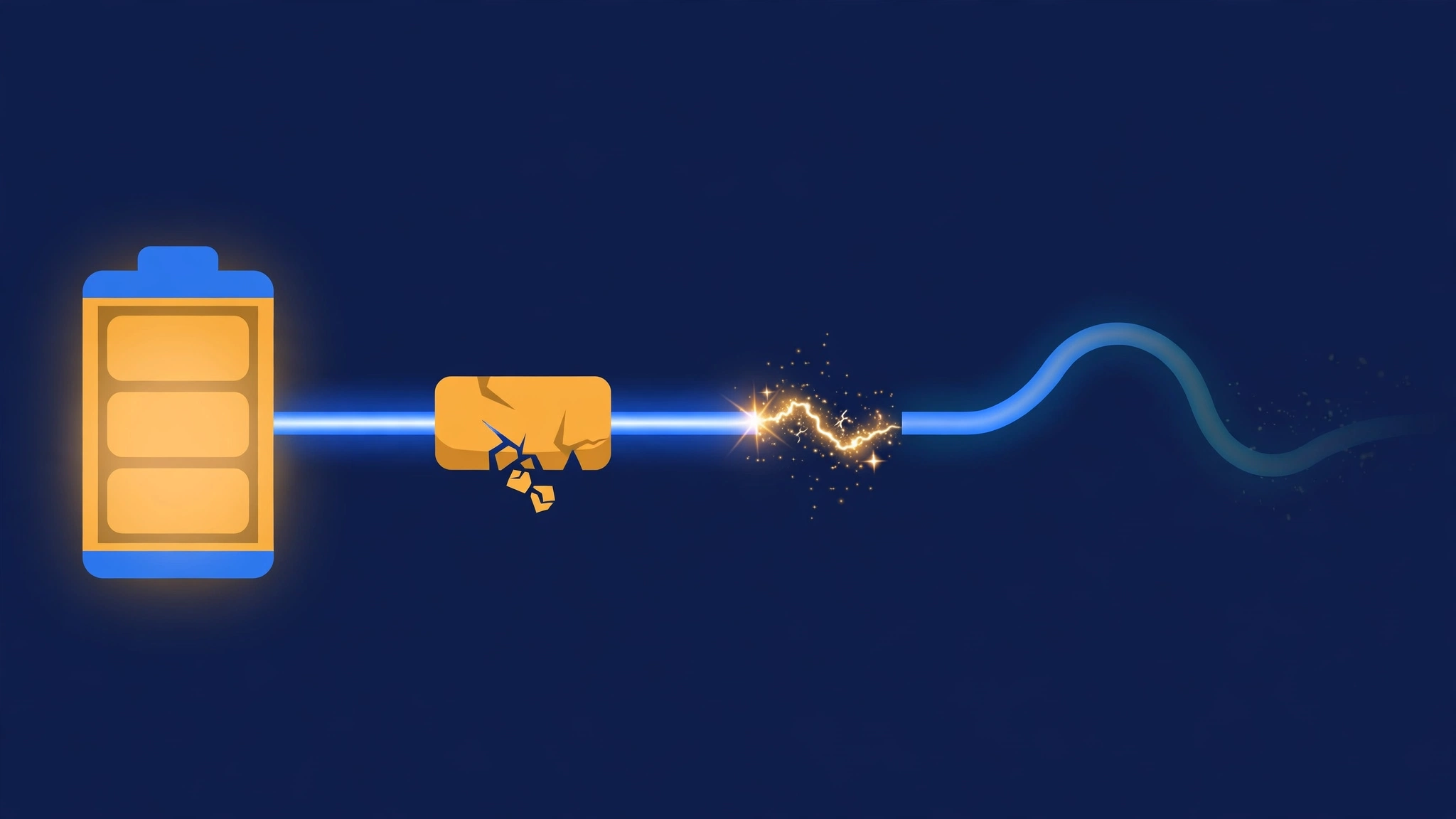
An open circuit is a break in the path. Current cannot flow through a break, so wherever the break is, the current there is zero. The battery voltage does not disappear. It appears across the break — the open terminals are where the full source voltage shows up. A voltmeter connected across an open in a series circuit reads the source voltage.
A common confusion is thinking that the current is trapped at the break. It is not trapped; it never starts. The break stops the loop, so no current flows anywhere in that series path. The other branches of a parallel circuit can still carry their current, but the branch with the break is quiet.
An open in a parallel path does something easy to miss. Each parallel branch takes current in proportion to its resistance. If one branch is open, it carries no current, and the total current drops by exactly that branch’s share. So one open branch lowers the total current and raises the equivalent resistance of the circuit — even though the other branches and their voltage stay the same.
What a short circuit is
A short circuit is the opposite: an unintended path of very low resistance. Current takes the easiest route, so most of it runs through the short and very little through the component or part it bypasses. The voltage across a shorted component drops to roughly zero, because current times near-zero resistance is near zero.
A shorted resistor is one route to a failed device. A shorted resistor in one branch means the other resistors do not see the voltage they are meant to see. But the source is not always shorted out entirely — the short is simply a low-resistance alternative and the current will rise, modestly or dramatically, with the final current depending on how low the resistance is and whether the supply includes source resistance.
A short across the source is the dangerous case. It is a short directly across a battery. A dead short like this means total current is great because resistance is the little there is, so battery current rises rapidly and the battery heats up. The heat can melt the battery, melt wiring, or start a fire, so a battery should never be shorted. Never try it to check a battery — use a meter instead.
The most dangerous short you will meet is one across a battery. A short across the battery is a short across the source, so the source delivers far more current than it is built for. That is why the same battery also heats up fastest.
One warning sign is the meter. If the battery voltage is fine but a resistor’s voltage is near zero, the resistor is shorted — it is not simply a burnt-out resistor. If a battery shows near-zero voltage and a large current, the battery has a short.
Common mistakes
- “An open circuit has no voltage.” It has full voltage across the break. It has no current, but the voltage is there. That is why metering across an open is useful.
- “A shorted resistor takes all the current.” It takes most of the current, but the other branches still receive some because their resistance is finite. The fault is a current divider, not a total stop.
- “A shorted out resistor increases the total resistance.” It does the opposite. A short reduces the resistance of the circuit, so total current rises — dramatically in a source short.
- “Metering a shorty needs big equipment.” No. A voltmeter across the resistor is enough: near zero volts across it means it is shorted, and if the battery reads near zero volts with high current running, the battery is shorted.
- “I need to physically inspect every part to find an open.” Often you can tell from readings alone. An open is about a zero current, while a short is about a near-zero voltage. If the voltage drop is the same across a resistor but the current is zero, the resistor is open rather than shorted.
Summary
Opens stop current and put full source voltage across the break. Shorts bypass resistance, pull large current, and make the voltage across the bypassed component near zero. The safest diagnostic is to use a meter: no current at a break is an open, near-zero voltage across a part is a short, and a battery with near zero volts and high current is itself shorted. Acting on the wrong cause — like one or more resistors shorted — changes both the diagnosis and the risk.
Quick-check questions
- What happens to the current and the voltage when a DC circuit has an open?
- What happens to current and voltage when a resistor is shorted?
- What would a voltmeter read across an open in a series circuit?
- Why is a short circuit across a battery dangerous?
- How can you tell whether a battery or a resistor is shorted?
Answers: 1. The current is zero everywhere in that path; the full source voltage appears across the open. 2. The shorted resistor has near-zero voltage across it; most of the current goes through the short, and total current rises. 3. It reads the source voltage — the full battery voltage appears across the break. 4. The battery delivers far more current than it is built for, so it heats up and can melt wire or start a fire. 5. A resistor reads near-zero volts while the battery holds its voltage, while a battery reads near zero with large current. Meters show it clearly.
Based on DOE-HDBK-1011/92, Electrical Science, Module 2, paraphrased for study.

Report a question

Top 10 Scorers
| Pos. | Name | Score | Duration |
|---|---|---|---|
| There is no data yet |

What is an open in a DC circuit?
What happens in a series circuit when an open occurs?
In a parallel circuit, what happens if only one branch opens?
What happens to the current when a short circuit occurs?
Why does a source's terminal voltage fall during a short circuit?
What are the consequences of a short circuit named in the handbook?
What protects a circuit against short circuits?
Why are parallel circuits more likely to develop damaging shorts than series circuits?
What are the opposite symptoms of an open and a short?
Why can a voltmeter across a load in an open series circuit read misleadingly?
