


What You’ll Learn
- What Table H.3 is: a summary that maps each piece of electrical PPE back to the section of the standard that governs it
- The shock-protection half of the table — rubber insulating gloves and sleeves, the Class G or E hard hat, and dielectric overshoes, with their 130.7(C) references
- The 1.2 cal/cm² floor: why the table lists nothing below it, and what that does and does not mean
- The three incident-energy thresholds that change the gear — gloves at 8 cal/cm², face protection at 12 cal/cm², and footwear at 4 cal/cm²
- How to dress a worker for a calculated 10 cal/cm² exposure, item by item, straight off the table
A Directory, Not a Rulebook
Every PPE decision in NFPA 70E traces back to a paragraph in 130.7(C) — but those paragraphs are scattered across one long section, and nobody standing at a job site wants to hunt through them. Table H.3 solves that problem by acting as a summary table: it lists the PPE for electrical hazards item by item and, beside each item, names the specific sections of the standard that describe it. It changes no requirements. It collects them — the shock-protection equipment in one block, and the arc flash equipment for incident energy exposures of 1.2 cal/cm² and above in another — so a reader can start from the garment and land on the governing rule in one step. Even workers using the arc flash PPE category method are advised to review the sections the table identifies, to be sure the PPE in use actually matches the identified hazards.
The Shock Half: Protection Against Contact
The shock hazard PPE block of Table H.3 covers the equipment worn against electric shock rather than arc flash, each item applied as needed for the exposure. Rubber insulating gloves are worn with their protectors, unless the requirements of ASTM F496 are met — the table points to 130.7(C)(7)(a) for both the gloves and the rubber insulating sleeves used as needed alongside them. Head protection against shock is a Class G or Class E hard hat, as needed, under 130.7(C)(3), and the eyes get safety glasses or goggles as needed under 130.7(C)(4). For the feet, dielectric overshoes are listed as needed under 130.7(C)(8). Two things about this block are worth noticing. First, every item is qualified by need: shock PPE is selected for the voltage exposure actually present, not worn as a fixed uniform. Second, none of these items carries an incident-energy rating — they answer a different hazard, and a worker can need items from both halves of the table on the same task.
The 1.2 cal/cm² Floor: Where the Table Starts
The incident energy threshold of 1.2 cal/cm² (5 J/cm²) is the floor of the arc flash half of Table H.3: the clothing and equipment rows apply to exposures greater than or equal to it. Below it, the table lists nothing, because no arc flash protection is required to be provided below that level — an injury from such an incident is expected to be survivable and nonpermanent. That floor is easy to misread, so be precise about what it says. It is a statement about arc flash PPE under this table. It does not cancel shock protection: a task below 1.2 cal/cm² can still present a shock hazard that calls for the rubber insulating gloves, hard hat, and other items in the table’s first block. And at or above the floor, the base requirement is an arc-rated clothing system with an arc rating appropriate to the anticipated incident energy exposure — with any underlayers arc-rated or made of nonmelting, untreated natural fiber.
Hands: The Gloves Change at 8 cal/cm²
Gloves are where Table H.3 draws its sharpest line, at 8 cal/cm² (33.5 J/cm²). For exposures from 1.2 cal/cm² up to and including 8 cal/cm², heavy-duty leather gloves are the listed hand protection. Above 8 cal/cm², leather alone is no longer the answer: the table calls for rubber insulating gloves with their protectors, or arc-rated gloves. The reasoning shows in the pairing — above that energy, the hand protection must itself carry a rating for the hazard, either the insulating rubber glove system with its leather protectors worn over it, or a glove built and rated for arc exposure. Note the boundary belongs to the lower band: at exactly 8 cal/cm², heavy-duty leather gloves still satisfy the table; it is exposures greater than 8 that move the worker into rubber gloves with protectors or arc-rated gloves.
Head and Face: The Line Is 12 cal/cm²
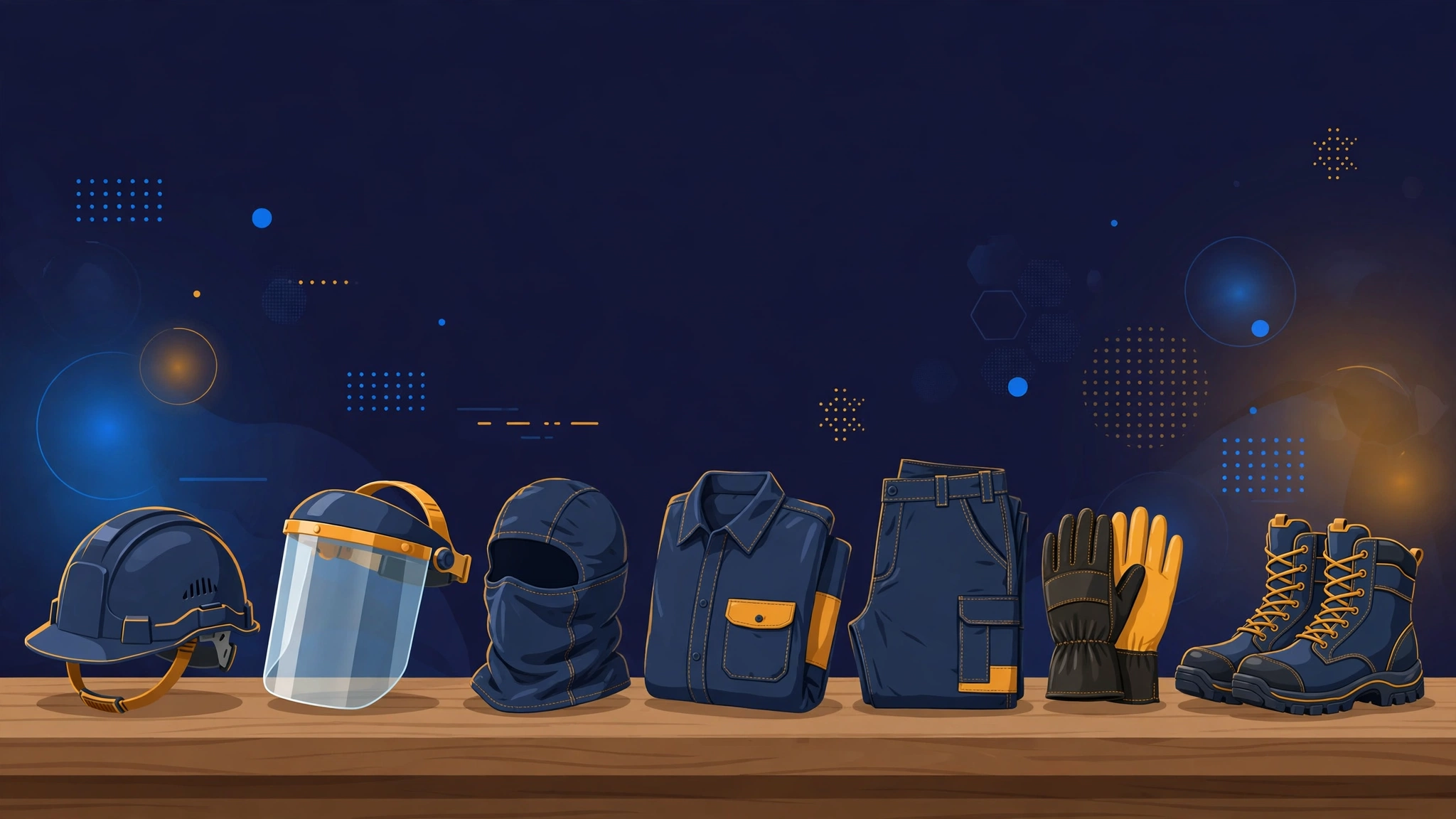
Face protection steps up at 12 cal/cm² (50.2 J/cm²). From 1.2 cal/cm² up to and including 12 cal/cm², the table lists an arc-rated face shield that covers the face, neck, and chin, worn with an arc-rated balaclava — or, as an alternative at the same exposures, an arc-rated arc flash suit hood. Above 12 cal/cm², the choice disappears: an arc-rated arc flash suit hood is the listed protection. Underneath and alongside, the rest of the head ensemble is constant across the arc flash half of the table — a Class G or E hard hat, safety glasses or goggles, and hearing protection. So a worker’s face gear has exactly two configurations in the table: shield plus balaclava (or hood) at and below 12 cal/cm², and hood alone above it.
Feet: Heavy-Duty Leather Becomes Mandatory Above 4 cal/cm²
Footwear has the lowest threshold in the table, at 4 cal/cm² (16.75 J/cm²). At exposures of 4 cal/cm² or less, heavy-duty leather footwear is listed as needed — worn where the task calls for it. Above 4 cal/cm², the qualifier vanishes: heavy-duty leather footwear is simply required. It is the only item in the arc flash block whose status flips from conditional to mandatory inside the table’s range, which makes it the easiest line to miss. A worker can be correctly dressed in clothing, gloves, and face protection for a 6 cal/cm² exposure and still be out of line with Table H.3 if he is standing in ordinary shoes.
The Thresholds at a Glance
| Exposure (incident energy) | Gloves | Face protection | Footwear |
|---|---|---|---|
| Below 1.2 cal/cm² | No arc flash hand protection listed | None listed | None listed |
| 1.2 to 8 cal/cm² | Heavy-duty leather gloves | Arc-rated face shield (face, neck, chin) + arc-rated balaclava, or suit hood | Heavy-duty leather footwear as needed (up to 4); mandatory above 4 |
| Greater than 8 to 12 cal/cm² | Rubber insulating gloves with protectors, or arc-rated gloves | Arc-rated face shield + arc-rated balaclava, or suit hood | Heavy-duty leather footwear (mandatory) |
| Greater than 12 cal/cm² | Rubber insulating gloves with protectors, or arc-rated gloves | Arc-rated arc flash suit hood | Heavy-duty leather footwear (mandatory) |
At every exposure at or above 1.2 cal/cm², add: an arc-rated clothing system rated for the anticipated exposure, a Class G or E hard hat, safety glasses or goggles, and hearing protection.
Worked Scenario
An incident energy analysis puts the exposure at a 480 V panelboard at 10 cal/cm², and the worker dresses straight from Table H.3. Start with the floor: 10 cal/cm² is well above 1.2, so the arc flash half of the table applies in full. Clothing: an arc-rated clothing system with a rating appropriate to a 10 cal/cm² exposure, with any underlayer arc-rated or nonmelting untreated natural fiber. Hands: 10 is greater than 8, so heavy-duty leather gloves alone do not satisfy the table — he wears rubber insulating gloves with their protectors, or arc-rated gloves. Head: a Class G or E hard hat, with safety glasses or goggles under the face protection, and hearing protection in place. Face: 10 is at or below 12, so he has the table’s choice — an arc-rated face shield covering face, neck, and chin together with an arc-rated balaclava, or an arc-rated suit hood; he takes the shield and balaclava. Feet: 10 is greater than 4, so heavy-duty leather footwear is mandatory, not optional, and he checks that his boots qualify before he starts. Finally, because the task also involves a shock hazard, he confirms the shock half of the table as well — the rubber insulating gloves he is already wearing for arc protection serve the shock exposure, with sleeves added if needed. Every item on his body traces to a row of the table and a threshold he can state.
Common Mistakes and Safety Notes
- Reading the 1.2 cal/cm² floor as “no PPE at all.” The floor applies to arc flash protection in the table; shock PPE from the first block can still be required at lower incident energies.
- Wearing leather gloves above 8 cal/cm². Past that threshold the table requires rubber insulating gloves with protectors, or arc-rated gloves.
- Treating the face shield alone as complete at 10 cal/cm². Up to 12 cal/cm² the shield must cover face, neck, and chin and be paired with an arc-rated balaclava — or replaced by a suit hood.
- Assuming footwear is always optional. Heavy-duty leather footwear is “as needed” only at or below 4 cal/cm²; above 4 it is mandatory.
- Skipping the table because you use the category method. The guidance behind H.3 advises reviewing the sections it identifies even when PPE is chosen by category, to confirm the gear matches the hazards.
- Forgetting the constant items. Hard hat (Class G or E), safety glasses or goggles, and hearing protection run through the whole arc flash half of the table — the thresholds change gloves, face, and feet, not these.
Summary
Table H.3 is a summary of the specific sections of NFPA 70E that describe PPE for electrical hazards. Its first block lists shock protection, applied as needed: rubber insulating gloves with protectors and rubber insulating sleeves under 130.7(C)(7)(a), a Class G or E hard hat, safety glasses or goggles, and dielectric overshoes. Its second block covers incident energy exposures of 1.2 cal/cm² and above — below that level no arc flash protection is required, because injury is expected to be survivable and nonpermanent. Inside that block, three thresholds do the work: heavy-duty leather gloves serve up to 8 cal/cm², with rubber insulating gloves and protectors or arc-rated gloves above 8; an arc-rated face shield with a balaclava (or a suit hood) serves up to 12 cal/cm², with the suit hood required above 12; and heavy-duty leather footwear is as-needed at or below 4 cal/cm² and mandatory above it — all over a constant base of arc-rated clothing, hard hat, eye protection, and hearing protection.
Quick-Check Questions
- What does Table H.3 actually provide?
Answer: A summary of the specific sections within NFPA 70E that describe PPE for electrical hazards — an index from each item of PPE to the sections that govern it. - Why does the arc flash half of Table H.3 start at 1.2 cal/cm²?
Answer: Below 1.2 cal/cm² there are no requirements to provide arc flash protection, because an injury from such an incident is expected to be survivable and nonpermanent. - A worker faces an exposure of 10 cal/cm². What hand protection does the table require?
Answer: Because 10 cal/cm² is greater than 8, heavy-duty leather gloves alone are not enough — rubber insulating gloves with their protectors, or arc-rated gloves. - What face protection applies at 10 cal/cm², and what changes above 12 cal/cm²?
Answer: At 10 cal/cm², an arc-rated face shield covering the face, neck, and chin with an arc-rated balaclava, or an arc-rated suit hood. Above 12 cal/cm², the arc-rated arc flash suit hood is required. - When is heavy-duty leather footwear mandatory under Table H.3?
Answer: At incident energy exposures greater than 4 cal/cm². At or below 4 cal/cm² it is worn as needed.
Based on NFPA 70E (2024), Informative Annex H, paraphrased for study.
Video lesson for this module is in production — coming soon.
Quiz for this module is being prepared.
Flashcards for this module are being prepared.
