


What You’ll Learn
- What Informative Annex H is for, and why its guidance works whether the arc flash risk assessment used the PPE category method or the incident energy method
- The two clothing systems in Table H.2 — everyday work clothing and the arc flash suit — and the minimum arc rating of each
- Which PPE categories each outfit covers: categories 1 and 2 on one side, categories 3 and 4 on the other
- Why Table H.2 settles only the clothing question, and where the rest of the PPE still comes from
- The table’s hard limit: when available fault current or fault clearing time exceeds what the category tables assume, Table H.2 cannot be used at all
One Annex for Either Way of Choosing PPE
Most PPE arguments start with a method argument. One crew works from the arc flash PPE categories in the 130.7(C)(15) tables; another works from a calculated incident energy in cal/cm². Informative Annex H steps around that split. The annex provides guidance on selecting protective clothing and other PPE regardless of which of the two methods the arc flash risk assessment used, and it adds guidance on electric shock protective equipment as well. It is informative, not mandatory — it is not part of the requirements of the standard — but it exists to make the daily business of getting dressed for electrical work simpler and more consistent. Its centerpiece for category-method users is a deliberate simplification: instead of stocking a different clothing ensemble for each of the four PPE categories, a facility stocks two.
H.1: Where the Category Tables Live
Table 130.5(C), Table 130.7(C)(15)(a), Table 130.7(C)(15)(b), and Table 130.7(C)(15)(c) are the references H.1 points to for selecting and using PPE under the arc flash PPE category method. The first tables assign a category to a task on a given type of equipment, based on the equipment’s parameters; the companion table then lists the clothing and other PPE that category requires. Section H.1 itself adds nothing new — it simply frames the annex. The working content starts in H.2, where those four category-based clothing requirements are compressed into two systems.
Everyday Work Clothing: The 8 cal/cm² Outfit
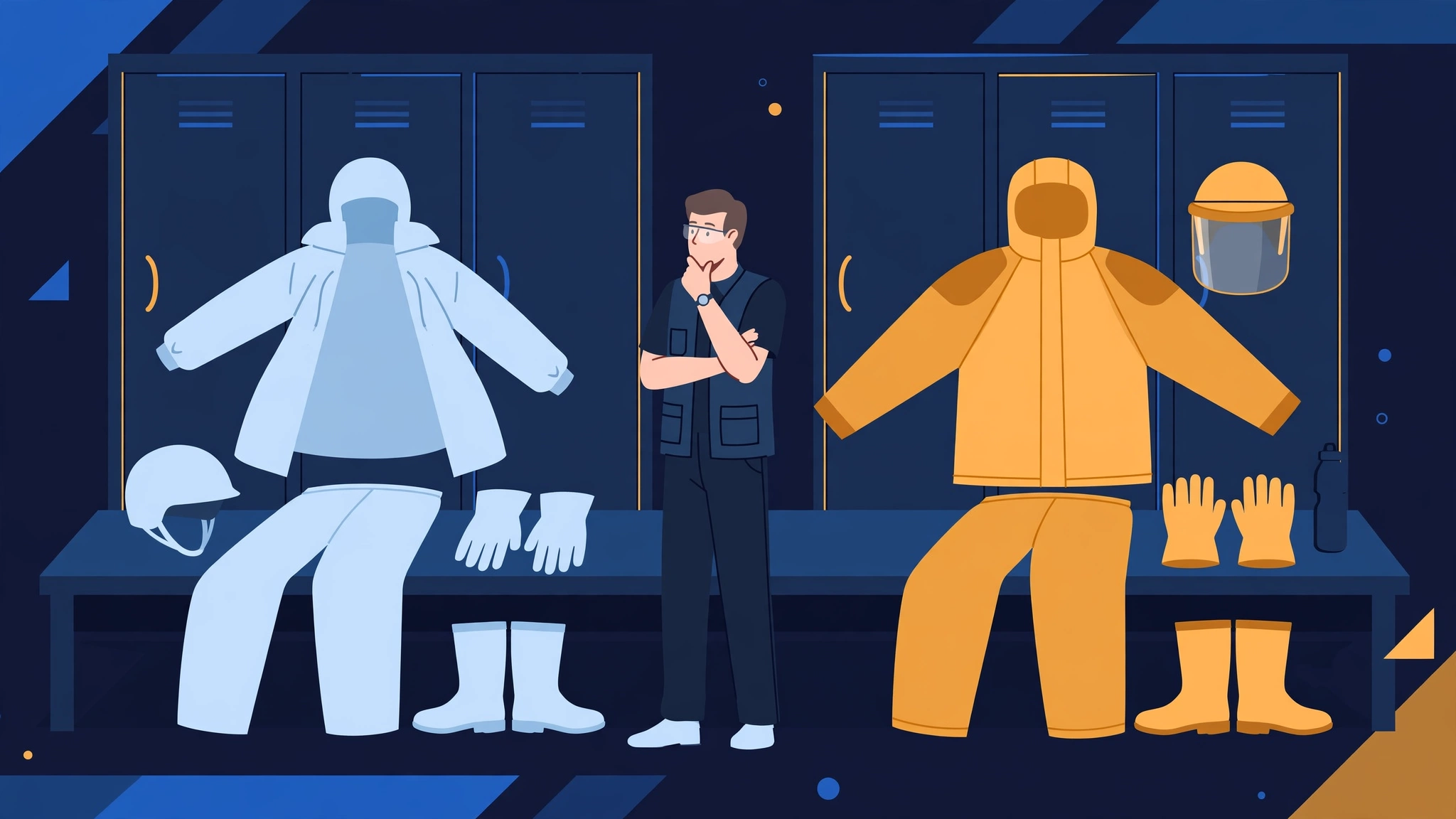
The everyday work clothing system is an arc-rated long-sleeve shirt worn with arc-rated pants, or arc-rated coveralls, with a minimum arc rating of 8 cal/cm². It applies to situations where a risk assessment indicates PPE is required and the category tables specify arc flash PPE category 1 or category 2. The simplification is the point: category 1’s minimum clothing rating is lower than category 2’s, yet one outfit rated at 8 cal/cm² satisfies the minimum arc-rated clothing requirements for both. A worker whose morning task lands in category 1 and whose afternoon task lands in category 2 wears the same clothes all day — no mid-shift change, no second set of garments to stock, launder, and inspect. For a facility with a large and diverse electrical system — the exact setting H.2 is written for — that uniformity is worth more than squeezing each category down to its bare minimum rating.
The Arc Flash Suit: The 40 cal/cm² Outfit
The arc flash suit is a total clothing system built from arc-rated shirt and pants, arc-rated coveralls, an arc flash coat and pants, or a combination of them, with a minimum arc rating for the clothing system of 40 cal/cm². It applies where a risk assessment indicates PPE is required and the category tables specify arc flash PPE category 3 or category 4. The logic mirrors the everyday outfit: category 3’s minimum rating sits below 40 cal/cm², so a single 40 cal/cm² system covers both of the high categories. Between the two outfits, the whole category range is dressed — the 8 cal/cm² everyday clothing for the lower half of the scale, the 40 cal/cm² suit for the upper half. A worker moving from a category 2 task to a category 3 task changes once, into the suit, rather than into a third ensemble tuned to category 3 alone.
The Table Itself: Table H.2
Table H.2 states the whole system in two rows:
| Clothing | Minimum arc rating | Applicable situations |
|---|---|---|
| Everyday work clothing — arc-rated long-sleeve shirt with arc-rated pants, or arc-rated coveralls | 8 cal/cm² | Risk assessment indicates PPE is required, and the category tables specify PPE category 1 or 2 |
| Arc flash suit — a total clothing system of arc-rated shirt and pants and/or coveralls and/or arc flash coat and pants | 40 cal/cm² | Risk assessment indicates PPE is required, and the category tables specify PPE category 3 or 4 |
Clothing Is Not the Whole Ensemble
The other PPE required for the category does not come from Table H.2. The clothing systems in the table fulfill the minimum arc-rated clothing requirements of the category tables — and only that. The clothing is used together with the other PPE appropriate for the arc flash PPE category, as listed in Table 130.7(C)(15)(c): depending on the category, that can include an arc-rated face shield or an arc flash suit hood, arc-rated hard hat liners, safety glasses or safety goggles, a hard hat, hearing protection, heavy-duty leather gloves, and rubber insulating gloves with protectors. The notes to the category tables must also be applied exactly as they appear in those tables. A facility that adopts the two-category wardrobe and stops there has simplified its clothing rack, not finished its PPE program — head, face, hearing, and hand protection are still selected category by category.
The Hard Limit: When Table H.2 Cannot Be Used
The fault current and clearing time assumptions behind the category tables are the boundary of the whole simplified approach. The estimated available fault current capacities and the fault clearing times — the arcing durations — that the category tables are built on are stated in the text of Table 130.7(C)(15)(a) and Table 130.7(C)(15)(b). For a power system with greater available fault current than those estimates, or with longer fault clearing times than those assumed, Table H.2 cannot be used. There is no third outfit and no extrapolation: in that situation, arc flash PPE must be determined and selected by means of an incident energy analysis, in accordance with 130.5(G). The two-category system is a convenience that lives entirely inside the category method’s stated envelope. Step outside the envelope — a stiffer source, a slower protective device — and the convenience is withdrawn and the calculation takes over.
Worked Scenario
A manufacturing plant with hundreds of panels, MCCs, and switchboards adopts the two-category approach and publishes a short procedure for using the PPE category method. Every electrician is issued the everyday outfit — arc-rated shirt and pants rated 8 cal/cm² — as standard work clothing, and the shop stocks shared 40 cal/cm² arc flash suits. On a typical day, a worker troubleshooting a 480 V MCC bucket whose task falls in PPE category 2 wears the everyday clothing he already has on, adds the face, hearing, and hand protection Table 130.7(C)(15)(c) calls for at that category, and starts work. Later, a task on the main switchboard lands in category 4: he puts on the 40 cal/cm² suit system over the same base, with the suit hood and the rest of the category 4 ensemble. Then engineering flags a problem: a utility upgrade has raised the available fault current at the service beyond the capacity the category tables assume, and one feeder’s clearing time is longer than the tables allow for. For that part of the system, the plant cannot reach for either outfit on the strength of a category. The PPE for work there has to come from an incident energy analysis under 130.5(G) — and garments are chosen against the calculated exposure, not against Table H.2.
Common Mistakes and Safety Notes
- Treating the two outfits as the whole PPE answer. Table H.2 covers arc-rated clothing only; the rest of the ensemble still comes from Table 130.7(C)(15)(c), category by category, and the category tables’ notes still apply.
- Stocking category 1 clothing separately. The everyday outfit’s 8 cal/cm² minimum is chosen precisely so one system satisfies categories 1 and 2 — splitting them again defeats the simplification.
- Assuming a 40 cal/cm² suit covers anything. The suit is the category 3–4 clothing system. It is not a substitute for an incident energy analysis where the category method itself does not apply.
- Ignoring the fault current and clearing time envelope. If the system exceeds the estimated available fault current capacity or the assumed clearing times in the category tables, Table H.2 cannot be used — full stop.
- Forgetting the arc rating is a system minimum. For the suit, the 40 cal/cm² figure is the minimum rating of the total clothing system, not a rating each layer must individually carry.
Summary
Informative Annex H gives PPE selection guidance that works with either the arc flash PPE category method or the incident energy method, plus guidance on shock protective equipment. Section H.2’s simplified two-category clothing system, Table H.2, dresses the whole category range with two outfits: everyday work clothing — an arc-rated long-sleeve shirt with arc-rated pants, or arc-rated coveralls, rated at least 8 cal/cm² — for PPE categories 1 and 2, and a total arc flash suit system rated at least 40 cal/cm² for categories 3 and 4. The table settles clothing only; all other PPE still comes from Table 130.7(C)(15)(c), and the category tables’ notes still apply. And the system has a hard edge: where available fault current or fault clearing time exceeds the values the category tables assume, Table H.2 cannot be used, and PPE must be selected from an incident energy analysis under 130.5(G).
Quick-Check Questions
- What is the minimum arc rating of the everyday work clothing system in Table H.2, and which PPE categories does it cover?
Answer: 8 cal/cm², and it covers situations the category tables place in arc flash PPE category 1 or category 2. - What makes up the arc flash suit system, and what is its minimum rating?
Answer: A total clothing system of arc-rated shirt and pants and/or arc-rated coveralls and/or arc flash coat and pants, with a minimum arc rating of 40 cal/cm², covering categories 3 and 4. - A worker is dressed in the correct Table H.2 clothing for his category. Is his PPE selection complete?
Answer: No. Table H.2 fulfills only the arc-rated clothing requirements; the other PPE appropriate for the category comes from Table 130.7(C)(15)(c), and the category tables’ notes must be applied. - When can Table H.2 not be used?
Answer: When the power system’s available fault current exceeds the estimated capacities, or its fault clearing times are longer than those assumed, in Table 130.7(C)(15)(a) and (b). - What replaces Table H.2 in that situation?
Answer: Arc flash PPE must be determined and selected by means of an incident energy analysis in accordance with 130.5(G).
Based on NFPA 70E (2024), Informative Annex H, paraphrased for study.
Video lesson for this module is in production — coming soon.
Quiz for this module is being prepared.
Flashcards for this module are being prepared.
